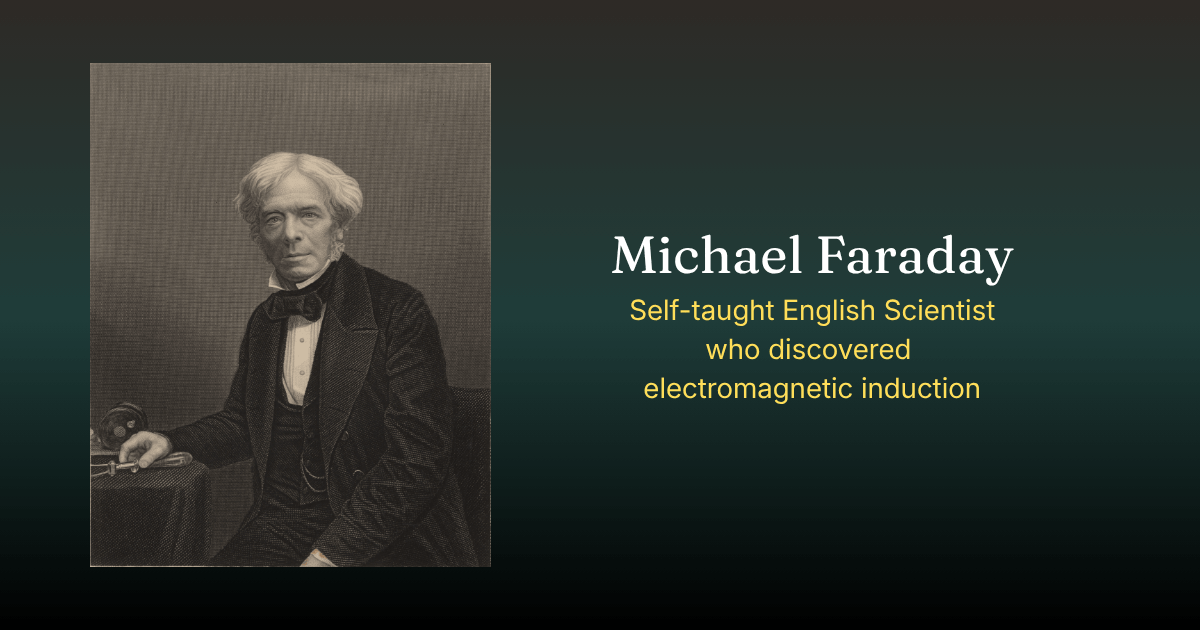
Michael Faraday, a blacksmith’s son with almost no schooling was sent, at fourteen, to bind books for a living. Nobody taught him science. He read his way to it — one volume at a time, off the very shelf he was meant to be stitching — and became the man whose discoveries make it possible to switch on a light.
A trade, not an education
Fourteen, and already at work
Michael Faraday was born in 1791 in Newington Butts, on the edge of London, the third of four children of a blacksmith. In the England of his time, a blacksmith’s son carried a low social status from birth, and his family had little money to spare on schooling. What education he received, by his own account and the Royal Institution’s own record of his life, went little beyond basic reading, writing and arithmetic. At fourteen, an age at which many Indian children today are only just entering high school, Faraday left off any further schooling entirely and was apprenticed to a bookbinder and bookseller named George Riebau.
A trade that happened to involve books
Bookbinding was, on paper, a modest trade—stitching pages, glueing spines, stretching leather over boards. Nobody apprenticed a boy to a bookbinder expecting him to become a scientist. But a bindery is, by its nature, full of finished books passing through young hands before they reach their owners, and Riebau turned out to be an unusually generous master. As the Royal Institution notes, he allowed his young apprentice to read the very books he was meant to be binding, rather than sending him straight back to the workbench.
The book that did it
One book in particular changed the direction of Michael Faraday’s life: Jane Marcet’s Conversations in Chemistry, a popular science text written, unusually for its era, specifically to make chemistry accessible to readers with no formal training. Faraday also credited Isaac Watts’s The Improvement of the Mind with shaping how he taught himself — a study guide, essentially, on how to learn without a teacher. Between them, the two books gave a bookbinder’s apprentice both a subject to fall in love with and a method for pursuing it alone.
Building his own classroom
A shilling a week, and a brother who paid it
Reading alone was not enough for Faraday. From around 1810, encouraged by Riebau, he began attending public lectures on ‘natural philosophy’ — the era’s word for science — given by John Tatum at the City Philosophical Society, a society of young men who met every other week purely to teach and learn from one another. Faraday could not have afforded the entrance fee on an apprentice’s wage; his older brother Robert, a blacksmith like their father, paid it for him. Nobody had assigned Michael Faraday this education. He built it himself, out of borrowed shillings and other people’s evenings.
Notes bound into a gift
True to the trade he was learning, Faraday made detailed notes at every lecture he attended, then bound them himself into finished volumes — a habit that would define his entire working life. He eventually presented four such volumes of Tatum’s lectures to Riebau, inscribed with a dedication thanking his master for encouraging his interest in science in the first place. It was at the City Philosophical Society, not in any school, that Faraday delivered his first lecture of his own.
A notebook sent to a stranger
Four farewell lectures
In 1812, as Michael Faraday’s seven-year apprenticeship was ending, a customer of Riebau’s shop gave him tickets to hear Humphry Davy, Britain’s most celebrated chemist, deliver a farewell series of lectures at the Royal Institution before Davy left to travel. Faraday attended all four, and did what he always did: he took careful, illustrated notes.
Three hundred pages, sent with a request
What Faraday did next took real nerve. He wrote up his notes in full, illustrated them with his own drawings of Davy’s apparatus, bound the whole thing into a book roughly three hundred pages long, and sent it to Davy with a letter asking for any scientific employment at all, however menial. He was twenty years old, with a bookbinder’s trade and no scientific credentials whatsoever, writing to the most famous chemist in the country on the strength of four lectures and his own notebook.
No, and then, unexpectedly, yes
Davy was impressed by the notebook’s thoroughness, but there was no position open at the Royal Institution, and his reply said as much. What changed Faraday’s fortunes was not persistence alone but ordinary workplace chance: not long afterwards, a laboratory assistant at the Institution was dismissed after a fight, and Davy, remembering the bookbinder’s apprentice who had written to him so carefully, offered Michael Faraday the job. He accepted immediately, taking a considerable cut in pay to do it.
Thrive Tip
Let a child’s curiosity outrun their circumstances.
Faraday had no school science lab, no tutor, and no family money for either — only a trade that happened to put books in his hands, and permission to read them. You may not be able to give your child every resource, but you can give them what Riebau gave Faraday: the room to follow an interest past where their formal lessons stop, and someone willing to notice when they do.
The Inspiring Michael Faraday Story: From assistant to discoverer
A humbling apprenticeship of a different kind
Working for Davy was not, at first, glamorous. Between 1813 and 1815, Faraday accompanied Davy and his wife on a long scientific tour of Europe, and Davy’s wife treated him openly as a servant — he travelled outside the coach and ate with the staff. It was, by every account, a miserable arrangement. But it also placed a bookbinder’s apprentice in direct contact with the leading scientific minds of the age, an access no classroom in England could have offered him at the time.
Finding his own questions
Once back in London, and increasingly working on his own problems rather than Davy’s, Michael Faraday began to make discoveries that were entirely his. In 1821, he demonstrated electromagnetic rotation — the principle behind every electric motor built since, from the fan in an Indian classroom to the starter motor in a car. In 1825, he discovered the chemical compound benzene. He was no longer copying down someone else’s lecture. He was standing at the front of one.
The discovery that lit the modern world
His defining breakthrough came in 1831, when Faraday demonstrated electromagnetic induction — the discovery that a changing magnetic field can generate an electric current. It is, without exaggeration, the principle that makes it possible to generate electricity at any scale: every power station on Earth, coal-fired, hydroelectric or nuclear, still turns a magnet inside a coil of wire because of what Faraday found in a basement laboratory in Mayfair. A boy who had almost no schooling had discovered the mechanism that would one day light schools he never lived to see.
Teaching the child he once was
Lectures built for people like him
In 1825, Faraday founded two lecture series at the Royal Institution that still run today: the Friday Evening Discourses for adults, and the Christmas Lectures, aimed specifically at young people. He delivered nineteen series of the Christmas Lectures himself over his career, the most celebrated being The Chemical History of a Candle, later published as a book. Faraday, who had once relied on a customer’s spare ticket to hear science explained at all, spent much of his career making sure no curious child would have to depend on similar luck.
What he turned down
By the time he was Britain’s most respected scientist, Michael Faraday could have collected any honour on offer. He twice declined the presidency of the Royal Society, and repeatedly said he would not accept a knighthood. He never patented a single one of his discoveries, and gave away much of what he earned. The bookbinder’s apprentice who had once begged Davy for any job, however menial, ended his career turning down the grandest titles his country could offer — not out of false modesty, but because, by every account, they had simply never been the point.
What was in the books all along
Back to the bindery
Return, for a moment, to the boy at George Riebau’s workbench — stitching pages by day, and, when permitted, reading them by lamplight. Nobody enrolled him in a science programme. Nobody assigned him Jane Marcet’s book or paid his way into John Tatum’s lectures, beyond a master willing to look the other way and a brother willing to spare a shilling. Faraday supplied the rest himself: the noticing, the returning, the refusal to stop at what his circumstances seemed to allow. More than a century later, a newspaper boy in Rameswaram found the same kind of adult in a teacher who took his class to the seashore, which I tell in the story of A.P.J. Abdul Kalam’s first teachers.
It is worth setting his story beside the idea explored in this site’s cornerstone essay on what ‘educate’ actually means: that real learning is drawn out of a child, not poured in. Nobody poured electromagnetism into Michael Faraday. He drew the whole of it out of himself, one borrowed book and one bound notebook at a time — and in doing so, drew out the modern electrical age along with it.