The quietest child in the room is not always the brightest one. What the confusion between obedience vs intelligence costs children — and what a parent can do about it, starting this week.
The Good Student Nobody Questions
A description that asks for less than it seems
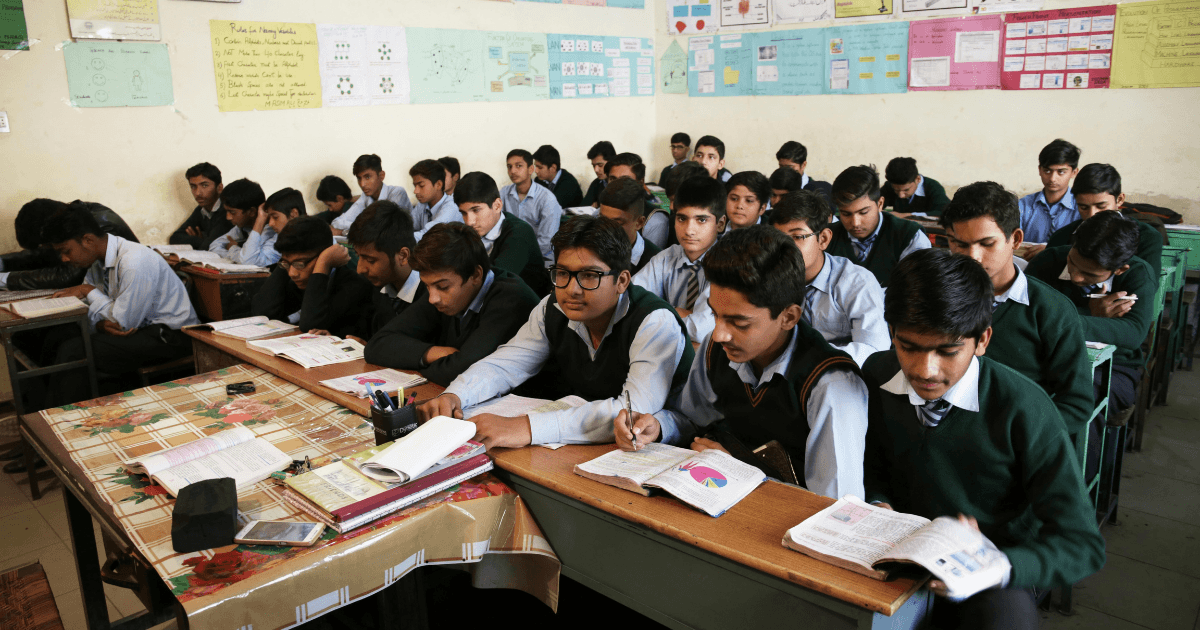
There is a child in nearly every Indian classroom who earns, with real warmth, the label “good student.” She sits straight, answers when called upon, and never talks back. Every assignment lands on time, in the expected format, with the expected answer. Parents display the report card. Teachers hold her up as an example at the next parent-teacher meeting. And the child absorbs the lesson the room has actually been teaching all along: compliance gets rewarded, and compliance gets mistaken for intelligence.
Two capacities, wrongly treated as one
This is worth naming plainly, because it is one of the more consequential confusions running through Indian schooling. Obedient students are frequently bright — nobody is disputing that. The trouble is that obedience and intelligence are separate capacities that happen to look alike from a teacher’s desk, and collapsing them into one produces a system that rewards the first while quietly starving the second. It then wonders, years later, why so many of its most decorated students cannot think a new problem through on their own.
What the Mark Sheet Actually Measures
A question no exam paper asks
Ask a parent what makes a good student and the answer usually circles back to marks. Ask a teacher, and behaviour joins the list — which, in practice, mostly means compliance. An exam that asks a student to list the causes of the First World War is not measuring how deeply they understand power, empire or human nature. It is measuring how faithfully they reproduced a list someone else compiled. Strip away the ceremony, and most examinations, from school through university, test recall dressed up as comprehension.
A structural problem wearing a personal face
This is not a minor flaw that a stricter teacher or a more motivated child could fix. It is structural, and its consequences widen with every year a child spends inside it — for the individual student, certainly, but also for a country whose future runs on the thinking capacity of the people its schools release into the world.
India’s Particular Version of an Old Confusion
Criticism the system has learned to absorb without changing
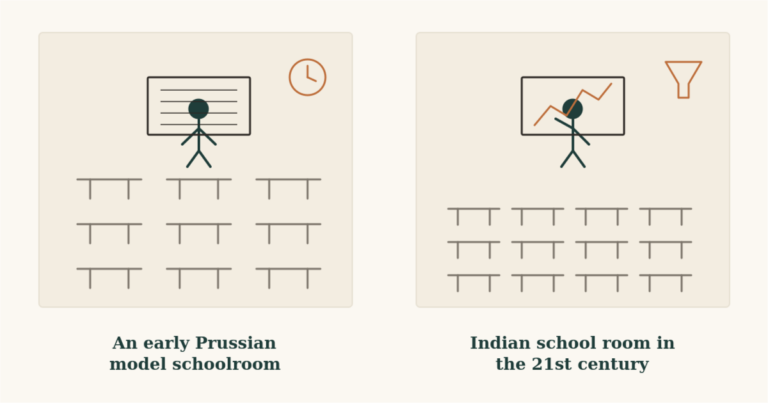
Indian schooling’s well-documented tilt towards rote memorisation makes this confusion sharper here than in many places. A child can recite the stages of photosynthesis without ever wondering why a leaf turns towards light — and a system built to reward the recitation has no way of noticing the gap. One long-running critique in The India Forum makes a related point starkly: students who answer in their own words, rather than the textbook’s expected phrasing, routinely lose marks for it. The system is not merely failing to reward original thought. It is actively marking it down.
A question that cost a student her voice
Picture a scene familiar to many Indian classrooms: a fifteen-year-old in a history class, where the teacher is explaining the causes of the 1857 uprising. She asks whether the textbook’s account tells the full story. Her teacher, racing the syllabus before the board exam, says there is no time for that today. The student notes the response and does not ask again. Two years later she has stopped asking questions in class altogether, having learned, correctly, that a question costs time the room does not have, while silence buys nothing but does no harm. She sits her boards and scores 91%. Nobody asks what the number cost her to reach.
Tagore, the Boy the Classroom Could Not Hold
A child who found school a kind of captivity
The confusion between silence and intelligence is not new, and India, of all places, had an early and famous rebuttal to it. As a boy, Rabindranath Tagore could not bear the confinement of formal schooling; his attention drifted out of the window while his classmates attended to the lesson, and nothing in the fixed hours and fixed answers gave him room to follow a thought of his own wherever it wanted to go.
The rebuke he built with his own hands
That early misery did not fade. It hardened into a lifelong argument with conventional schooling, one Tagore eventually built into brick and open sky at Shantiniketan, where a child’s curiosity, not a syllabus, set the day’s pace. When Maria Montessori visited the school in 1939, she declared herself in complete sympathy with its founder’s philosophy — one of the great educational thinkers of the twentieth century recognising, in Tagore’s answer, something close to her own. The boy whose wandering attention would have earned him a poor conduct mark went on to write two nations’ anthems and win a Nobel Prize. A system built to produce “good students” by breaking his restlessness would have produced nothing of note at all.
What Einstein’s School Record Actually Shows
Ahead of his classmates, not behind them
Einstein’s reputation as a hopeless student is mostly myth — the real record argues the opposite case. By twelve, he had taught himself algebra and Euclidean geometry over a single summer and found his own proof of the Pythagorean theorem; within two more years he had mastered differential and integral calculus, entirely through self-study. This was not a slow child catching up. This was a child working years ahead of his desk-mates, on his own terms.
What he refused to perform
What Einstein would not do was perform obedience. He resented the rigid, memorisation-heavy regime at Munich’s Luitpold Gymnasium, and at fifteen he left before finishing, without a diploma, unable to make himself continue inside a method that asked him to store rather than understand. Decades later, reflecting on that schooling in his Autobiographical Notes, he wrote that it was little short of miraculous that the instruction methods of his day had not managed to kill off a child’s inquiring curiosity entirely — a line written more than a century ago that still describes any classroom where a curious child is told to stop asking and get back to the portion.
Darwin, Newton, and the Others the System Misjudged
A father’s despair, and a habit mistaken for idleness
Charles Darwin gave his teachers little to celebrate. He showed no interest in the classical languages his school prized, and his own father despaired of him openly, certain the boy’s fascination with beetles, birds and shooting would come to nothing. That patient watching of living things, dismissed as idleness by every adult in the room, was in fact the most productive habit Darwin possessed — one no classroom of the time had the language to recognise, let alone reward.
Pulled from school to manage a farm
Isaac Newton fared no better on paper. His schoolmasters described him as idle and inattentive, and his mother, seeing little promise in his books, withdrew him from school in his early teens to manage the family farm at Woolsthorpe — a job at which he showed no aptitude whatsoever. Only his uncle’s insistence that the boy be allowed back to finish his schooling, and eventually to enter Cambridge, stood between the world and a very different Isaac Newton.
What the pattern actually tells us
None of this makes every restless, unbiddable child a future Newton — most children who clash with a syllabus will not go on to reshape a field of science. But the pattern is worth sitting with, because it shows exactly what the debate over obedience vs intelligence keeps missing: schools are built to reward the predictable — the standard method, the approved answer, the steady pace — while a genuinely original mind wants to take an idea apart in its own order, at its own speed. That is precisely why such minds so often look unremarkable inside a classroom and turn out to be anything but outside one.
The Student Who Peaked at School
Twelve years of performing knowledge
Composite portraits like this one turn up in every counsellor’s practice, so consider a student we might call Rohan. He scored 97% in his Class 12 boards, sat consistently in the top three through school, and never once caused a teacher a moment’s trouble. He entered a respected engineering programme and did reasonably well, until an open-ended project asked for his own view on an unsolved problem, and he found he had almost nothing to offer. Not from laziness. From twelve years spent being assessed exclusively on his ability to reproduce someone else’s correct answer, during which nobody had ever once asked him what he thought.
A product working exactly as designed
Rohan is not a failure. He is a product working precisely as his schooling designed him to work. He is also, increasingly, not alone — and that is the part of this story with real financial and emotional stakes for a family that has just spent two years and several lakh rupees on the assumption that marks alone would carry a child through whatever came next.
The Cost the Report Card Never Shows
What the labour market is already telling us
For decades, enough structured, instruction-following roles existed to absorb students trained this way, and many did reasonably well inside them. That window is narrowing. The India Skills Report 2024 found just over half of India’s assessed graduating youth employable against the skills employers were actually looking for — not because they lacked degrees, but because reasoning, adaptability and independent judgement were missing, and no marking scheme had ever asked for them. The economy is shifting its questions faster than the classroom is shifting its answers.
Why this is an economic story, not only an educational one
Classroom obedience is comfortable for schools and reassuring for parents, and it still leaves a graduate underprepared for a workplace that increasingly pays for judgement rather than recall. That gap is not an argument against structure or discipline. It is an argument against mistaking one for the other, at a moment when the mistake has started to show up on payslips as well as report cards.
The Child Who Was Sent Out — and Is Doing Fine
A different kind of difficult
Set Rohan’s story beside a different composite — call her Kavitha. Her school found her difficult, though never in the disruptive sense: she asked questions her teachers could not always answer, argued with the textbook’s reading of a poem, and occasionally changed her mind mid-argument when a better point landed. She heard, more than once, that there were no marks for being clever. Her scores were solid, never spectacular — 78%, 81% — and she never once made a topper wall.
What outlasted the marking scheme
Today Kavitha runs a public policy research organisation whose work reaches people who make decisions affecting millions of lives. She does not think of herself as remarkable. She thinks of herself as someone who never stopped asking questions, even after being told, repeatedly, to stop. The child who “overthinks” is very often the child who thinks, and a system’s discomfort with that child says more about the system’s limits than the child’s ability.
The Intelligence the System Was Never Built to See
A single number that never fit
In 1983, the Harvard psychologist Howard Gardner challenged the idea that intelligence is one measurable quantity captured by an IQ score. He argued instead for several relatively independent capacities working in combination: linguistic and logical-mathematical among them, but also musical, spatial, bodily-kinaesthetic, interpersonal and intrapersonal, with a naturalistic capacity added later. Gardner’s own definition, from his Harvard Project Zero research, describes intelligence as a capacity that lets a person solve real problems or make things a culture actually values — not the speed of recall a school day usually rewards.
What Indian classrooms have chosen to measure
Indian schooling, at its present stage, tests two of Gardner’s capacities with any seriousness: linguistic and logical-mathematical. Everything else — the spatial sense that could become an architect, the interpersonal read that could lead a team, the bodily-kinaesthetic control behind a surgeon’s hands or a dancer’s feet — is treated as extracurricular, something for after the “real work” is done, which in practice means never. Gardner’s framework has its critics, some of whom argue that a few of his “intelligences” are better described as talents; even granting that, the core claim survives the argument intact. Intelligence is plural, and the classroom measures a narrow slice of it.
What Rote Learning Does — Not Only to a Mark Sheet
A lesson children absorb about their own minds
Repeated reward for reproduction and repeated penalty for questioning teaches a child something well beyond the subject on the page. It teaches them that their own thoughts carry little weight, that uncertainty should be met with compliance rather than curiosity, and that the adult at the front of the room understands the material better than the mind currently trying to make sense of it. This site has argued elsewhere that the word “educate” itself means to draw out rather than pour in — and a classroom built on obedience does the opposite on both counts: it pours facts in, and does everything it can to stop anything being drawn out.
What survives, and what quietly does not
Twelve years of that lesson produces a culture that prizes obedience and pays for it, eventually, with the inventiveness it never made room for. Schools call themselves meritocracies, and the rank lists appear to prove it — but look closely, and “merit” turns out to mean rule-following measured to two decimal places. That arrangement rewards the child who will not conform least of anyone in the room, and it flatters the child who was never once asked to think for themselves. The confusion at the heart of this article sits exactly there.
What Parents Teach Without Meaning To
Two responses to the same 74%
Consider two ways a parent might respond to the same report card, showing the same 74%. The first: “You should have scored higher — look at your classmate, she got 89%. What went wrong?” The second: “Tell me something you learned this term that genuinely surprised you. What’s a question nobody answered?” These are not interchangeable. The first response teaches a child that a comparative number is the point of the exercise. The second teaches them that their curiosity, their actual encounter with ideas, matters to the people who love them. Repeated across years, the two responses build different minds.
The intention was never the problem
Indian parents invested in their children’s education, which nearly all of them rarely set out to suppress a child’s intelligence. They set out to secure a child’s future, and when that future is defined almost entirely by high marks and agreeable behaviour, the unintended result is the very confusion this article has been naming: compliance gets equated with capability, and the child who thinks differently gets quietly diminished along the way.
Thrive Tip
After the next test, ask your child to teach you the one answer they were proudest of, and play the slow student, asking why at each step.
If they can teach it, they own it. If they can’t, you have both just discovered something more useful than the mark.
What a Teacher Can Do — Without Waiting for Policy
Rewarding the question the syllabus cannot answer
An Indian school system as large and slow-moving as this one changes through millions of small choices, not through any single order from above. A teacher who says “I don’t know, let’s find out” rather than steering the class back to the portion teaches something no textbook contains: that an unanswered question is worth more than a memorised one.
The quiet child at the back
A teacher who notices the quiet child at the back, never disruptive, never performing, but occasionally alight when a genuinely interesting idea enters the room, and asks that child a question privately, away from the pressure of a public answer, may discover a mind that compliance had simply been hiding. Quiet is not the same as empty, and this confusion misreads the silent child exactly as badly as it misreads the difficult one.
Two Objections Worth Taking Seriously
“Isn’t some obedience just called discipline?”
This objection deserves a direct answer, because nothing here argues for chaos in the classroom. Discipline — meeting deadlines, working within a structure, respecting people with more experience — is a genuine virtue, and a child who lacks it entirely will struggle well beyond school. The claim is narrower: obedience is not a reliable stand-in for intelligence, and a system that treats the two as interchangeable ends up measuring the wrong thing. A child can be disciplined and questioning at once; the two are not in competition.
“My child’s school will never change — what’s the point at home?”
A fair worry, and the arithmetic runs in the parent’s favour. Nobody is claiming that one questioning household cancels six hours of rote instruction. The claim is that a child needs at least one place where thinking aloud is welcome, and one place is genuinely enough to keep the habit alive. School shapes what a child knows for the exam. Home shapes what a child believes learning actually is, and that second belief outlasts every marking scheme it will ever sit under.
The World This Generation Is Walking Into
The professions that are growing
The fields adding jobs, design, research, entrepreneurship, policy, counselling, engineering for genuinely complex systems, reward independent thought, comfort with ambiguity and the ability to build something that does not yet exist. These are not outcomes an obedient education produces reliably. They are, almost by definition, outcomes a curious one does. This site has made a related case about the many forms intelligence takes beyond a marks column, and the argument holds here with equal force: the professions absorbing today’s graduates are not asking who reproduced the syllabus most faithfully.
The work compliance was built for is disappearing fastest
The roles that reward pure compliance, precise instruction-following with no deviation, are also the roles most rapidly being automated. A child trained exclusively to obey is being prepared, without anyone intending it, for exactly the category of work that will need fewer human beings with each passing year. That is not a reason for panic. It is a reason for clarity about which child is actually best prepared for what is coming.
Redefining What “Good” Actually Means
The quality an exam was never built to score
A genuinely good student, in the sense that matters once school ends, is not the one who never questions. It is the one who knows when to question and how — not the fastest memoriser, but the one who understands most deeply; not the highest scorer on a standardised paper, but the one who can take an unfamiliar problem and work their way through it without being told how.
Back to the child in the second row
Return, once more, to the classroom this article opened in. Nothing about that quiet, compliant child needs fixing. The curiosity the system never asked about is still there, the way a seed still holds a shoot before the soil gives it room. What she is owed is not a lower grade for asking an inconvenient question, or a note on her file about attitude. She is owed a teacher and a parent who recognise what they are actually looking at when a child stops simply accepting an answer, and protect it, rather than quietly teaching her to put it away.