Some schools already teach the way children actually learn. What child-centred education looks like in practice — from Finland to Delhi to a valley in Andhra Pradesh — and the questions to ask at your child’s school.
The schools that already exist
A valley, a capital, and a country far north
There is a school in the Chittoor district of Andhra Pradesh, a few hours’ drive from my city, where children move through the syllabus at their own pace, and no child is labelled “behind” for moving slowly. Its 360-acre campus — a declared bird sanctuary since 1991 — is part of the classroom.
In Delhi, more than a thousand government schools begin every day with a class that carries no marks at all; its subject is happiness. And in Finland, children do not start formal school until they turn seven, homework is counted in minutes, and the country still performs above the average of the world’s richest nations.
None of these places is a fantasy. Each one runs today, on ordinary money, with ordinary children.
Why these schools matter to you
This article is for the parent who senses something missing in their child’s schooling but cannot quite name it. The missing thing has a name: child-centred education — schooling built around how children actually grow and learn, rather than around syllabus schedules and rank lists. In the sections below, I will walk you through the schools and systems getting this right, the research behind them — checked, with its weak spots shown rather than hidden — and, most practically, the questions this knowledge equips you to ask at your child’s school. Whichever school that is.
What this article will not claim
Let me set the limits early. Nothing here will tell you that your child’s school is bad, or that you must hunt for an alternative school by Monday. Most families cannot choose freely; fees, distance, boards and admission lists all narrow the field, and I respect that. What changes when you understand child-centred education is smaller and far more useful: the questions you ask at the school gate, the things you celebrate at home, and the confidence with which you engage the school your child already attends.
Why the usual model strains our children
A classroom built for someone else’s purpose
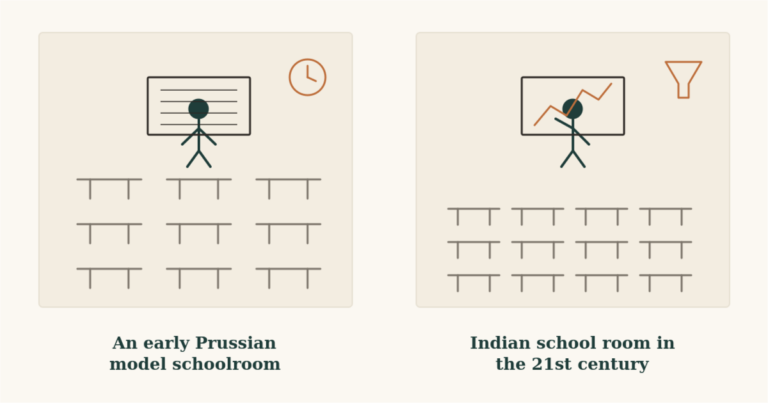
The school day most of us know — one syllabus, one pace, a bell every forty minutes, an examination at the end — was never designed around children. It traces to two decisions, a world apart: a Prussian king in 1763, building a loyal, disciplined citizenry after military defeat, and a British administrator, Thomas Babington Macaulay, deciding in 1835 what an Indian student should learn, and in which language.
Neither man was solving a factory’s problem — the popular story that pins this design on industrial efficiency turns out to be a modern embellishment, not documented history — but neither was solving a child’s problem either. Both were solving a state’s problem, and a compliant, well-drilled population solved it efficiently. I have written elsewhere about the metaphor buried inside this design — the child as a container to be filled. That design has scale on its side. What it has never had is a child at its centre.
The strain is no longer guesswork
The cost of that design now sits in our own national data. When NCERT surveyed nearly 3.8 lakh schoolchildren across India, 81 per cent named studies, examinations and results as a major cause of anxiety, and satisfaction with school life fell as children moved into the board-exam years. Sit with that figure for a moment: four in five children, anxious about the very thing school is supposed to be. The deeper trouble is what the system measures. It rewards a narrow band of ability — I have argued before that marks in maths and science alone cannot describe a child’s intelligence — and then quietly makes a child’s worth hang on that band.
Also Read: Why Your Child Is Anxious
The better question
So the useful question is no longer whether the current model has problems. Every parent standing outside an exam hall already knows the answer. The useful question is: what does better actually look like — and does it exist anywhere outside conference speeches? It does, not in one lucky school, but across continents, boards and budgets. Before we visit these places, it is worth naming what they share, because the shared part matters more than any single school’s name.
What child-centred education looks like when it works
The child is a person, not a container
Every school in this article, whatever its country or method, starts from the same premise. A child is not a vessel waiting for information. Children are developing people — with emotional needs, natural curiosity, a social life, and bodies that need movement, rest and play. In these schools, decisions flow from that premise. In most schools, decisions flow from the examination timetable. That single difference in starting point explains almost everything else that follows.
Wellbeing is part of learning, not a break from it
The second shared conviction sounds soft and is not. A child who feels safe, connected and settled is in the right state of mind to learn; a child under constant stress is not, because chronic stress interferes with the very functions schoolwork demands — attention, memory, reasoning. These schools therefore treat wellbeing as a condition for learning, never as a reward given after the portions are covered. The evidence for this position arrives later in this article, and it arrives with numbers.
Teachers who are trusted
In each of these schools, teachers work as trusted professionals. They know their students as individuals, they adapt their teaching to what they see in front of them, and they are not judged mainly on test scores. The trust sets off a useful cycle: a respected profession attracts capable people, capable teachers build real relationships with children, and those relationships — more than any smartboard or worksheet — are what carry learning. A demoralised teacher racing a syllabus deadline cannot do this, however good her intentions.
Assessment that serves the child
Finally, these schools assess children to understand them, not to rank them. The technical name is formative assessment: regular, low-stakes feedback that tells the teacher and the child what to work on next. Observation, portfolios and conversation do much of this work; in the early years, several of these schools use no examinations at all. The contrast with our system is sharp. An exam that ranks a child against forty others tells the child where she stands. It tells nobody what she needs.
Finland — strong results without the pressure
A school day that would puzzle an Indian parent
Finnish children begin formal schooling at seven. Before that, they play — deliberately, as policy. Once school starts, the load stays light: Finnish teenagers have reported among the lightest homework hours in the developed world — under three hours a week in the OECD’s counts, against two to three hours a day in many competitive systems. There is no board-style standardised testing until the very end of school, and no coaching industry waiting outside the gate. The whole arrangement runs on trust: trust in teachers as professionals, and trust in children as capable learners.
What the scores actually say — honestly
Finland became famous by topping PISA — the OECD’s international test of 15-year-olds — in the early 2000s. I owe you the current picture, not the famous one. Finnish scores have fallen from that peak, as scores have fallen across most developed countries, and in the 2022 round Finland still performed above the OECD average in mathematics, reading and science. So the honest claim is not “Finland is number one”. The honest claim is stronger where it matters: a system with light homework, late testing and no cram schools continues to outperform the average of the world’s richest countries — which tells you the pressure our children carry is not the price of good results.
The gap Finland refuses to open
The most instructive Finnish number is not the average score but the gap around it. The system runs no elite schools and tolerates no failing ones; a child’s school matters far less to her outcome than it does almost anywhere else. And in the 2022 assessment, Finland was one of only four countries that stayed above the OECD average while also protecting students’ sense of belonging and satisfaction with life. Hold that against our own arrangement, where a family’s entire hope narrows onto one child’s rank. Finland’s quiet lesson is that high performance and a protected childhood are not enemies. They appear, in fact, to feed each other.
Montessori — a century old, still ahead of the evidence
What the classroom looks like
Maria Montessori built her method in early twentieth-century Rome, working with children others had written off as unteachable. She discovered that the children were fine; the classroom was not meeting them where they were. In a Montessori classroom today, children choose their own work from a carefully prepared set of hands-on materials. Ages mix, so younger children learn from older ones and older children deepen their understanding by teaching. The early years carry no tests, no homework and no grades — yet the work is rigorous, and what it builds is deep concentration, independence and a self-driven relationship with learning.
The lottery that made the evidence strong
Testing a method like this fairly is difficult, because parents who choose Montessori may differ from parents who do not. An American city’s admission lottery solved the problem: when more families apply than there are seats, chance decides who gets in, so lottery winners and losers come from the same kinds of homes. The resulting study, published in the journal Science, found the Montessori children ahead on reading, mathematics, self-control and social understanding — and the twelve-year-olds wrote more creative essays and reported a stronger sense of community at school. Same families, different method, better outcomes.
The children the method lifts most
A later study followed children admitted — again by lottery — to two public Montessori preschools in a high-poverty American city. Over three years, the Montessori children pulled ahead on academic achievement, social understanding and what researchers call mastery orientation — the habit of treating difficulty as something to work through rather than proof of being weak — and they simply liked school tasks more. The detail worth underlining: the achievement gap between lower-income Montessori children and higher-income children elsewhere narrowed until it was no longer statistically significant. One honest note on scope — this was a preschool study, ages three to six, where the method’s evidence is strongest.
The adults those children became — with a caveat
Does any of it last? One study asked 1,905 adults about their wellbeing and their schooling history, and found that people with at least two childhood years of Montessori reported higher adult wellbeing across all four factors measured — general wellbeing, engagement, social trust and self-confidence — with longer attendance linked to higher scores. The caveat, plainly: this is an association, not proof. These adults were not randomly assigned as children, and families who chose Montessori may have differed in other ways. I pass the finding to you with that label attached, because that is how it deserves to be carried.
A note for choosing one in India
Montessori schools now run across Indian cities — Chennai and Bengaluru have long traditions of them — usually covering the early years before children move into CBSE or ICSE streams. If you consider this path, look for a school that practises the full method: mixed-age classrooms, long uninterrupted work periods, trained Montessori teachers. Plenty of schools borrow the name for the signboard while keeping conventional rows and tests inside. The name is not the method, and it is the method the research studied.
Reggio Emilia — children as co-authors of their learning
A town that rebuilt education after a war
The Reggio Emilia approach grew out of northern Italy after the Second World War, built by the educator Loris Malaguzzi together with the town’s parents. Their conviction: children are not passive receivers of adult knowledge but active makers of meaning, capable of serious intellectual and creative work when the environment and relationships are right. In a Reggio classroom, projects grow out of children’s own questions and can run for weeks. Teachers carefully document children’s thinking — recording it, displaying it, planning from it — and the classroom itself is designed so intentionally that Reggio educators call the environment the “third teacher”.
What the economists found — and the fine print
A team led by the Nobel-winning economist James Heckman evaluated Reggio Emilia’s municipal preschools decades on, and found that adults who had attended them did significantly better than those who had received no formal early education — on employment, socio-emotional skills and school completion. Now the fine print, which I would rather show than hide: compared with people who attended other decent preschools, the differences were small, partly because good practice spread across Italian systems over time. Read properly, the finding is not “Reggio or nothing”. It is that humane, well-run early education pays off decades later — and Reggio helped define what well-run looks like.
Delhi’s Happiness Curriculum — the idea at government scale
Thirty-five minutes without marks
The strongest Indian counter to “this only works in expensive schools” is a government programme. Since July 2018, over a thousand Delhi government schools have run a daily 35-minute happiness class for every child from nursery to Class 8 — more than eight lakh students, most of them first-generation learners. The class builds mindfulness, self-awareness, reflection and relationship skills, and it carries no grades and no examinations at all. That absence is deliberate: it is the one period of the day fenced off from performance anxiety, in a system otherwise soaked in it.
What the researchers observed
Researchers from the Brookings Institution spent time inside these classrooms, and their study reported children building better relationships inside and outside class — more reflective about quarrels with friends, more perceptive about tensions at home — alongside strong mindfulness across grades and visible enthusiasm from teachers and school leaders. None of this makes the Happiness Curriculum a miracle cure, and its evaluators would say the same. What it demonstrates is something arguably more valuable: wellbeing-first schooling can run at government scale, in ordinary crowded classrooms, without an international board or a private fee structure.
Rishi Valley — the Indian original
A school inside a bird sanctuary
Long before any of this had research behind it, a school in the Chittoor district of Andhra Pradesh was practising it. Rishi Valley, founded on the educational philosophy of Jiddu Krishnamurti and running for close to a century, holds that education must grow the whole person — intellect, emotion, character — and that a school should run without fear. The conviction is visible in the campus itself: 360 acres of reforested valley, declared a bird sanctuary in 1991, where conservation and the child’s relationship with the natural world belong to daily life rather than to an annual Environment Day.
The Learning Ladder that reached the villages
What makes Rishi Valley matter far beyond its own gates is its outreach wing, RIVER — the Rishi Valley Institute for Educational Resources, which built the Multi-Grade Multi-Level (MGML) methodology for the classrooms most of rural India actually has: one teacher, many ages, many levels.
Children progress along a “Learning Ladder” at their own pace; a child who misses school resumes exactly where she stopped; older children help younger ones. Through teacher training, the model has spread to government classrooms in several states — Tamil Nadu’s Activity-Based Learning programme grew from this root, alongside adoption in Chhattisgarh, Uttar Pradesh, Jharkhand and Madhya Pradesh.
The point deserves stating plainly: child-centred education is not a luxury of high-fee schools. It has run for decades in some of India’s least-resourced classrooms.
The thread through them all — skills of the heart
The number worth remembering
Running through every school above is what researchers call social-emotional learning, or SEL: deliberately building self-awareness, self-management, social awareness, relationship skills and responsible decision-making. If that list sounds like “soft skills”, the data says otherwise. The largest analysis of its kind combined 213 school programmes covering 270,034 students and found that children in SEL programmes improved not only in skills, attitudes and behaviour but in academics too — an 11-percentile-point gain in achievement over comparison groups. Emotional learning, in other words, is not time subtracted from studies. It feeds them.
Discipline that repairs instead of punishes
You can read a school’s real values in how it handles misbehaviour. The traditional route is punishment: rule broken, consequence given, matter closed. Restorative practice takes a different route — when harm happens, the priority is repair: the person harmed is heard, the relationship is mended, and the child who caused harm takes genuine responsibility rather than merely serving a penalty.
A 2025 systematic review of these practices in schools found they reduce school violence, improve children’s emotional wellbeing and strengthen the sense of belonging — the felt certainty of being known and valued, which is among the stronger foundations of both engagement and mental health. For most of us raised on stricter discipline, this is a genuine shift. The structure stays. Its purpose changes: from compliance to repair.
Thrive Tip
Try one restorative conversation at home this week. The next time a rule is broken, hold back the usual “Why did you do it? Say sorry.” Ask three questions instead: What happened? Who was affected by it? What would make it right? Then let your child answer all three before you speak. The apology that follows tends to be real — because your child built it, instead of reciting it.
Our own policy already agrees
Here is the strangest part of this whole story: on paper, India agrees with every school in this article. The National Education Policy 2020 names conceptual understanding over rote learning, critical thinking, creativity, holistic development and the nurturing of each child’s unique capabilities among its founding principles. The schools profiled here are not rebels working against the system’s direction. They are simply early — already standing where our own policy says every school should eventually arrive. The gap between that paper and your child’s Tuesday will take years to close. Which is exactly why the last part of this article belongs to you.
The questions this knowledge lets you ask
Ask about wellbeing, not only results
Whether you are choosing a school or engaging the one you have, the revealing questions are rarely about toppers. Ask instead: how does the school support a child who is struggling emotionally? Is there a trained counsellor on campus? How are conflicts between children handled — punishment, or something closer to repair? What does Monday morning feel like for a child who is anxious? A school’s answers to these — including the awkward silences — tell you its actual values more reliably than its prospectus or its board results ever will.
Ask how the school measures a child
Next, ask what assessment is for in that school. Does the child receive regular, low-stakes feedback that shows her what to work on — or only marks that show her where she ranks? Do teachers know your child as an individual, or is she one of forty faces to a teacher with no room to notice? A school that can describe your particular child — what lights her up, where she hesitates — is doing the real work. A school that can only quote her percentile is doing the easy kind.
Ask about play, rest and homework
For younger children especially, ask how much genuinely free play the day contains, and how much homework travels home. The evidence you have just read gives you standing here: the best-performing light-homework system in the world assigns less in a week than many of our schools assign in a day. A school that sends an eight-year-old home with two hours of daily homework has made a choice about childhood that the evidence does not support — and you are allowed to say so, politely, with the numbers in hand.
Ask about the teachers
Finally, ask about the adults. How long do teachers typically stay? High turnover usually signals low morale, and low morale flows straight into classrooms. Do teachers get professional development time and real autonomy—or a script and an inspection? The connection runs one way: teachers who feel trusted and respected develop the capacity to trust and respect children in return, and that relationship is the engine of nearly everything meaningful your child will experience at school.
Thrive Tip
At the next parent-teacher meeting, trade one question. Drop one of the usual mark-related ones and ask instead: “When have you seen my child most interested in class?” The answer tells you where your child’s learning is alive right now — and it quietly tells the teacher what kind of parent you are: one watching the child, not only the report card.
What this changes, starting at your dinner table
When you cannot change the school
Most readers of this article will not move their child to Rishi Valley or Helsinki, and nothing here asks you to. But remember what every one of these schools is really built on: safety, curiosity, permission to struggle, adults who see the whole child. Every one of those is available at home tonight, free. School shapes what your child knows for the examination; home shapes what your child believes learning is, and what she believes her worth rests on. Celebrate effort and honest questions, let mistakes be information rather than shame, and you have built a one-room school of exactly the kind this article describes.
The demand that changes the system
The research is no longer ambiguous. Children learn best when they feel safe, engage deepest when curiosity drives the work, and grow resilient when they are allowed to fail and try again without shame. The schools exist — in Finland, in Italy, in Delhi’s government classrooms, in an Andhra valley a short drive from Tamil Nadu. The evidence is public, and our own national policy already points the same way. What remains is for enough parents to ask for it — one question at a parent-teacher meeting at a time — while refusing, at home, to let a child’s worth shrink to a percentile. That refusal costs nothing. It is also, as the schools in this article keep proving, where everything better begins.

One Comment
Comments are closed.