A child can deliver a perfect answer and still not understand it. The word ‘educate’ has been telling us what real learning looks like, all along — and what parents can do about it, starting this week.
A perfect answer nobody understands
The recitation
Picture a Class 6 classroom on a warm afternoon. The teacher asks a question, and a girl in the second row stands up and delivers the answer — word for word, exactly as the textbook prints it, down to the punctuation. The teacher nods. The class moves on.
By every measure our system uses, something successful just happened: a question was asked, and the correct answer was produced. For a moment, it looks exactly like real learning. Yet ask that same girl one small follow-up — why does it happen that way, or what would change if — and watch the confidence drain from her face.
She has the answer. She does not have the understanding. The distance between the two is where real learning lives — and closing it is the entire reason this website exists.
The uncomfortable question
Most of us have met this child. Many of us, if we are honest, were this child. The recitation is not her failure; she did precisely what the system asked of her, and she did it well. The uncomfortable question is aimed at the rest of us: what exactly did we teach her, if a single “why” can undo it — was it ever real learning at all? We call what happens in that classroom education. It is worth pausing to check whether the word agrees.
The word’s confession
What “educate” actually means
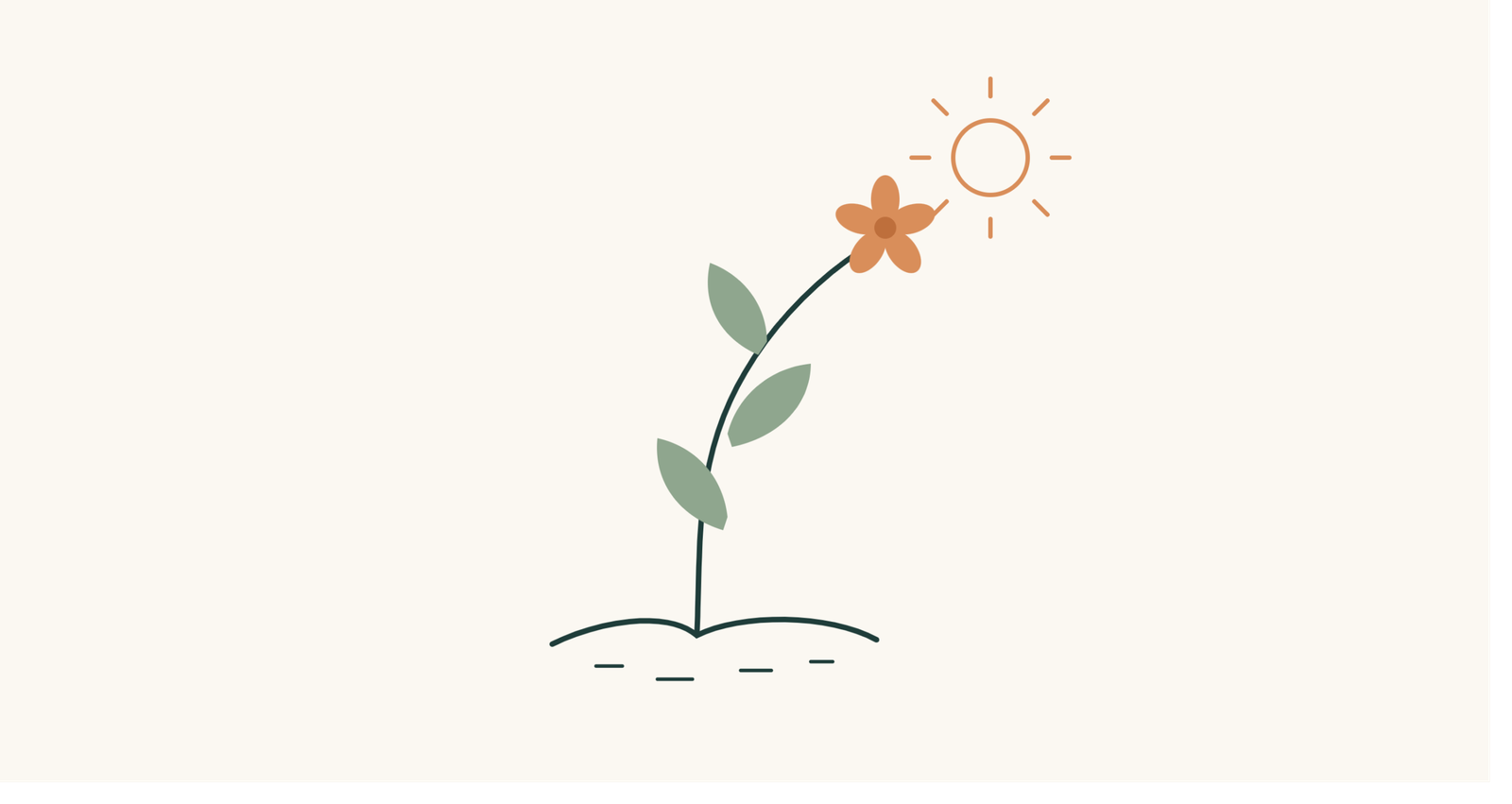
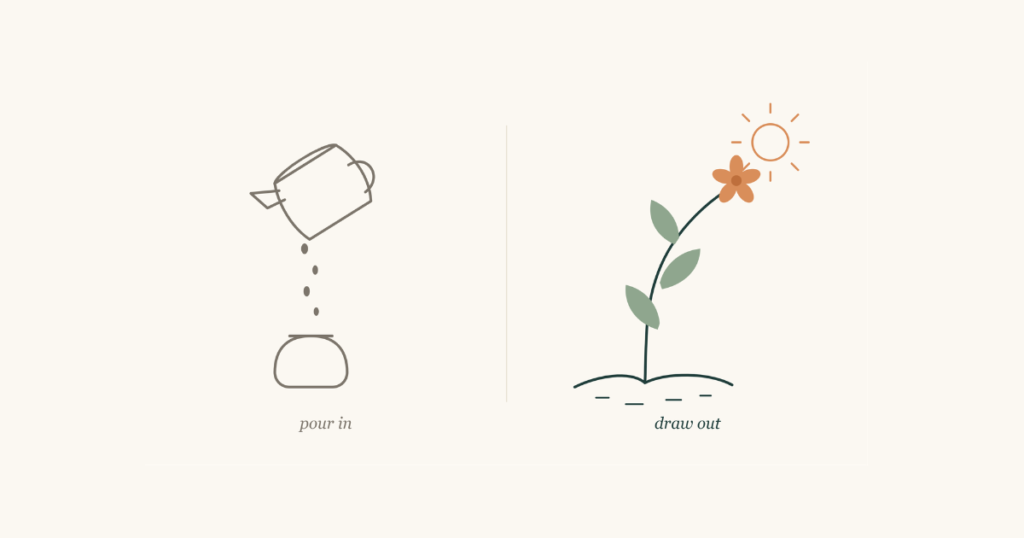
The English word educate comes from Latin, and its roots hold a quiet surprise. Educare means to bring up or nourish; its close relative educere means to lead out or draw forth — e- (out) plus ducere (to lead). Neither root says anything about filling, depositing, or transferring — the meaning of educate, in the end, is draw out, not fill up. The words do not describe pouring knowledge into a child. While the first speaks of nurturing — raising a child as one tends a growing thing — the latter describes drawing something out of one: leading forth what is already within — curiosity, reasoning, the capacity to make sense of the world. Education, by its own name, is an act of release, not an act of installation — which is another way of saying that real learning was never meant to be poured.
The metaphor we practise instead
Now hold that meaning against what happens in most classrooms and most homes at exam time. The syllabus is a quantity to be transferred. The child is a container to be filled. The examination measures how much of what was poured in can be poured back out, unspilled. Teachers speak of “covering portions”; parents ask whether the portions have been “completed”; children speak of subjects being “finished”. Every one of these phrases belongs to the pouring metaphor. None of them belongs to the word educate. The word itself has been telling us what real learning looks like. We stopped listening.
Why a metaphor matters
A metaphor may sound like a writer’s concern rather than a parent’s. It is not, because the metaphor we hold decides what we do. If a child is a vessel, then a slow child is a small vessel, a distracted child is a leaky one, and the solution to every problem is to pour harder — more tuition, more hours, more repetition. But if a child is a growing plant, the questions change entirely: what does this child need to grow? What is blocking the light? The first metaphor leads to pressure. The second leads to attention — and attention, not pressure, is where real learning starts. A parent who changes nothing but the picture in their head will find themselves treating their child differently within the week.
Avvaiyar’s handful of sand
An old Tamil answer
None of this is a new or imported idea — there is an older voice, much closer to home. Avvaiyar, the celebrated Tamil poet who lived many centuries ago, wrote: “Kattradhu kai mann alavu, kalladhadhu ulagalavu.” It translates, simply, to: what we have learned is a handful of sand; what we have yet to learn is the size of the world. Consider what that couplet quietly assumes. If everything learnable amounts to a world, and a lifetime of study gathers only a handful, then education cannot possibly mean transferring the world into the child. The quantity does not fit the container — and Avvaiyar knew it.
What the couplet really teaches
The couplet’s wisdom lies in what it implies a learner must therefore become. Since no school can hand a child the world, the only honest gift is the ability to keep gathering — to stay curious, to ask, to find out. A child taught only what and when collects a handful and stops, believing the handful is the point. A child taught how and why keeps walking the beach for the rest of their life. Centuries apart, a Tamil poet and a Latin root arrive at the same verdict: real learning is not a quantity delivered. It is a capacity awakened.
The pouring-in machine
How the system operationalises the wrong metaphor
To be fair to everyone inside it, our education system did not choose the pouring metaphor out of malice. It chose scale. When you must school hundreds of millions of children with limited teachers, money, and time, the industrial model is seductive: a fixed syllabus, a uniform pace, a standard test. Pouring is measurable; drawing out is not — or at least, not easily. So the system measures what it can pour and calls the measurement education, whether or not any real learning occurred. The syllabus becomes a conveyor belt, the academic year a production schedule, and the board examination a quality check at the end of the line — a check, as we saw with our Class 6 girl, of storage rather than understanding.
The examination tail wags the learning dog
Once the examination becomes the destination, everything upstream reorganises itself to serve it. Teachers, whatever their private convictions, must finish portions before the test; question banks and “important questions” circulate because they work; answers are taught in the exact form the marking scheme rewards. I have written elsewhere about why marks alone cannot capture a child’s intelligence — but notice here the deeper mechanism: the test does not merely measure the pouring; it justifies it. Why does the child need to memorise this? For the exam. Why does the exam ask for memory? Because that is what was taught. The circle closes, and inside it, the question “does the child understand?” never needs to be asked.
The coaching industry: pouring, perfected
Beyond the school gate waits an industry that has refined pouring into a science. Coaching institutes do not pretend otherwise; their promise is precisely more of it — more hours, more tests, more repetition, delivered with industrial discipline. For a narrow purpose, the method genuinely works: entrance examinations largely reward practised retrieval, and practised retrieval is what coaching sells. The trouble begins when parents mistake this narrow effectiveness for education itself, a confusion I examined closely in the article on what topper advertisements hide. A machine built to fill vessels faster cannot draw anything out by working harder — and no amount of repetition manufactures real learning it was never built to produce.
A word for the teachers
Before going further, one thing needs to be said plainly: teachers are not the villains of this story. Most enter the profession because something in them wants to light lamps, not fill buckets. The system then hands them forty-five children, a syllabus deadline, an inspection regime, and a marking scheme — and pouring becomes the only survivable strategy. Many still smuggle real teaching into the gaps, and every adult who thinks fondly of one particular teacher is remembering someone who did. A.P.J. Abdul Kalam remembered one all his life, a teacher who answered a boy’s confusion with a walk to the seashore, as I tell in the story of Abdul Kalam. The argument of this essay is aimed at a metaphor and the machinery built on it, not at the people trapped inside the machinery with our children.
Why pouring fails — even at its own game
The brain was never a vessel
Here is the pouring model’s deepest problem: it fails even by its own standards, because the brain it imagines does not exist. Memory is not a tank that holds whatever is poured until needed. It is a living system that aggressively discards what seems unused and unconnected.
The German psychologist Hermann Ebbinghaus demonstrated this in the 1880s: when material is memorised without meaning, most of it is lost within days—a steep slide known as the forgetting curve, whose shape modern researchers have replicated almost exactly.
Every parent has watched the curve in action without knowing its name: the formulas crammed in April are gone by June. The pouring was real. The vessel, it turns out, has no bottom. Whatever this was, it was not real learning.
What our own national report card says
If the forgetting curve describes the individual child, India’s most sobering education survey describes the aggregate result.
The Annual Status of Education Report, which tests hundreds of thousands of rural children each cycle, found in its ASER 2024 national findings that roughly half of Class 5 children could not read a simple Class 2-level text — and even by Class 8, about a third still could not. After five to eight years inside the pouring machine, the most basic capacity — reading — has not formed in a vast share of children.
Whatever is being poured is not landing as real learning. The 2024 numbers mark an improvement over recent years, which shows how long the gap has stood.
Performing knowledge versus possessing it
The pouring model survives these failures because it has one great talent: producing the performance of knowledge. A child can recite the water cycle, name the parts of a flower, and reproduce a proof — and every recitation looks, from the outside, exactly like real learning. The difference only appears under the pressure of a new question.
Ask the child who “knows” evaporation why wet clothes dry faster in wind, and the performance has nothing to offer; the knowledge was stored in exam shape, and the world refuses to ask questions in exam shape. Psychologists call the missing ability transfer — using what you learned in one setting to handle another. Transfer is the entire point of education. It is also precisely what pouring does not produce.
The cost arrives later
The cruellest feature of this failure is its timing: the bill arrives years after the purchase. Through school, the poured child looks successful — good marks, good conduct, portions completed. The reckoning comes at the first place where life stops asking textbook questions: an engineering course that assumes the physics was understood rather than memorised, a workplace that pays for problem-solving rather than recall, an adult life dense with decisions no marking scheme anticipated. Parents who sense something hollow behind strong marks are not imagining it. They are seeing the difference between a child who performs knowledge and a child who owns it — before the world makes the difference visible.
What real learning looks like
Not a fantasy — a method
At this point, a reasonable parent asks: “Fine, but what is the alternative — candles and philosophy?” The honest answer is that real learning is not a mood; it is a method, and an evidenced one. Its tools are old and unglamorous: questions that make the child do the reasoning, problems posed before solutions are shown, time and permission to explore, and an adult who resists the urge to hand over answers. Socrates taught this way in Athens; every good grandmother in a kitchen has taught this way without naming it. What has changed recently is that the method now carries data alongside tradition.
The children at the hole in the wall
The most famous evidence is Indian. In 1999, scientist Sugata Mitra installed a computer in a wall facing a Delhi slum—no instructions, no teacher, the screen visible from the street—and simply watched. Within days, children who had never seen a computer, many unable to read English, taught themselves to use it and then taught each other.
Mitra repeated the experiment in Shivpuri and in a village in Uttar Pradesh; the results held. In a later experiment in coastal Tamil Nadu, Tamil-speaking children left with material in English worked their way into the basics of molecular biology — a subject nobody had taught them, in a language nobody had taught them. Nothing was poured. Everything observable was drawn out — by curiosity, by the group, by the itch of an unanswered question.
What the follow-up studies added
Mitra’s later work in British schools took the idea from street corner to classroom. In what he called Self-Organised Learning Environments, a teacher poses one large question — why does hair grow? How do we know the Earth is old? — and small groups of children, sharing a computer, chase the answer while the adult mostly stays out of the way. The Gateshead experiments reported children learning material considered years ahead of their age, retaining it months later, and — the detail I find most telling — continuing to explore the topic afterwards, unasked. Retention and appetite together: the two things pouring reliably fails to produce, arriving as a pair the moment children do the finding themselves.
The evidence at scale
One researcher’s experiments, however striking, could be an exception — so it matters that the largest analysis of its kind points the same way. In 2014, researchers led by Scott Freeman combined 225 separate studies of university science and maths courses, comparing traditional lecturing with active learning — methods in which students reason, discuss, and solve problems rather than receive information. The result was unambiguous: examination performance rose significantly with active learning, and students taught solely through lectures were roughly 1.5 times more likely to fail. Sit with that finding, because it demolishes the usual defence of pouring: even on the pouring model’s home ground — examinations — real learning wins.
It already happens here
Nor is any of this foreign practice waiting to be imported. Across India, schools and teachers already work this way — some by philosophy, many by instinct. I have profiled several in the article on schools that are getting education right: classrooms where projects replace dictation, where a wrong answer opens a discussion instead of closing one, where a teacher’s favourite sentence is “what do you think?” These schools sit for the same board examinations as everyone else. Their children don’t suffer for understanding the syllabus instead of swallowing it. What stood in the way of real learning was never possibility. It was only the metaphor.
Thrive Tip
Tonight, replace one answer with one question. When your child asks you something, try “What do you think happens?” before you explain. Count to ten in your head before rescuing them. The silence will feel long to you. To the child, it is the sound of being trusted to think.
The system knows
NEP 2020’s quiet admission
Here is the strangest fact in this whole story: officially, India already agrees with every word above. The National Education Policy 2020 — the country’s own blueprint for its schools — names among its founding principles a shift toward conceptual understanding rather than rote learning, alongside critical thinking, creativity, and recognition of each child’s unique capabilities. Strip away the policy language, and the document is a confession: the state itself has concluded that the pouring model has failed, and has written real learning into national intent. The argument of this essay is not a rebel position. It is, on paper, government policy.
Why paper hasn’t become practice
Then why does your child’s Tuesday still look like pouring? Because a policy changes documents faster than it changes incentives. Board examinations still largely reward reproduction, so schools still teach towards reproduction; parents still read marks as the measure of a school, so schools still manufacture marks; teacher training, textbooks, and inspection regimes all turn slowly. None of this is a reason for despair — syllabi are being redesigned, and assessment reform is genuinely underway — but it is a reason for realism. The system will take years to become what its own policy promises. Your child, meanwhile, is in Class 7 now, which is why the last section of this essay belongs not to the system but to you.
The objections worth taking seriously
“Board exams are the reality — won’t my child fall behind?”
This is the objection I respect most, because it comes from clear eyes: whatever this essay argues, your child will still sit the board examination, and the neighbours’ children will still be pouring. So hear the answer in the system’s own currency.
The Freeman meta-analysis quoted earlier did not measure joy or creativity — it measured examination performance, and real learning won. The reason sits in the forgetting curve: meaningless material slides away within days, but material anchored to meaning holds, which is why the child who understands the physics revises in a week what the memoriser must rebuild from nothing. Drawing out is not a rival to exam success. Properly understood, it is the superior exam strategy — one that merely refuses to stop working the day after the exam.
“My child’s school won’t change — so what’s the point at home?”
A fair worry, and the arithmetic behind it is wrong in your favour. The claim was never that one questioning parent cancels six hours of pouring; it is that a child needs at least one place where thinking is welcome — and one is genuinely enough to keep the capacity alive.
Remember what the hole-in-the-wall children had: no supportive school, no trained teacher, no curriculum — only unclaimed time, a question, and each other, and it sufficed for self-taught molecular biology.
Your home offers more than that wall ever did. And the two environments are not symmetrical: school shapes what your child knows for the examination, but home shapes what your child believes real learning is. The second belief outlasts every marking scheme, and it is entirely within your gift.
“My child is already in Class 10 — is it too late?”
No — and be careful with the assumption hiding inside the question. Curiosity is not a window that closes in primary school; it is the mind’s default state, suppressed where unwelcome and quick to return where invited. Any adult who has watched a supposedly “study-tired” teenager burrow for hours into something they chose knows the machinery is intact.
What changes with age is only the entry point: a sixteen-year-old will roll their eyes at “what do you think?” delivered like a technique, but will talk for an hour if you ask a real question about something they genuinely know. Start there — inside their interest, not inside the syllabus — and work inward. The plant turns towards light at every age.
“Isn’t this only for naturally bright, self-driven children?”
The quiet fear beneath this one deserves a direct answer: drawing out is not a luxury method for gifted children — if anything, the evidence runs the other way. The children at the Delhi wall were not selected for brilliance; they were whoever wandered past, and the method still worked, because it asks only for the one thing every child ships with: the pull of an unanswered question.
In fact, it is the poured child who needs unusual gifts — the stamina to memorise without meaning is rare and exhausting, which is why the pouring model fails most children and calls them failures. A method that works with a child’s grain, rather than against it, is precisely the one that does not require an exceptional child. It requires only a patient adult.
What a parent can do — starting this week
Become a question-asker, not an answer-dispenser
The single most powerful change costs nothing and requires no syllabus: change what you do when your child asks you something. The pouring reflex is to answer — quickly, completely, and with mild pride. The drawing-out response is to return a smaller question: What do you think? What have you noticed? How could we find out? You are not withholding help; you are redirecting the thinking back to the child, where real learning actually happens. Expect protest at first — children raised on poured answers find questions unfair. Persist gently. Within weeks, you will hear the difference: answers that begin with “maybe it’s because…” instead of a recited line or a shrug.
Rehabilitate “I don’t know”
Somewhere in their schooling, most children learn that I don’t know is a small disgrace — something to be hidden behind a guess or a silence. Reverse this at home and start with yourself. When your child asks something beyond you, say the honest words — I don’t know; let’s find out — and then actually find out together, that evening, out loud. You are modelling the single most important posture a learner can hold: comfort at the edge of one’s knowledge. Avvaiyar’s couplet, remember, is not an insult but an orientation — the world-sized portion is not a humiliation; it is the invitation. A child who watches a parent enjoy not-knowing inherits the whole beach, not just the handful. The same words do quiet work when a doubtful forward lands in the family group, which I take up in the piece on teaching children to doubt a forward.
Protect unmonitored time
If you have read my manifesto, you know the image of the plant in the shade: nobody guides the shoot to the light — it finds the way, and is stronger for the finding. The domestic translation is unmonitored time, and it is disappearing from Indian childhoods, squeezed between school, tuition, and supervised everything. Guard some of it fiercely. An hour in which nothing is scheduled, nobody is watching, and boredom is allowed to do its slow work is not an hour stolen from studies. It is where a child meets a problem without a rescuer, fumbles, adjusts, and discovers their own competence — the one lesson no adult can pour.
Follow the thread of their interest
Drawing out needs something to draw, and the surest handle is whatever already fascinates your child — cricket statistics, K-drama plots, insects, trains, the household’s finances. The pouring mindset dismisses these as distractions from the syllabus. Look closer: every genuine interest is a working model of real learning — self-motivated, question-driven, gladly repeated, effortlessly retained. A child who can recite the batting averages of an entire IPL squad does not have a memory problem at school; they have a meaning problem. Rather than prising the interest away, run a quiet experiment: feed it, ask questions inside it, and watch how far a child travels when the destination is theirs.
Change what you ask after the exam
Finally, examine the question you ask when the paper comes back, because your child hears it as the definition of what matters. How much did you get? teaches that the number is the point. Try, instead, asking one question about the substance: Which question made you think the hardest? What did you get wrong that you now understand? You are not pretending marks don’t exist — they do, and I will never tell you otherwise. You are teaching a subtler truth: the mark is the shadow, real learning is the object, and in this family we look at objects, not shadows. Children calibrate to what their parents genuinely celebrate. Celebrate the thinking, and you will get more of it.
Thrive Tip
After the next test, ask your child to teach you the one answer they were proudest of — and play the slow student, asking why at every step. If they can teach it, they own it. If they can’t, you’ve both just found out something more useful than the mark.
The child, reimagined
Back to the second row
Return, finally, to the girl in the second row — the perfect answer, the draining confidence at one small “why”. Nothing in her needs fixing. The curiosity that the system never asked about is still in there, the way the shoot is in the seed; children do not lose the capacity to wonder, they only learn where it is unwelcome. Imagine her in a classroom — or simply a home — that asks what she thinks, lets her not know, gives her the time and the thread to follow. The recitation would still be available to her. But behind it, there would now be something the follow-up question cannot drain: understanding she assembled herself, from the inside out. Children like her often grow into the student nobody worries about, a pattern I follow in the myth of the good student.
The word was right all along
That, in the end, is the whole argument, and it was hiding in plain sight inside a word we say every day.
Educate: to nourish, to draw forth — never to pour in. Avvaiyar knew it in Tamil; the Romans knew it in Latin; the research now confirms it in data; our own national policy concedes it in print.
What remains is for the adults in each child’s life to act on it — one returned question, one honest I don’t know, one protected empty hour at a time. Our children do not need to be filled. They need to be believed in, questioned, and given light. Real learning, like the plant’s slow turn towards the sun, they will do themselves.