Long before marks, boards, and coaching centres, two separate decisions in two different centuries shaped the Indian education system your child sits in today. Here is where it came from — and why NEP 2020 is the first real attempt to change it.
A history of Indian education system that feels inevitable
The nine o’clock bell
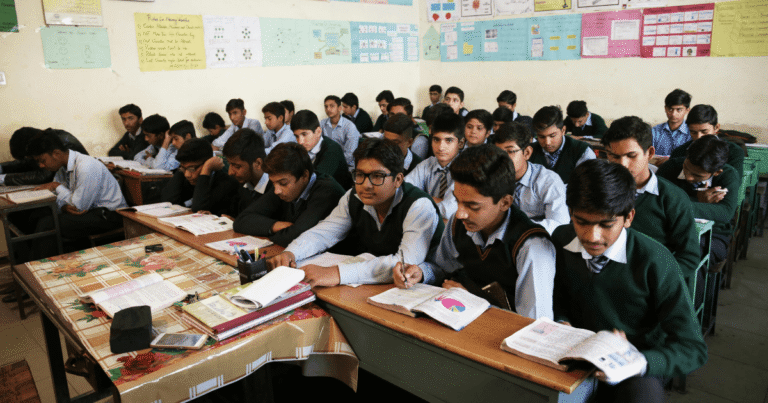
A bell rings, and forty children of the same age file into rows of identical desks. At the front, a teacher stands. A syllabus dictates what will be covered this term, this month, this week. At the end of the year, a single examination decides who moves forward and who repeats the class. None of this feels designed. It feels like weather — the way a school day simply is, everywhere, for everyone, and always has been.
The shrug that ends the question
Ask a parent why school works this way, and you will usually get a shrug. This is just how school is. That feeling of inevitability is worth examining on its own. It is quietly teaching a parent that the system’s shape cannot be questioned, only endured.
Two decisions, not one slow evolution
The truth about the history of Indian education system is less comfortable, and more useful. The classroom your child sits in was not shaped gradually, the way a river cuts a canyon over millennia. It was built deliberately by named people, on identifiable dates, for stated reasons—twice. Once in a European kingdom in 1763, a king decided what a citizen needed to know. He also decided how a school should deliver it. Once more in Calcutta in 1835, a British administrator decided what an Indian student should learn. He also decided which language.
Between them, these two decisions account for nearly everything that still feels unquestionable about a modern Indian school day. Neither decision was inevitable. And neither was really about the child sitting in the room.
Before there was a “system” at all
Learning as apprenticeship, not institution
For most of recorded history, education was not something a state organised. It was a relationship. The gurukul, the traditional Indian model, had a child leave home to live with a teacher, learning not from a syllabus but from proximity — watching, serving, absorbing, asking. No age cohort existed, because a gurukul rarely grouped children by birth year. There was no final examination in the sense we would recognise, because mastery was demonstrated through practice rather than certified on paper.
The same shape recurs across pre-modern history: a master and an apprentice, a guild and its trainee. A philosopher and the students who gathered around him in an Athenian garden fit the same pattern. Teaching was personal because there was no other way to deliver it at any scale.
Nalanda and Takshashila — sophistication without standardisation
It would be wrong to read this as primitive. India built sophisticated institutions of higher learning, long before Europe’s oldest universities existed. Takshashila operated as a major centre of learning from as early as the sixth century BCE. It drew students from across South Asia and beyond. They studied under individual master teachers, gathered in one location. Nalanda, founded in the fifth century CE under the Gupta dynasty, went further still. It was a fully residential university housing thousands of students and teachers. Its library was so vast that, by several accounts, it burned for days when destroyed centuries later.
These were real institutions, with real scale and real prestige. They were not systems in the modern sense. No national curriculum bound them. Age-graded classes never sorted their students. No single standardised examination determined what came next for every learner who passed through. A student’s education still depended on which teacher accepted them, and what that teacher chose to teach.
What the world shared before the 1700s
This pattern — real learning, real institutions, no standardisation — was not an Indian peculiarity. It was simply how education worked almost everywhere, from the guild apprenticeships of medieval Europe to the philosophical schools of ancient Greece. The idea that every child of a given age should sit through an identical curriculum, assessed by an identical test, is not ancient at all. On the scale of educational history, it is remarkably recent.
1763 — the year the modern classroom was invented
Frederick the Great’s decree
The recognisable shape of a modern school — children grouped by age, a set curriculum, compulsory attendance, an examination gatekeeping what comes next — traces to a single decree. In 1763, Frederick the Great of Prussia issued the Generallandschulreglement, establishing compulsory schooling for children roughly between five and thirteen, funded through local taxation and overseen by state inspectors. For its time, this was a genuinely radical proposition. A state, not a family or a guild, was responsible for ensuring every child received an education. That education, the decree insisted, should look the same regardless of which town the child happened to live in.
What the Prussian education system actually delivered
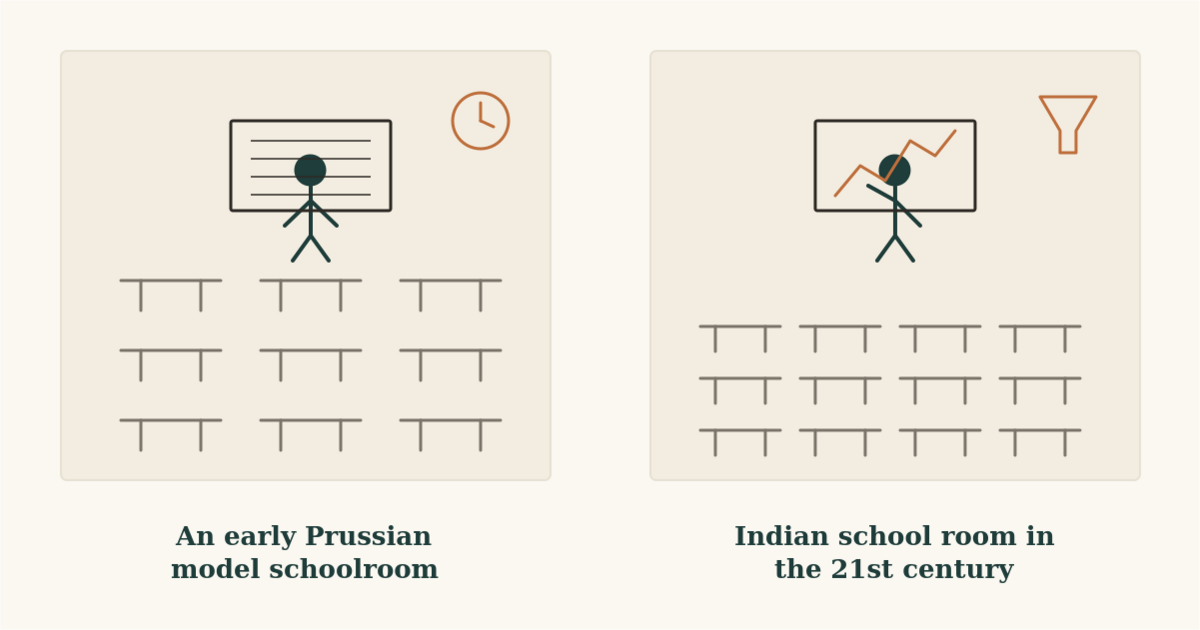
The reforms deepened after Prussia’s defeat in the Napoleonic Wars, when the state doubled down on education as a tool of national rebuilding. Teacher training became formalised. A national curriculum took shape. Prussia also introduced the Abitur, a final examination that determined access to universities and, through them, the professions. This is the architecture a modern parent would recognise instantly: age cohorts, standard content, an exam that gatekeeps the future. It did not exist as a coherent system before Prussia built it.
Correcting a story I nearly told you
Here I need to correct a story I very nearly told you as settled fact. It is the version most education writers reach for. I want this article held to the same standard I ask of every claim on this site. The popular telling says Prussia designed this system deliberately to manufacture docile, obedient factory workers. It’s a story repeated by well-known education reformers, and widely believed among parents I speak with.
What the record actually shows
It turns out to be historically shaky. Prussia was barely industrialised when Frederick the Great issued his decree; no factory floor was waiting to receive these graduates. Historians who studied the record describe a different motive: building a literate, loyal, disciplined citizenry and army after military humiliation. This was obedience to the state, not obedience to a factory foreman. The system still functions like an assembly line, sorting children by age and processing them through identical stations. But the story that it was built specifically for factories is a modern embellishment, not documented history. I would rather give you the less dramatic, more accurate version than the one that makes a better opening line.
How one country’s decree became the world’s default
What made 1763 consequential was not that Prussia kept this system to itself. Horace Mann, appointed the first secretary of the Massachusetts Board of Education in 1837, toured European schools in 1843. He returned deeply impressed by what he had seen in Prussia: compulsory, tax-funded, standardised schooling, delivered at a scale no American state had attempted. Mann’s common school movement was built explicitly on the Prussian template. It spread rapidly through the northern United States and, from there, shaped schooling systems across the industrialising world. A decree written for one German kingdom became, within a century, the default template most of the planet now treats as simply what school is.
1835 — the year Indian education changed direction
What existed before Macaulay
Indian education in the early nineteenth century was not a blank slate awaiting British instruction, as colonial administrators believed. Gurukuls continued the older oral tradition. Pathshalas taught village children reading, writing and arithmetic in the vernacular. Madrasas offered Islamic and Persian scholarship. Tols preserved Sanskrit learning. These systems were uneven in reach and, by modern standards, narrow in whom they served — but they were indigenous, functioning, and centuries old.
The Minute that redirected everything
On 2 February 1835, Thomas Babington Macaulay, then serving on the Committee of Public Instruction, submitted his Minute on Indian Education. In it, he argued that government funding should flow to English-medium Western learning, rather than Sanskrit or Arabic scholarship — the founding document of colonial education India would run on for the next century. Macaulay was unambiguous about the aim. He wanted to produce a class of Indians who were, in his own words, “Indian in blood and colour, but English in taste, in opinions, in morals and in intellect.” These would be administrators and intermediaries, who could help govern India on Britain’s behalf.
Bentinck signs off
Governor-General William Bentinck approved the resolution weeks later, redirecting government education funds decisively towards English instruction and away from the older institutions.
Where the vessel metaphor was born
Independence in 1947 changed the flag, the syllabus content and the stated purpose of Indian education. It did not change the grammar Macaulay’s Minute had installed. English-medium instruction stayed at the top, and a credential exam system kept determining advancement. Marks remained the currency by which the system measured a child’s worth.
The vessel metaphor this website keeps returning to has two parents, not one. A child as a container — filled, then tested on how much stayed in — did not begin with the Prussian decree or the Macaulay Minute alone. It is what happens when you combine them: a Prussian-shaped classroom, delivering a colonially inherited curriculum, examined by a colonially inherited logic of merit.
Thrive Tip
Ask your child one question this week: “Who decided school should work this way?” Not as a trick, and not expecting a historian’s answer. Notice what they say. Most children — like most adults — have never considered that the shape of their day was a choice someone made, and could in principle have been made differently. That moment of noticing is worth more than any single date in this article.
The twentieth century: the same machine, running faster
Standardised testing arrives
The twentieth century did not change the architecture Prussia and Macaulay had assembled; it refined the machinery running inside it. Psychometric testing, developed in the early 1900s, gave the impulse to sort and rank children a scientific-sounding vocabulary. Board examinations, already present in colonial India, hardened into the high-stakes gatekeeping structure familiar to every parent reading this. A single set of papers, taken on fixed dates, now determines years of a young person’s trajectory.
The entrance-exam era begins
Independent India layered a new funnel on top of the inherited structure. IIT Kharagpur, the first of what would become a network of elite technical institutes, was inaugurated in 1951. It was built to train the scientific and technical workforce a newly independent nation needed. The intention was nation-building. The effect, over decades, was different: a new summit for the exam-and-credential logic to organise itself around. A single entrance test now stood between a student and a small number of coveted seats.
Coaching as a private answer to a public bottleneck
Where a public bottleneck exists, a private industry tends to follow. Kota’s transformation from a declining industrial town into India’s best-known coaching hub traces to a single mathematics tutor: V.K. Bansal, an engineer who began teaching students from his home in the early 1980s. One of his pupils cleared the IIT entrance exam in 1985. What started as informal tuition became, just over a decade later, an industry housing hundreds of thousands of migrating students a year. It was a private-sector response to a bottleneck the public system had created but could not itself resolve. The same funnel that built Kota is the one I trace in full in the piece on what topper advertisements hide.
2020 — the first official admission
What NEP 2020 actually says
Here is the strangest fact in this entire history of Indian education system: the Indian state has now, on paper, agreed with most of the argument this article is making. The National Education Policy released in 2020 names conceptual understanding over rote memorisation as a founding principle. It adds critical thinking and the recognition of each child’s individual capabilities to where Indian education should go next. Stripped of policy language, it amounts to an admission that the system built in 1763 and redirected in 1835 has not been serving children the way it should.
Why paper hasn’t yet become practice
A policy document changes far faster than the incentives underneath it. Board examinations still largely reward reproduction. Parents still read marks as the measure of a school. Teacher training, textbook design and inspection regimes all turn slowly, by necessity. A system educating hundreds of millions of children cannot safely lurch from one model to another overnight.
Five years in — too soon to call
It would be dishonest to say this reform has already succeeded, and equally dishonest to say it has failed. Five years is not long enough to judge a shift this structural, set against a system that has run largely unchanged for two and a half centuries. What we can say with confidence is narrower, and more useful. For the first time since 1835, the state’s own direction and this website’s argument are pointing the same way.
The objections worth taking seriously
“Wasn’t the old gurukul system also exclusive?”
This is a fair challenge, and I do not want to romanticise what came before 1763 and 1835 as some lost golden age. Access to a gurukul, a tol or an early madrasa was narrow, often restricted by caste, gender and geography in ways a modern reader would rightly find troubling. Nothing in this article argues for returning to that system. The argument is narrower than that. The structure — relationship-based, unstandardised, responsive to one child at a time — had something worth learning from. That is true even where the access to it did not.
“If it’s 250 years old, why does it work well enough for some children?”
A system can be structurally flawed and still work adequately for a subset of children — usually those whose learning style, temperament and family resources happen to align with what the structure rewards. A system producing some visible successes has never been proof that it serves most children well. It is proof only that variation within any population means someone thrives under almost any set of conditions. The relevant question for a parent is not whether the system can work. It is whether it is working for this particular child.
“Isn’t this just history — what can a parent actually do with it?”
History alone changes nothing. What it does is remove the excuse of inevitability. A parent who believes the classroom’s shape is how school has always been will accept its pressures as natural weather. It becomes something to be endured, rather than questioned. A parent who knows the shape was built by two decisions is freer to ask a different question at home. Neither decision was concerned with the child’s wellbeing. Which parts of this system genuinely serve my child? And which parts am I only obeying out of habit?
What this history of Indian education means for the day your child is living right now
The system was built for compliance, not curiosity, in both centuries
Frederick the Great wanted a loyal citizenry. Macaulay wanted administrative intermediaries. Neither man was designing for a child’s curiosity, wellbeing or long-term flourishing. Both were solving a state’s problem, and a compliant, well-drilled population solved it efficiently. That is the throughline connecting a 1763 decree to a 2026 coaching timetable. The machinery was never built around the child in the room. It was built around what the state, or the institution running it, needed the child to become.
Understanding the machine is the first step to not mistaking it for nature
None of this means the system cannot be worked with, or that a family has to reject school to protect a child. It means holding the system’s demands — the marks, the exam calendar, the coaching schedule — as exactly that: demands made by a particular machine. They were built for particular historical reasons, not as facts about what learning requires. That distinction changes how a parent responds when the machine’s demands start to cost more than they deliver.
One thing you can do this week
Next time your child’s school day feels like the only possible shape a childhood could take, remember the two dates in this article. A king in 1763 and an administrator in 1835 built the outline. Everything since — the boards, the entrance exams, the coaching towns — has filled in that outline, without ever redrawing it. You are allowed to ask, of any single demand this system makes on your child, whether it is actually necessary, or inherited.
Back to the classroom that feels inevitable
It was never inevitable
Return, then, to the shrug this article began with — this is just how school is. It never was. It was Frederick the Great’s answer to a defeated kingdom’s need for loyal citizens. Thomas Babington Macaulay supplied the second answer, decades later, to an empire’s need for administrative intermediaries. Two men, separated by more than half a century, built the outline your child’s Tuesday still follows. Neither one was thinking about your child.
What comes next in the history of Indian education system
NEP 2020 is the first line of a possible third chapter. Unusually, it is written with the child’s understanding, rather than the state’s convenience, as its stated aim. Whether it becomes more than a line on paper will depend on incentives changing far more slowly than any policy document. What will not wait five years, or fifty, is the child currently living inside whichever chapter is running today. History does not owe you optimism about the system. It does owe you the plain fact that the system was built, not born. Anything built by two decisions can, in principle, be rebuilt by better ones.