Between school, tuition and homework, movement is often the first thing squeezed out of a child’s day. Neuroscience suggests it should be the last, because the benefits of movement for children are clear.
Picture your child’s evening: school until mid-afternoon, tuition after that, then homework until whatever hour it now runs to. Somewhere in that sequence, there is rarely a slot marked “move.” It isn’t anyone’s decision, exactly — it’s just what’s left after everything else has claimed its hour.
Here’s what that quiet omission costs: the benefits of movement for a child’s brain are real, measurable, and backed by some of the most striking neuroscience of the last two decades. Not movement as exercise-for-fitness, but movement as a direct input into memory, focus, mood and mental resilience — the very things a packed evening is meant to be protecting.
This is for every parent who has looked at a full timetable and quietly decided movement was the one thing that could wait. The evidence says it’s the one thing that shouldn’t.
The Benefits of Movement for Children, According to the Brain Science
It helps to understand the mechanism first, because it is genuinely striking. When a child moves, their heart pumps faster, and blood carries oxygen and glucose to the brain — essentially premium fuel for thinking. But that is only the start.
Movement also triggers the release of a protein called Brain-Derived Neurotrophic Factor, or BDNF. Harvard psychiatrist Dr John Ratey — one of the world’s leading authorities on exercise and the brain — nicknamed BDNF “Miracle-Gro for the brain,” and in his book Spark, he explains that when researchers sprinkled BDNF onto neurons in a petri dish, the cells spontaneously sprouted new branches — the same structural change that happens when the brain learns something new.
Movement doesn’t just prepare a child to learn. It physically grows the machinery that does the learning. Ratey also reports a German study in which participants who did brief sprints during a treadmill session learned new vocabulary 20% faster than those who hadn’t moved beforehand — not 20% more words, 20% faster.
Movement floods the brain with dopamine (motivation), serotonin (mood) and norepinephrine (focus). Ratey has compared the effect of a good bout of movement to a small dose of Ritalin — the medication used for ADHD. So the twenty minutes a child spends kicking a ball around before homework is not twenty minutes lost from study time. It’s twenty minutes spent building the exact machinery that study time depends on.
If sleep is the harder battle in your house, Sleep Is Not Laziness explains why teenagers need more of it than most are getting — the two are closely linked; movement earlier in the day measurably improves sleep quality at night.
The Benefits of Movement for Children: What Naperville Proved
If the mechanism alone doesn’t convince you, consider what happened in Naperville, Illinois — not as a scheduling template to copy, but as proof of scale: proof that movement’s effect on the brain is large enough to move real academic outcomes, not just a marginal nudge.
In 2003, PE staff at Naperville Central High School, led by coordinator Paul Zientarski, built a before-school movement period for students who were behind in reading, timed deliberately before their hardest academic class. Students who moved directly before their reading class read roughly half a year ahead of peers who hadn’t; in mathematics, students who moved before pre-algebra improved their test scores by 20.4%, compared with 3.87% for a group that hadn’t moved first. Naperville students later sat an international science and maths test alongside students from dozens of countries and finished just ahead of Singapore in science — the top score globally that year.
The point here isn’t that your child’s school should adopt a zero-hour PE period, though some might. The point is the size of the effect: this is what happens when you treat movement as seriously as any other input into learning. Most children get nowhere near this much of it.
What Regular Movement Does for Memory and Focus
Memory and Learning
BDNF is most active in the hippocampus — the part of the brain that converts short-term memories into long-term ones. Aerobic activity increases the volume of the hippocampus, making it physically larger and more capable. A larger, better-nourished hippocampus means better recall — of formulas, dates, concepts, everything a child is asked to remember for an exam. A comprehensive analysis of 133 randomised controlled trials found that movement produced a measurable boost in cognition across all ages, and children and teenagers showed the biggest gains in memory of any age group tested. A child’s brain is at its most plastic right now, which means it responds to movement more powerfully than an adult’s would.
Focus and Attention
A systematic review published in Frontiers in Psychology found that physical activity significantly improves executive function in adolescents — attention, working memory, and the ability to filter out distractions. Research from the University of Nevada found that more physically active students stayed on task longer and had better short-term memory than their less active peers. That’s the difference between a child remembering what they read five minutes ago and drawing a blank.
Maths and Reading, Specifically
Worth knowing if a tutor is pushing more hours as the answer to a lagging subject: researchers at the University of Southern California found that regular physical activity improved standardised test scores in maths and reading more than in other subjects. These two subjects carry the heaviest academic pressure in Indian schools. The reason lies in the prefrontal cortex, responsible for reasoning and language processing; movement increases blood flow specifically to this region. A child who moves before a maths session is, in effect, arriving with their prefrontal cortex already running on a full tank.
What Regular Movement Does for a Child’s Mood and Stress
A Built-In Anti-Stress System
Most parents have heard of endorphins — the chemicals behind the “runner’s high.” Less well known is that movement also lowers cortisol and adrenaline — the hormones released under stress — while raising endorphins, natural mood elevators and painkillers.
Neuroscientist Dr David Linden of Johns Hopkins has written that exercise has a dramatic antidepressive effect and blunts the brain’s response to physical and emotional stress.
Exam season is stressful. Family expectations are stressful. Social pressure is stressful. Movement interrupts the stress cycle directly — not by removing the stressor, but by changing how the brain responds to it. Regular movement also strengthens the brain’s capacity to handle future stress, so a child who moves consistently becomes more resilient over time, not only calmer on the day.
Anxiety and Depression
The WHO estimates that 14% of 10–19-year-olds worldwide live with a mental health condition, with depression and anxiety the leading causes of illness and disability in this age group. A 2025 meta-analysis in BMC Public Health, covering 30 studies of children and adolescents, found physical activity interventions significantly more effective than control conditions at improving mental health, with particularly strong effects on stress and social competence. For mild to moderate depression, some research suggests exercise can be as effective as antidepressants or cognitive behavioural therapy — not a casual claim, but a peer-reviewed finding.
The Mood–Learning Connection
A child’s emotional state directly affects how much they can learn. An anxious brain is a distracted brain; a low-mood brain struggles to retain information. A stressed child sitting through a revision session often isn’t really absorbing it — they’re just present. Movement addresses this at the root: when mood lifts, concentration improves alongside it.
What Regular Movement Does for a Child’s Social World
Here’s a benefit that gets little attention: shared physical activity teaches children how to be around people. Research published in the Journal of School Health found that students who regularly took part in physical activity reported stronger social competence — better communication, greater empathy, and a stronger ability to work in a team.
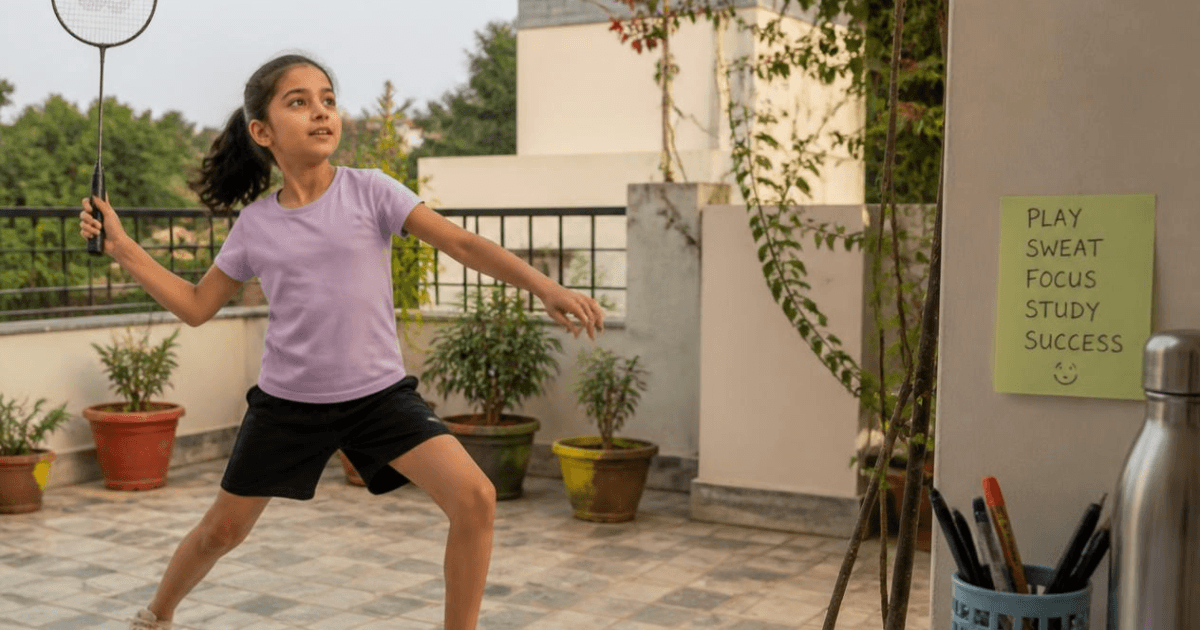
A Sunday cricket game with cousins, an evening badminton session with the building’s other children, a family walk — children and teenagers who regularly take part in team or group activity develop stronger non-verbal communication and are better at reading social cues, and report a stronger sense of belonging, one of the most protective factors there is for teenage mental health. None of this requires a school programme. It requires only that the activity happens regularly, with other people.
Sport has the power to change the world. It has the power to inspire, it has the power to unite people in a way that little else does.
— Nelson Mandela, 2000 Laureus World Sports Awards
Why This Matters More at Home Than It Used To
It would be convenient if schools reliably guaranteed this much movement on their own. Increasingly, that isn’t a safe assumption. In Chennai, physical training periods have been repeatedly repurposed to teach other subjects once school managements come under pressure to improve exam results, according to the Tamil Nadu Teachers Association — and in 2025, Karnataka’s Commission for the Protection of Child Rights found the same pattern happening at scale across the state, prompting a government circular ordering schools to stop.
This isn’t a case for despair, and it isn’t really a case against any particular school — it’s simply a reason the maths has changed. If school-day movement can no longer be counted on as a given, what happens at home carries more of the weight than it used to. The good news is that home is more than capable of carrying it: none of the benefits described so far depends on a formal PE period. They depend on the movement happening at all.
“My Child Isn’t the Sporty One”
This is probably the most common reason movement quietly disappears from a busy week, and it’s worth addressing directly. Many parents unconsciously file movement under “sport,” and sport under “things my child isn’t especially good at.” But the science doesn’t care whether a child is athletic. The benefit comes from movement itself, not from winning. A child who jogs awkwardly around the park for twenty minutes gets the same BDNF release as a school athlete. A child who dances through a Zumba video at home gets the same cortisol drop as one who scores the winning goal. The brain doesn’t distinguish elegant movement from clumsy movement — it just responds to the fact that movement happened.
If your child dreads anything that feels competitive, or team selection has always been a small public humiliation, work around it rather than work past it. Walking briskly, swimming, cycling, dancing at home, even a vigorous bout of housework: the brain benefits regardless of the form it takes.
Fun First, Competition Only If It Fits
This is worth stating plainly, because so much of what gets marketed to parents as an “extra” sport starts from the opposite end: how fast can this child be made competitive? Weekend coaching, summer camps and after-school sports academies often sort and drill for ability from the first session, before a child has had the chance to enjoy moving.
For most children, that’s backwards. The evidence in this article is about movement itself — the brain does not require a competitive frame to release BDNF, lower cortisol, or build a friendship on a Sunday morning. Introducing movement as fun, first, protects the very thing you’re trying to build: a habit the child wants to keep, rather than a performance they learn to dread.
None of this means competition is wrong for every child. Some children genuinely want it — they ask to play again, they keep track of their own improvement unprompted, they seek out the match rather than waiting to be sent to it. That is the signal worth watching for, and it’s the same principle this site argues for everywhere else: a genuine strength shows itself in evidence, not in a parent’s hope for one.
Suppose a child shows that evidence; more structured or competitive training is a reasonable next step — shaped by what the child wants and what the family can realistically support. The goal was never to manufacture a competitive child. It was only to notice one who was already showing up.
Small Moves, Big Returns
A child does not need to train for the Olympics to get these benefits. Research from Stanford’s Lifestyle Medicine programme introduced the idea of “exercise snacks”—short bursts spread throughout the day: ten minutes of brisk walking, a quick set of jumping jacks between study sessions, a stretch during a break.
Even 15 minutes of outdoor exercise has been shown to improve attention and working memory more than the same 15 minutes indoors — the combination of movement and natural light adds something an indoor session alone doesn’t. If your child has a gap between tuition sessions, a short walk outside does more for their brain than another ten minutes at the desk.
The WHO recommends at least an hour of moderate physical activity a day for adolescents. Only 19% of teenagers currently reach that — not because today’s teenagers are lazy, but because the systems around them, from longer school days to more tuition hours, have made it steadily easier to stay still.
What a Parent Can Actually Do

- Treat movement as non-negotiable, like sleep or food. This site has already made the case that sleep isn’t optional; movement deserves the same status. A daily walk, a weekend game, a standing family activity — something that happens regardless of how the week is going, not only when time allows.
- Put movement before the hardest homework, not after it. The Naperville evidence is clear on sequencing: a child’s brain absorbs difficult material better right after moving than after an hour of sitting still. If your child has any flexibility in how their evening is structured, encourage the toughest subject to follow a walk, a game, or any burst of activity — not to precede it.
- Build movement into long study sessions. For every 45 to 60 minutes of sitting and revising, a few minutes of movement — standing, walking around, anything that raises the heart rate — measurably improves both focus and retention afterwards.
- Lead with fun, not fitness or ranking. Frame movement to your child as something enjoyable in itself, not as training, punishment, or a competitive sorting exercise. If real competitive interest shows up later, follow it — don’t manufacture it early.
- Don’t wait for the school to provide it. If PE at your child’s school has become unreliable — quietly repurposed for other subjects, as has happened elsewhere in Tamil Nadu and Karnataka — that’s worth a conversation with the school. But don’t make your child’s movement contingent on that conversation going well. Everything in this article is available at home, starting today, regardless of what the school timetable says.
- Model it yourself. Children absorb what a household treats as normal. A parent who visibly protects their own daily walk or weekend game teaches a lesson no amount of instruction can achieve on its own.
One Final Thought
Dr Ratey’s words about the mechanics of learning are worth carrying with you:
Right now, the front of your brain is firing signals about what you’re reading, and how much of it you soak up has a lot to do with whether there is a proper balance of neurochemicals and growth factors to bind neurons together. Exercise has a documented, dramatic effect on these essential ingredients.
— Dr John Ratey
The next time the evening feels too full for a walk or a game, it’s worth remembering: the homework that follows works better because of it, not despite it. Movement is not the opposite of academic achievement. For a developing brain, it is one of the conditions for it.