
Exam stress in teenagers is meant to rise in board week, and some of it sharpens the mind. Here is how a parent keeps it useful, from the last fortnight of revision to the morning the results arrive.
A week before the first paper
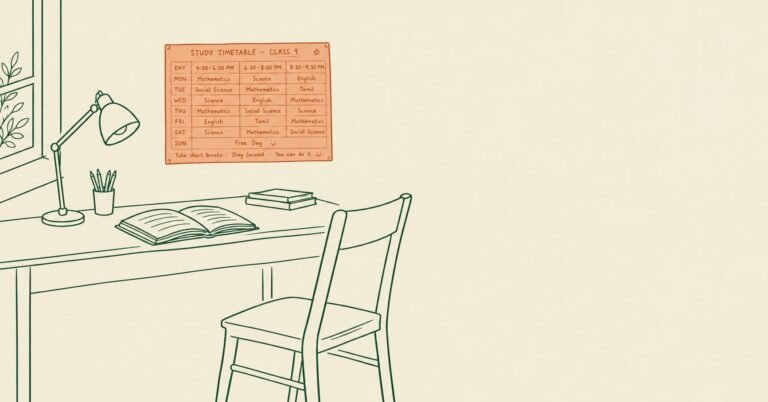
Meghna’s desk, the second week of February
Meghna is in Class 12 at a CBSE school in Chennai, studying physics, chemistry and mathematics. Her first board paper is next Tuesday. Her practicals finished in January. Since then, the house has rearranged itself around her without anyone announcing it. The television stays off, and her younger brother has been asked to keep his cricket commentary down. Every evening, her mother asks whether a chapter is “finished”. Meghna says yes more often than is true. She is not falling apart. She is, however, eating less, sleeping later and rereading her chemistry notes for the fourth time. Most mornings, the familiar knot of exam stress in teenagers sits in her stomach.
A household drawn from many Februaries
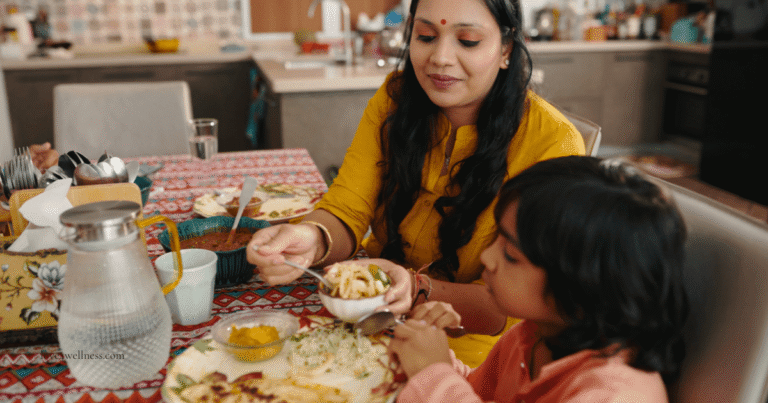
Meghna is not one girl. I have assembled her from a pattern that repeats in home after home each February. It shows up as the hushed house, the rereading, the parent unsure which question to ask. Drawing her this way lets us look closely at the week itself without exposing any real child’s week. Her details are invented; the season is not. Every board family in this city lives some version of it. That is why her week, rather than a list of tips, gives this article its shape.
A pressure with a date on it
This piece is narrower than the anxiety that settles in for months and follows a child from term to term. I have written about that slower weight in the article on anxiety in children. Exam stress differs in one useful way: it keeps a calendar. It builds through the run-up, peaks in the hall, and returns briefly on results day. Because it moves through stages, a parent can meet it at each one, and the sections below follow that order.
Some stress is meant to be there
The nerves that sharpen a mind
Start with a reassurance that sounds odd: Meghna should be somewhat nervous. A faster heartbeat, a dry mouth and a wandering mind are signs of a body preparing for effort. It does the same before a race or a dance performance. A child who feels nothing at all on the morning of a board exam has often simply stopped caring. So a parent’s aim is not to drain every trace of tension from the house. Instead, it is to keep that tension working for the child.
Telling the body a different story
How a teenager reads her own nerves turns out to matter. In one well-known study, researchers worked with students preparing for the GRE, an entrance test for American postgraduate study. Before a practice paper, one group heard that feeling anxious can actually help. That group outscored the others on the maths section, and the gap reappeared on the real test months later. Their knowledge had not changed, only the story they told about their racing hearts. At home, the translation is simple. When your child says her stomach is in knots, try: “That’s your body getting ready. It means this matters to you.”
Where useful turns into harmful
Trouble begins when the nerves stop sharpening and start flooding. Meghna’s knot becomes a concern when it costs her sleep night after night or when meals go untouched. It is also a warning when she sits down to revise and cannot hold a page in her head. Those are the signs that exam stress in teenagers has tipped from fuel into weight. Most of what follows is about keeping the needle on the right side of that line. A short section near the end covers what to do when it crosses over.
Why exam stress in teenagers peaks in Class 12
Eight in ten, by the government’s own count
Meghna is in large company. In early 2022, NCERT surveyed nearly 3.8 lakh school students. About eight in ten named studies, examinations and results as what made them anxious, rising to roughly 85 per cent in Classes 9 to 12. Satisfaction with school life also fell, from 81 per cent in middle school to 68 per cent in the senior classes. Because it ran during the pandemic, when school life was far from normal, the exact figures deserve some caution. The direction, though, is hard to argue with: the closer Indian children get to the boards, the heavier school feels.
What the marks actually decide
Part of that weight comes from a belief that every mark decides everything. For Meghna, the truth is more specific, and more useful.
Take TNEA, the route to a Tamil Nadu engineering seat. There, her cutoff is built directly from her Class 12 mathematics, physics and chemistry marks, adjusted so that CBSE and State Board scores compare fairly. What CBSE vs State Board means for the TNEA cutoff explains how. JEE works differently.
An IIT or NIT seat needs a minimum board score, as the guide to what JEE Main actually gates sets out. Her rank, however, comes from the entrance exam itself. Several other routes use the board result mainly to decide who may apply. The entrance exam calendar after Class 12 sets them out route by route.
Name the route out loud at home
This matters because vague stakes feel infinite. A child who believes every lost mark closes every door carries all of it into every paper. By contrast, some children know exactly where the weight sits. For one plan, mathematics matters most and English simply needs to be solid, and that is a load a child can measure. So sit down together this week and say the route aloud. Name the exams she is aiming for, what each asks of her board marks, and what the fallback looks like. The guide to entrance exams other than JEE and NEET shows how many doors remain open. Stakes with edges are far easier to hold than stakes without them.
A second chance, kept in the pocket
It also helps to know that one paper is not the end of the line. CBSE holds a supplementary examination each July. A Class 12 student who has passed can use it to improve her marks in one subject. Nobody should plan around it, and it comes too late for some admission timelines. Still, a teenager who knows a safety net exists tends to walk into the hall a little straighter.
The weeks before — how she studies matters more than how long
Rereading feels like work
Meghna’s fourth pass through her chemistry notes feels productive. The pages look familiar, and familiarity feels like knowing. Unfortunately, the two are different. A major review of ten common study habits rated rereading and highlighting low in usefulness, though they are what most students rely on. Worse, the comfortable glow of recognition hides gaps until the paper exposes them. That is a dependable recipe for panic in the hall, and a quiet source of exam stress in teenagers who have, by any measure, worked hard.
Close the book and write what you remember
The same review gave its highest rating to practice testing, which means pulling information out of memory rather than reading it in. In an Indian home, this has an ordinary shape. It looks like previous years’ CBSE papers attempted against the clock with the textbook shut. Or it is a blank sheet on which Meghna writes all she recalls about electrochemistry before checking the chapter. It feels harder than rereading, and that difficulty is precisely why it works. Every gap she finds at her desk in February is one she will not discover in the hall in March.
Little and often beats the marathon
The review’s other top-rated habit was spacing study out over several days instead of cramming it into one long sitting. In the fortnight before the boards, that means returning to each subject several times in shorter bursts, rather than “finishing” chemistry on Monday and never opening it again. It also quietly answers the all-night question. A teenager who has spaced her revision has little reason to sit up at two in the morning. Nothing is waiting to be crammed.
Your part is the timetable, not the syllabus
Where does a parent fit? Most of us cannot check a calculus answer, and we do not need to. A parent’s best contribution in these weeks is practical: a quiet house at the right hours, protected mealtimes, and noticing when “revision” has drifted back into rereading. Swap the evening question, too. Ask “what did you test yourself on today?” instead of “how many chapters are done?” The first rewards the habit that works; the second only rewards the feeling of progress.
The body sitting the exam
The night before is for sleep
Sleep is the most common sacrifice of board week. Families offer it up in the hope that one more hour of study will help. A study that tracked 535 fourteen- and fifteen-year-olds through daily diaries found the opposite. After nights of extra study bought with lost sleep, students struggled more with lessons and tests the next day. This trade grew more common as students moved up through school, exactly when it costs the most. I have written about the teenage body clock in Sleep Is Not Laziness. For board week, the practical rule is plain: the last evening belongs to rest, and the final chapter can wait.
Breakfast before the hall
CBSE papers begin at 10.30 in the morning, after a journey to the centre and an anxious wait outside it. A child who skips breakfast arrives running on empty. A systematic review of breakfast studies in children and adolescents found that breakfast tends to help thinking in the hours that follow. Memory benefited most consistently, although the authors note that many studies were small. Nothing elaborate is needed. The idli, dosa or upma the family already eats, with some curd or fruit, is plenty. The longer picture is in the article on what your child eats.
A walk is not time stolen from revision
When the timetable tightens, movement usually goes first. Yet in one randomised study of adolescents, a single 25-minute exercise session improved performance on an attention test, whether the exercise built endurance, strength or coordination. In board week, that could be an evening walk, a few overs of terrace cricket or a skipping rope on the balcony. None of it is a treat to be earned once revision is done; it helps the revision land. I make the longer case in Movement as Medicine.
Six slow breaths at the desk
Indian tradition has long held that a slower breath steadies the mind, and pranayama is built around that idea. On this particular point, modern research offers measured support. A systematic review of slow-breathing techniques, pranayama among them, linked fewer than ten breaths a minute with greater relaxation and less anxiety. Only fifteen studies met its standards, so the support is real but modest. The practice is easy to teach at home. Breathe in gently through the nose for a count of four, out for a count of six, and repeat six times. Done before a study session and again before a paper, it gives a racing mind something steady to hold.
Thrive Tip
Before board week begins, agree a lights-out time with your teenager for the night before each paper. Then write it into the revision timetable as though it were a subject. When the plan itself protects sleep, nobody has to argue for it at eleven at night.
Inside the hall, when the mind goes blank
The paper that was in the envelope all along
Almost every adult remembers some version of this moment, and Rowan Atkinson turned it into comedy. In the 1990 pilot of Mr Bean, Bean arrives at a maths exam having revised trigonometry. He opens his envelope, finds a calculus paper, and spends the exam in mounting despair. In the closing minutes, the invigilator mentions a second, white trigonometry paper in the envelope. Bean could have answered it all along. Audiences laugh because the mistake is so familiar. A frightened mind narrows its attention until it stops checking what is actually in front of it.
Fifteen minutes to read, not to panic
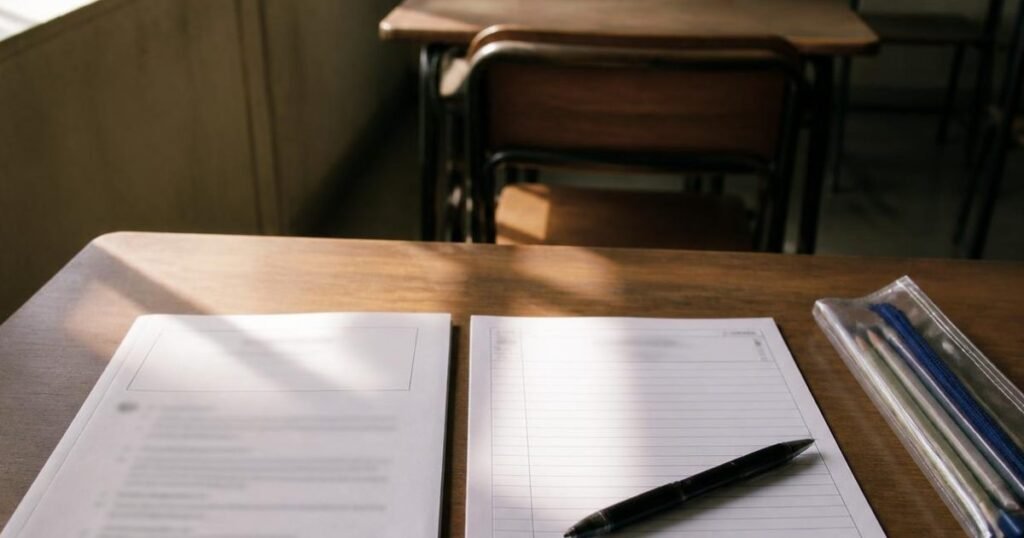
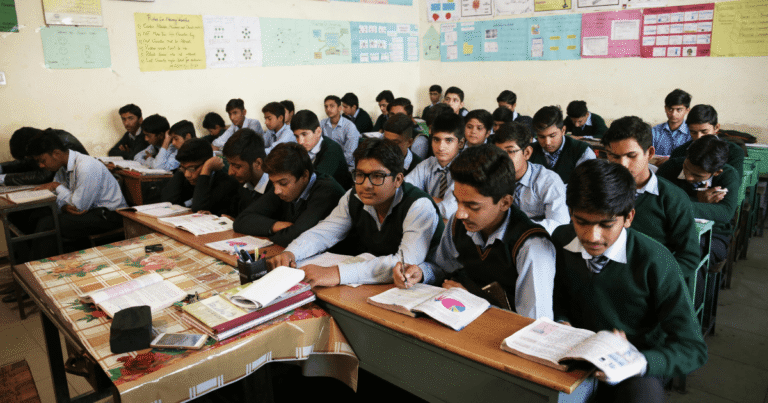
CBSE builds a remedy into every paper. Question papers are handed out at 10.15, and students get fifteen minutes to read before writing begins at 10.30. A teenager who panics through that quarter-hour loses it. One who uses it well takes two slow breaths, then reads every question once, marking those she can answer at once. She starts writing with a plan and an early win. It is worth rehearsing at home: a past paper, fifteen minutes of reading only, pen down, before the clock starts.
Ten minutes with a pen before the bell
A second tool suits the wait outside the centre. One study worked with Class 9 students before a final exam. Ten minutes of writing about their worries just before the paper raised their scores, and the most anxious gained the most. The researchers’ explanation is practical. Worries crowd the mental workspace a student needs for solving problems. Putting them on paper seems to clear some of it. Meghna could do this on the morning of each exam, in a notebook she leaves in her bag. Nobody else needs to read it.
Skip, mark, return
Even well-prepared students go blank on a question. The useful habit, rehearsed beforehand until it is automatic, is to stop wrestling with the blank. Mark the question, move to one she can answer, and come back later. Momentum restores calm faster than staring does, and the stuck question often looks different twenty minutes on. A parent can help rehearse this simply by asking after each practice paper, “What did you do when you got stuck?”
Results day and the face your child reads first
The first ten seconds
In May, the result arrives on a phone screen, usually with the whole family close by. Whatever the number says, your teenager will read your face before she hears your words. Disappointment that crosses a parent’s face in those first seconds can outlast every kind sentence that follows. So decide in advance what your first words will be, whatever the marks; the Thrive Tip below offers one way. I have written about how worry travels from parent to child in The Fear You Pass Down Without Meaning To. Results day is where that transfer happens fastest.
Marks that disappoint are not marks that decide
Suppose the result is lower than hoped. This is where the route the family named in February earns its keep. A weaker physics score shifts the TNEA cutoff by an amount anyone can calculate. However, the JEE rank stays untouched, and the July sitting stays open. So do the many routes that never ran through a single board score. As I wrote in what I believe, a parent’s fear is not foolish; it comes from love. On results day, the child simply needs the love to arrive first.
Thrive Tip
Write down your first sentence before the result is out. Something like: “Whatever this says, we’ll look at it together and work out the next step.” Say it before you say anything about the number.
When exam stress in teenagers needs more than a calm parent
Signs that it has outgrown the exam
Most exam stress fades within days of the last paper, but some does not. Watch for sleep or appetite that stays disturbed for weeks, and for a child who withdraws from friends and pastimes. Panic attacks and any talk of hopelessness matter too. Pay particular attention if these signs continue after the exams have ended, because then the exam was never the whole story. The fuller picture of what to watch for sits in the article on anxiety in children. Any mention of self-harm needs professional help the same day.
Who to call
Help is closer than many families realise. CBSE runs a free counselling service for Class 10 and 12 students each board season. Its toll-free line, 1800-11-8004, runs round the clock, and trained counsellors talk with students and parents. For a child on any board, Tele-MANAS, the Government of India’s free mental health helpline, answers at any hour on 14416. If worry is shaping daily life, a school counsellor, a paediatrician or a mental health professional is the right next step. Calling early is not an overreaction. More often, it is the kindest thing a parent can do.
The week after the last paper
Back at Meghna’s desk
Picture Meghna in early April, the last paper behind her. Her textbooks are stacked by the door for a cousin, and the television is back on. She has slept until nine three days running. Years from now, nobody in the house will remember which chemistry question tripped her up. What she may remember is quieter. Did her family make those weeks easier to carry? Did someone guard her sleep and her breakfast? And what did her mother’s face do when the result came through?
What the family keeps
That is the real opportunity in board season. In the end, exam stress in teenagers is a rehearsal for every later stretch of pressure. The entrance exams, a first job and the demanding years of adult life all ask for the same skills. Some teenagers learn in Class 12 that nerves can be fuel and that sleep is part of the work. They learn that a blank can be skipped and revisited, and that their parents’ love does not move with their marks. Those children carry something out of the exam hall that no marksheet records. That, more than any score, is the part worth nurturing.