You never told her to be frightened. Here is how parents pass anxiety to their children anyway — and why the most useful place to intervene turns out not to be the child.
The fear you never said out loud
The evening that looks fine
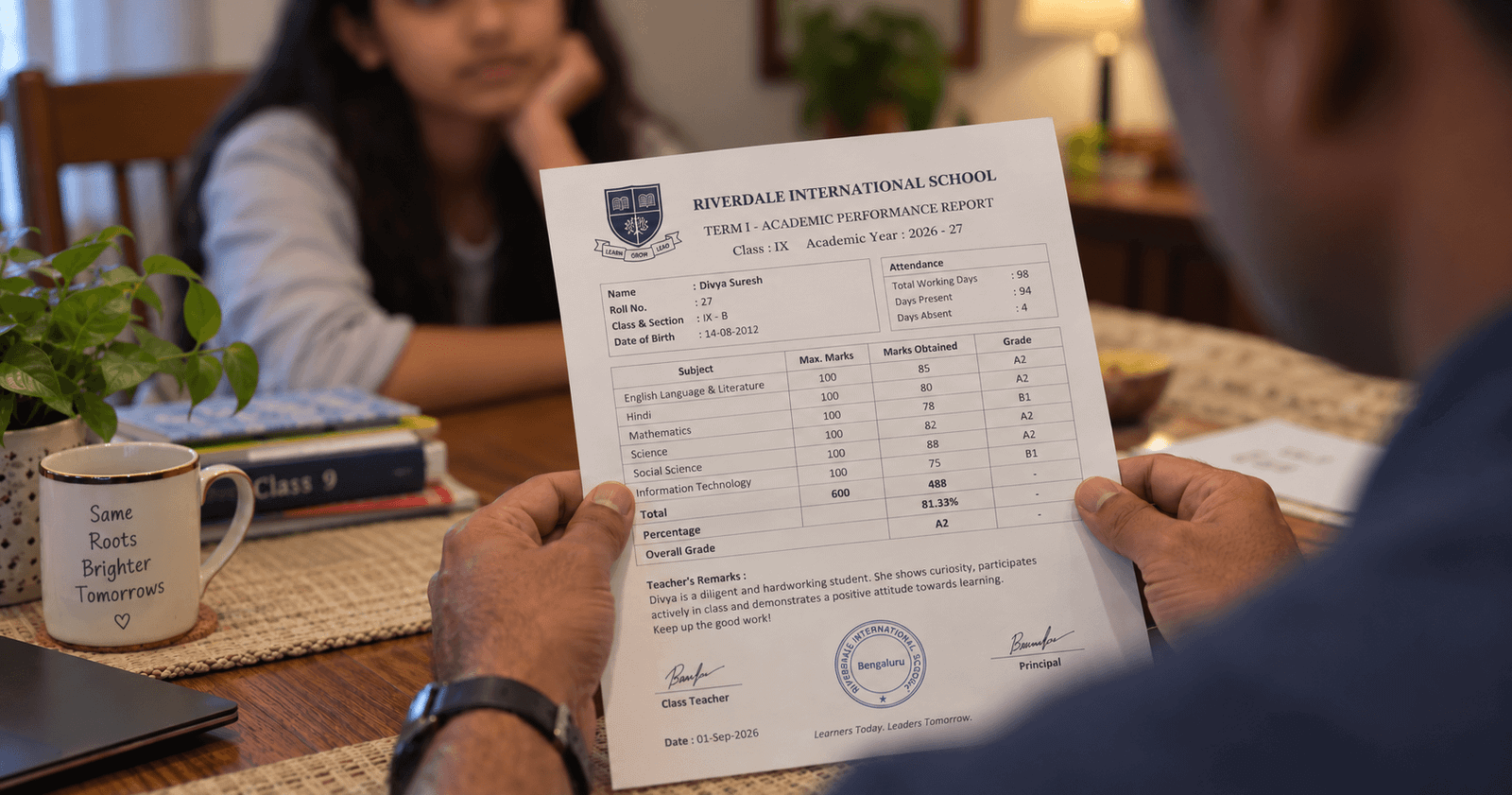
Divya is in Class 9, and the term test marks came home on Tuesday. Seventy-eight in mathematics. Her father, Suresh, studies the sheet for slightly longer than the sheet requires, and then says, mildly, that it is fine and there is time. He means it. He has decided, quite deliberately, not to be the kind of father who shouts about marks.
Yet by Thursday, Divya has stopped mentioning school at the dinner table. By Sunday she is working through four hours of sums nobody asked her to do, and she is not enjoying a minute of it. Nothing frightening was said in that house all week. This is how parents pass anxiety to their children: quietly, sideways, and mostly without words.
Divya and Suresh are not real
They are composites, assembled from patterns that recur across many families rather than drawn from any one of them. Counselling ethics are strict about case histories, and rightly so. But the pattern they carry is real enough that most parents will recognise a version of it. That is the only reason to put them on the page at all.
A face was enough
Researchers at Macquarie University once showed thirty toddlers, aged between fifteen and twenty months, a rubber snake and a rubber spider. The mothers were asked to greet one toy with a warm, pleased expression and the other with a look of fear and disgust. That was the whole intervention. No words, no warnings, nothing a child could later repeat. The toys reappeared a minute later, and again after ten minutes, with the mothers now wearing neutral faces. Even then, the toddlers showed more fear of the toy their mother had disliked and pulled away from it more. A facial expression, held for a few seconds, had done the teaching.
Even a rubber flower
An obvious objection arises here, and the same research group tested it. Perhaps snakes and spiders are special — perhaps children are primed to take a warning about them. So the follow-up study, with seventy-one toddlers, added a rubber mushroom and a rubber flower to the set—harmless objects, with nothing menacing about them at all. The same effect appeared for those too. The children were not learning about snakes. They were reading their mother, and taking her reading of the world as their own.
Why “without meaning to” is the whole problem
Notice what this rules out about how parents pass anxiety to their children. A parent can control what they say. Most of us can control our tone with effort. Almost nobody controls the half-second of expression that crosses their face before the words arrive, and that half-second is doing work whether or not anyone intends it to. The transmission runs on channels that sit below the level of decision. Which is precisely why so many careful, thoughtful parents find their child carrying a fear they were at pains never to hand over.
What this article is not saying
None of this makes you the author of your child’s anxiety. Indian parents are not anxious because they are careless. They are anxious because the system is genuinely narrow and the seats are genuinely few. A wrong turn at sixteen does feel irreversible from where they stand. As What I Believe puts it, your fear is not foolish. It comes from love and from an accurate reading of the odds. The argument here is narrower and, I hope, more useful: fear that has good reasons still travels, and travelling is a separate question from being justified.
How parents pass anxiety to their children: three routes
One direction, three doors
The research literature keeps arriving at the same short list, and it is worth naming plainly before we walk through it. A child picks up a parent’s fear from what they watch, from what they hear, and from what they are spared. In practice, the three routes overlap, and a single Tuesday evening can involve all of them. Still, they behave differently, they show up differently in a house, and — the part that matters most — they respond differently to being noticed.
How common this is, measured in India
Before the mechanisms, a sense of scale. Researchers surveyed 570 students in Classes 11 and 12 across pre-university colleges in Udupi district, Karnataka, all of them preparing for competitive entrance examinations. Eighty-seven per cent reported high pressure from their parents about academic performance, and the scale they used broke that pressure into three parts: psychological pressure, restriction, and expectations pitched too high. Most striking, though, was a separate finding in the same study. The students’ self-imposed stress scored high as well. By Class 12, the pressure was no longer only coming at them. It had moved in.
What the child watches
The half-second before you speak
Return to Suresh and the marksheet. His sentence was generous. His face, in the seconds before the sentence, was not — and Divya was reading the face, because that is what children do when the stakes are unclear. Psychologists call this social referencing: a child meets an ambiguous situation, looks to the adult, and adopts whatever verdict they find there. A marksheet is exactly such a situation. Seventy-eight means nothing on its own. It means whatever the person holding it appears to think it means.
A phone call about a cousin’s rank
The watching is not confined to conversations the child is part of. A mother takes a call from her sister, hears that the nephew in Coimbatore has cleared his scholarship test, and something in her posture changes for the rest of the evening. She has not addressed a word to her son. He has, nevertheless, learned three things: that ranks are the currency, that other people’s children are competitors, and that his mother becomes someone slightly different when the subject comes up. None of that was taught. All of it was absorbed.
What the wider evidence adds
One clever experiment proves less than it seems to, so it matters that this finding has been gathered up and checked. A systematic review and meta-analysis pooled the studies of parent-to-child fear transmission through modelling in early life, drawing on twenty-three of them. The pattern holds across the literature rather than resting on one laboratory. Infants and toddlers acquire fear and avoidance by watching a parent’s reaction to something new, and they do it reliably enough to measure.
The route that survives your best behaviour
This is the route most resistant to good intentions, and therefore the one worth understanding first. A parent who has resolved to say nothing about marks will still flinch at a marksheet. A parent who has promised not to compare will still go quiet when the neighbour mentions a rank. The resolution governs the sentence; it does not reach the flinch. The same reflex fires when your child’s ambition frightens you — the flinch arrives before any of the reasonable objections do, and the child sees the flinch first. That is not a failure of sincerity, and treating it as one only adds guilt to a situation that already has quite enough.
What the child hears
A short burst is enough
The second route is the one parents assume is the only one, and it is more powerful than they think. In a series of experiments, researchers gave children aged roughly six to nine short descriptions of unfamiliar animals — some positive, some threatening, some neutral. A brief passage of frightening information shifted what the children believed about an animal they had never seen. It also changed whether they would put a hand into a box they were told contained it. Notably, the information did not have to be repeated. One telling did it.
The warning that installs itself
Here too, the finding has been checked at scale rather than left resting on a handful of studies. A systematic review and meta-analysis of parental verbal threat information has since gathered this line of research together. The evidence points in the same direction. What a parent says about a threat shapes what the child comes to believe about it. Words, unlike expressions, are chosen. This makes it the route a parent can actually control.
Sentences that were meant as motivation
Consider the sentences that circulate in most Indian homes around Class 9. If you don’t get ninety, that’s it. Do you know how many lakhs of children are writing this exam? Your cousin managed it, so what is your problem? Every one of them is intended as fuel. Every one of them is also, structurally, threat information — a statement about how dangerous the world is and how thin the margin for error is. The parent hears themselves motivating. The child hears a description of the odds, delivered by the person they trust most to describe the world accurately.
Why the fear outlasts the sentence
The most uncomfortable finding in this area is about what happens afterwards. In one experiment, some children were given threatening information about an animal and then had a mildly bad experience with it. They ended up more frightened than children who had only had the bad experience. The warning did not merely add fear on its own account. It changed how the child interpreted what happened next. Apply that to a child told repeatedly that one paper decides everything, who then has a bad paper. The sentence was spoken in Class 9. It is still doing work in Class 12.
What the child is spared
Accommodation, and why it looks like love
The third route is the least obvious and, for parents who have already given up shouting, usually the most active. Clinicians call it family accommodation: the adjustments a family makes to spare a child distress. You answer for her when the relative asks about marks. You email the teacher yourself rather than making her do it. The elocution gets skipped, because she cried the last time. You sit in the room while she studies, because she says she cannot concentrate otherwise. Each decision is kind. Each one is also a small message about what she can and cannot survive.
Almost every parent does this
This is not a rare pathology, and the numbers make that plain. Among parents of children with anxiety disorders, ninety-seven per cent of mothers and eighty-eight per cent of fathers reported at least one accommodation in the previous fortnight. Roughly four such behaviours were running at any one time. Other work puts accommodation among such families at close to universal. So the question was never whether you accommodate. Everyone does. The question is only whether a particular accommodation has quietly stopped being a kindness.
The presentation she did not have to give
Follow one instance to its end. Divya has a class presentation and is dreading it; Suresh writes to the teacher, and Divya is excused. The relief in the house that evening is real and shared. But she has now completed a full circuit: fear arrived, avoidance followed, and relief confirmed that avoidance was the correct response. Nothing in that sequence gave her evidence that she could have stood up and spoken. Next term, the same fear will arrive with a track record behind it.
The lesson hidden inside the rescue
There is a line in What I Believe about the plant kept in the shade — that nobody instructs the shoot, and it is stronger for having found the light itself. Accommodation is the gentlest way to block that. Not by force, and not by pressure, but by removing the difficulty before the child can discover what she would have done with it. This is also where the present piece meets When to Push Your Child and When to Let Go. That article works through the harder question: when a difficulty is worth insisting on, and when it is not.
Where how parents pass anxiety to their children also stops
The trial where the child never met a therapist
Now the finding that changes what a parent should do about all this. At the Yale Child Study Center, 124 children aged seven to fourteen with anxiety disorders were randomly assigned to one of two treatments. Sixty of them received individual cognitive behavioural therapy, with no parent involvement. The other sixty-four received nothing at all — their parents did. Twelve parent-only sessions aimed squarely at reducing accommodation, with no contact between the child and a therapist at any point. The parent-only treatment came out as effective as treating the child directly.
Five in a hundred, against thirty-one
A second trial asks the prevention question rather than the treatment one. Researchers recruited 136 families in which a parent had an anxiety disorder and the child, aged six to thirteen, did not yet have one. Half the families went through a brief family programme; half received an information pamphlet and monitoring. After twelve months, five per cent of children in the programme had developed an anxiety disorder, against thirty-one per cent in the comparison group. When the same families were traced six years later, the difference had held.
Keeping this article’s own denominator clean
Two honesty notes, because a piece about invisible transmission should not smuggle anything past its reader. First, a Swedish team recently tested a lighter, six-session version of the same idea and found it clearly less effective. They concluded that it remains premature to draw firm conclusions about preventing anxiety by working with anxious parents. The approach is promising, not proven. Second, and more important for you: every trial described above concerns diagnosed anxiety disorders, in mostly Western families, with children aged six to fourteen. Your worry about your daughter’s stream choice is not the same thing.
What the evidence licenses, and what it does not
So I will not tell you that a Yale trial proves anything about Class 11 in Chennai. What travels between the clinic and your house is not the outcome but the mechanism, and mechanisms are described in behaviour: a face, a warning, a rescue. Those three things happen in your house whether or not anyone in it has a diagnosis. The trials show that these behaviours are changeable, and that changing them on the adult’s side shifts something on the child’s side. That is a modest claim. It is also the most practical one available.
Why this is good news, not a verdict
Parents usually hear “it starts with you” as an accusation, so let me put the reading I would rather you took. If a child’s fear were entirely their own temperament, a parent would have little to do but wait and hope. The evidence says otherwise. The part of this that runs through you is the part closest at hand. Unlike the examination system, the seat shortage or the neighbours, it is the one thing in the whole picture you can actually reach.
Am I passing my anxiety to my child? A week of noticing
The question that gets a real answer
Am I passing my anxiety to my child is a question most parents ask themselves in the abstract, late at night, and answer with either guilt or dismissal. Neither response produces information. Asked concretely, over one ordinary week, it produces a great deal — because all three routes leave marks you can see, provided you know what you are looking for.
Watch the half-second, not the sentence
For one week, pay attention to your own body at the moments when your child’s future comes up: the marksheet, the report, the phone call about somebody else’s child. You are not auditing what you said. You are noticing what happened in your shoulders, your jaw and your face in the second before you said it. Most parents are startled by how much is going on there, and startled again by how visible it must be from three feet away.
Say the fear out loud, once
Then do something counterintuitive with what you find. A fear that is named is far less contagious than a fear that leaks, because naming it hands the child a frame instead of a mood. I noticed I went quiet when I saw your marks. That was me worrying about your future, not judging you. You have not burdened her with your anxiety; she was already carrying it, in a version she had to invent for herself. You have replaced her invented version with an accurate one. When the worry is about her future, choosing the moment matters as much as the words, which I take up in the article on talking to a teenager about the future without a fight.
Let one rescue go
Finally, pick a single accommodation and stop it — one, chosen for being small. She calls the teacher. She answers the relative about her marks herself. Warn her it is coming, tell her why, and stay in the room while she does it. What you are after is not toughness but evidence: one experience of a feared thing surviving contact with her. As Behind Every Topper, 94 Students Who Didn’t Make It argues in a different register, the outcomes you never see are the ones that shape what you believe. She has never seen herself cope. Give her one instance to look at.
Thrive Tip
This week, catch yourself once. The next time your child’s marks, stream or future comes up, notice your face before you notice your words. Then say the quiet part out loud, kindly and briefly: “That look was my worry, not my verdict on you.” One sentence, once. It costs nothing, and it corrects a reading your child has been making without your knowledge.
Where this stops being your job
One plain caveat before the close. Some children are anxious in a way that no amount of parental noticing will resolve. Sleep, appetite, school attendance or ordinary daily functioning have genuinely gone, and have stayed gone for weeks. That is not a sign that you noticed too late or handled it badly. It is a sign that the problem has moved beyond what parenting adjustments are designed to reach, and a paediatrician or a qualified child psychologist is the right next call. Making it early is a form of good parenting, not an admission of failure.
Back to the evening that looks fine
What Divya was actually learning
Nothing that happened in that house on Tuesday was cruel or careless. A father looked at a marksheet, took a moment, and said something kind. What his daughter took from the evening was not the sentence. It was the moment before it. From that moment she concluded how much was riding on seventy-eight in mathematics, and she acted on it all weekend, unprompted and at some cost to herself.
Your fear is not foolish
I want to be careful not to leave you where this kind of article usually leaves parents: anxious about being anxious. Your fear has real grounds. The funnel is narrow, the competition is genuine, and caring about your child’s future is not a defect to be corrected. What the evidence asks of you is far smaller than becoming a different person. It asks you to notice that the fear is being read, and to decide what you would like it to say.
The instruction you never meant to give
Every parent gives their child instructions they never intended. That is not a failure of parenting; it is simply what happens when a small person spends years studying a large one for clues about how dangerous the world is. The good news sits in the same sentence. That is how parents pass anxiety to their children, and it is also how they pass on everything else. If the fear travelled without your meaning it to, so can the steadiness. A child watching your face for a verdict can easily read a different one.