
How to get into a national law university, explained for parents: what CLAT tests, who can sit it, what a seat costs, and how a rank becomes an admission.
A door most families walk past
An argument at the dinner table
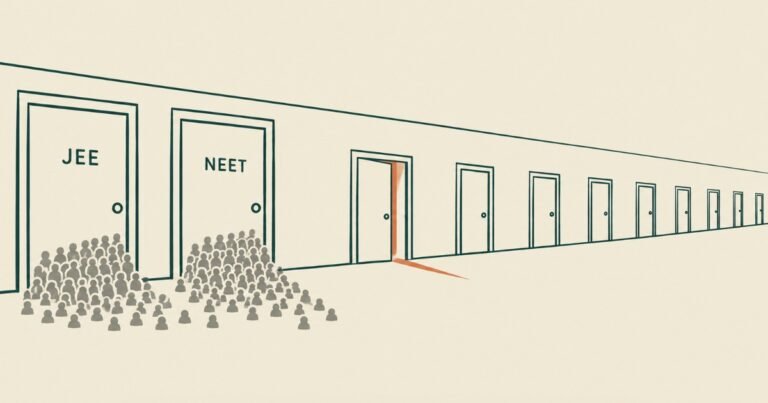
Keerthana is in Class 12, in the PCM stream, at a CBSE school in Tambaram. She reads the newspaper before her parents do, argues about the editorial page over breakfast, and once spent a whole Sunday building a case for why her building’s parking rules were unfair — and won. Her family has always assumed she will write JEE, because that is what a bright PCM child in Chennai writes. Nobody at the table has ever asked how to get into a national law university, because nobody at the table has ever thought of law as a door that was open to her.
Why Keerthana is a composite
Keerthana is not one real student. She is assembled from a pattern I meet often enough to recognise on sight: the science student whose strongest evidence points somewhere her stream never mentioned. Her details are invented; the shape is real, and it is the shape this article is written for. If you have a Keerthana at home — in any stream — the rest of this guide is the information your family has probably never been handed in one place.
How to get into a national law university, in any year
Most CLAT pages are written for a single season and go stale by the next one. This one is built to be useful whether you are reading it in March, in August or the week after the result. The dates that change every year sit together in one box near the top, and everything below it is the machinery that stays put: what the test is, who can sit it, what a seat costs, how counselling turns a rank into an admission, and what to do at each point in the cycle. Read the box for this year; read the rest for how to get into a national law university in any year.
The dates that change every year
This cycle at a glance
The details in this box belong to one admission cycle and are re-checked each July, when the Consortium publishes its next notification. The rest of the article explains how the process works, which changes far less; where it quotes a figure from the last cycle, it says so.
Cycle: CLAT 2027, for admission in 2027–28. Last checked: 30 September 2026.
- Registration: 3 August to 31 October 2026, according to the Consortium’s press release.
- Exam: Sunday, 6 December 2026, 2 p.m. to 4 p.m.
- Application fee: ₹4,000 for General and OBC candidates, ₹3,500 for SC, ST, BPL and PwD candidates, non-refundable; previous years’ papers cost ₹500 extra, according to the CLAT 2027 UG instructions.
- Participating universities: 26.
- Tamil Nadu test centres: Vellore and Tiruvarur have been removed as test-centre cities; candidates who chose them must pick another city by 31 October.
- Counselling, last cycle: registration fee ₹30,000 (₹20,000 for reserved categories), at least fifteen university preferences, and five allotment rounds between January and May, per the Consortium’s counselling instructions.
- AILET (NLU Delhi, separate test): registration closes 10 November 2026.
What CLAT is — and what it is not
One test, twenty-six universities
CLAT, the Common Law Admission Test, is the single entrance examination that most of India’s National Law Universities use to fill their five-year undergraduate law programmes. The universities run it together through the Consortium of National Law Universities, which lists its member universities on its own site — from the National Law School in Bengaluru and NALSAR in Hyderabad to the Tamil Nadu National Law University in Tiruchirappalli. For the current cycle, the Consortium’s instructions state that all 26 of those universities take part. So a child writes one paper, receives one all-India rank, and competes for seats across the whole group through one shared counselling process.
The university that is not on the list
Here is the detail that catches families out every year. The National Law University in Delhi is not a member of the Consortium, and it does not admit through CLAT. It runs its own examination, AILET, with its own form, its own fee and its own deadline. A parent who hears “the National Law Universities use CLAT” and stops there can miss one of the best-known law schools in the country simply by never filling in a second form. If your child is serious about law, both applications belong on the family calendar. I set out AILET, SLAT and the routes that need no entrance test at all in the guide to the other law routes.
A test of reading, not of law
The word “law” in the name persuades many parents that CLAT tests legal knowledge, and that a child who has not studied law is at a disadvantage. The Consortium’s own syllabus says the opposite. In the legal reasoning section, it states that candidates will not require any prior knowledge of law. The passages set out a rule or a principle, and the questions ask the child to apply it to a situation. What the section really rewards, therefore, is careful reading and clean thinking — the same habits Keerthana used on her building committee.
What a legal-reasoning question feels like
An illustration makes this concrete. It is my own invented example, much shorter than a real CLAT passage, and not taken from any paper.
Suppose a passage explains that a person who finds lost property must take reasonable steps to return it to the owner, and may keep it only if those steps fail. The questions then describe situations. A boy finds a wallet with an ID card on a bus and keeps it after one day: has he acted lawfully? A girl finds an unmarked umbrella and hands it to the conductor: does the rule require anything more?
Nothing outside the passage is needed. The child reads the rule, notices the words “reasonable steps”, and applies them carefully — which is exactly why a thoughtful reader with no legal training can do well.
Five sections, all built on passages
The paper runs for two hours and carries 120 questions, each worth one mark. Those questions are spread across five areas, and the Consortium publishes the share each one carries: English language and logical reasoning at roughly a fifth of the paper each, current affairs and legal reasoning at roughly a quarter each, and quantitative techniques at around a tenth. Nearly every question hangs off a passage of up to about 450 words. In practice, a CLAT candidate spends two hours reading, and the child who reads quickly and accurately under pressure starts with a real advantage.
The maths is Class 10 maths
Parents of science students sometimes assume the quantitative section is where their child will shine, while parents of arts students fear it most. Both are over-reading it. The Consortium’s syllabus describes the quantitative section as Class 10 mathematics, applied to graphs, tables and short sets of facts. It is a small section, and a comfortable grasp of percentages and ratios settles most of it.
The arithmetic of a wrong guess
Every wrong answer costs a quarter of a mark. On a four-option question, a pure guess is right only once in four tries, so on average it barely helps and adds risk. Once a child can rule out even one option, though, the odds favour answering, and after ruling out two they favour it clearly. It is worth explaining this to your child plainly, well before December, because the calm, practical way to handle negative marking is settled long before exam day.
Who can sit it — a wider door than families think
Any stream, one marks floor
Nothing in CLAT’s eligibility asks about stream. The Consortium’s eligibility rules set a minimum of 45 per cent in Class 12, or its equivalent grade, for general candidates, and 40 per cent for SC, ST and PwD candidates. A PCM student, a commerce student and a humanities student sit the same paper on the same terms. This is the point our series keeps returning to: some doors are genuinely shut by the stream, but this one only appears to be.
No upper age limit in force, and Class 12 students apply while still studying
There is no upper age limit in force for the undergraduate programme. A child in Class 12 applies while still studying and proves the Class 12 result at the time of admission. So a student who decides late, a student who took a year out, and a student who wants a second attempt can all apply. That last point matters more than families expect, because it turns a missed year into a delay rather than a closed door.
Why the floor is not the same everywhere
The Consortium’s rule is the common minimum, but each university admits under its own rules as well, and they do not always match. The National Law School in Bengaluru, for example, sets 45 per cent for PwD candidates where the Consortium’s common rule says 40. Differences like this rarely affect a strong student, but they can decide a borderline case, so a family with a child near the floor should read the brochure of every university on the preference list, not only the Consortium’s page.
Keerthana’s stream closes nothing
Return to Keerthana for a moment. Her PCM subjects neither help nor hurt her eligibility; what matters is that she clears the marks floor and writes a strong paper. Her physics will not appear on the question paper, but her reading habit will appear on nearly every page of it. For a family that assumed her stream had already chosen her future, that single fact can change the whole conversation.
What a National Law University seat actually costs
Reading one university’s fee sheet
Fees vary a great deal between universities, so the only honest way to show the scale is to read one fee sheet in full. The National Law School in Bengaluru lists its annual cost for the current year at ₹3,18,200 for tuition and facilities plus ₹1,32,800 for housing, a total of ₹4,51,000 a year, along with a one-time admission fee and a refundable deposit. Across five years, even before any increase, that comes to over ₹22 lakh. Compare the fee sheets of every university on your list, and plan for a residential professional degree rather than a college a bus ride away.
Five years, lived on campus
The money is only half of the commitment. The integrated degree runs for five years — at Bengaluru, five academic years divided into trimesters — and most children live on a campus in another city for all of them. For a family in Chennai, that may mean a seventeen-year-old moving to Bhopal, Jodhpur or Guwahati. Some children flourish with that independence; others need more time at home first. Ask honestly which your child is, because it belongs in the decision as much as the rank does.
The home-state advantage
Some National Law Universities reserve a share of their seats for students from their own state. In Bengaluru, for instance, 25 per cent of seats are reserved horizontally for Karnataka-domicile students. For a Chennai family, the equivalent is the Tamil Nadu National Law University in Tiruchirappalli, which also admits through CLAT. Because a home-state quota can move a rank that looks out of reach into a realistic seat, it deserves a place on your preference list rather than a footnote.
Planning the money before the result
Talk about money before counselling begins. Once allotments begin, decisions come with fees attached and deadlines measured in days, and a family that has not already agreed on its ceiling ends up deciding under pressure. Sit down early, with the fee sheets of the five or six universities your child is most likely to reach, and settle on what you can genuinely carry across five years — including housing, travel and the loan terms, if you will need one.
From rank to seat — how counselling decides where your child studies
A second registration, with a real fee
A CLAT rank does not arrive attached to a seat. After the result, the Consortium runs a separate counselling process, and a candidate who wants a place must register for it and pay a counselling fee. In the last cycle, that fee was ₹30,000 for general candidates and ₹20,000 for reserved categories, according to the Consortium’s counselling instructions, and the whole amount is refunded to a candidate who is never allotted a seat. The amount changes from year to year, which is why the box at the top carries it; the principle does not. Keep the money ready before the result, because the counselling window is short.
A long preference list, chosen in advance
At registration, your child lists the universities they are willing to attend, in order. In the last cycle, the Consortium required at least fifteen preferences, and it considers a candidate only for the universities they actually list. This is the single most important document your family will produce in the whole process. A university left off the list is a university your child cannot be allotted, however good the rank.
Freeze, float or exit
Each time a round allots your child a seat, they must choose one of three options. Freeze means accepting the seat and leaving counselling. Float means holding the seat while staying in the running for a university higher on the list. Exit means walking away from counselling altogether. Freezing and floating both require paying a confirmation fee, so floating costs real money.
Why the order is the real decision
A candidate can only move up their preference list in later rounds, never down. Suppose Keerthana is allotted her fourth choice in the first round and floats. In later rounds, she can be moved to her first, second or third choice — but never to her fifth. So the preference order needs to reflect what your child would genuinely choose, in the order they would choose it, with the fees and the home-state quota already weighed. A list built in a hurry on the day registration closes quietly turns into the decision itself.
Silence counts as a no
The rule that surprises families most is the simplest. A candidate who does not choose freeze, float or exit within the stated time is treated as not interested, and loses both the seat and their place in counselling. In a household juggling board exams, other counselling and travel, a missed deadline is easy to imagine. Put every counselling date on the same calendar as the board timetable, and decide in advance who in the family is responsible for checking each result.
A process that runs into May
Counselling does not finish in a week. In the last cycle, the Consortium published five allotment lists between early January and the middle of May, so the process spanned the Class 12 board examinations, and the final round closed only weeks before engineering and medical counselling began. A child may still be floating a law seat while other options open up. That is manageable if the family expects it, and exhausting if it does not.
After the Consortium’s rounds close
Even after the common rounds end, some seats stay empty. Individual universities may then fill vacancies through their own processes; the Tamil Nadu National Law University, for instance, invited applications against vacant seats for its undergraduate programmes after the Consortium’s rounds. If your child’s rank sits just outside the final allotments, it is worth watching the websites of the universities on the list before assuming the door has closed.
Where is your child in the cycle?
Class 9 and 10: reading, not coaching
At this age, the most useful preparation for CLAT looks nothing like preparation. A child who reads widely — a good newspaper, long-form non-fiction, novels they choose themselves — is building the one skill every section of the paper tests. Discussing what they read at the dinner table, disagreeing, and defending a view with reasons does the rest. Nothing here needs a coaching class, and nothing here is wasted if your child finally chooses a different path.
Class 11: a trial, not a commitment
Class 11 is the right moment for a low-stakes experiment. Let your child sit one full-length practice paper. The result matters far less than the reaction afterwards. A child who comes away curious and wanting another try is showing you evidence; a child who finds the passages a chore is showing you something too, and both are worth knowing a full year before any form is filled.
Class 12, August to October: the forms
In the current cycle, registration runs from early August to the end of October, and the box at the top carries each year’s dates. This is the moment to fill in the CLAT form, choose a test city carefully, and decide whether to apply for AILET as well, since NLU Delhi sits outside CLAT entirely. Put both deadlines on the calendar the day registration opens, because a form left to the last week of October has to compete with school examinations and every other deadline in the admissions season that runs before the board exams.
December: the paper and the answer key
In recent cycles, the exam has been held in early December, and the Consortium publishes a provisional answer key within days, reviews objections, and then issues a final key before the result. For your child, the most useful thing after the paper is rest, followed by an honest look at the provisional key rather than a week of anxious speculation.
December to May: counselling beside the board exams
Counselling registration usually opens soon after the result. In the last cycle, three rounds ran before the board examinations and two after them, so decisions land on either side of the exams. Plan for this now. Agree on the preference list before the result, keep the fee ready, and decide who will watch each round. That way, your child can give the board examinations their full attention while the family handles the paperwork.
If the window has closed
If you are reading this after registration has closed, nothing is lost that a year cannot recover. There is no upper age limit, so a gap year spent reading, working or studying elsewhere is not wasted. The Delhi route, several private universities and state entrance routes may still be open, so check them before writing the year off. I compare them, with their dates, in seven other doors into law. The one thing to avoid is a rushed attempt made only because the calendar said so.
The worries worth taking seriously
“Engineering felt safe. Law feels like a gamble.”
I understand this fear, and it is not foolish. Many of us grew up believing that engineering and medicine were the only secure paths, and anything else was a risk taken by families who could afford one. Yet safety was never really a property of the degree; it came from a child doing work they were good at and willing to keep improving in. A child with genuine reading and reasoning strengths who forces themselves through engineering may be taking the larger risk. The honest question is which path your child’s evidence supports.
“What if she changes her mind halfway through?”
Five years is long, and seventeen-year-olds change. Two things help. First, test the interest before committing, with past papers in Class 11 and conversations with people who practise law in its many forms. Second, read each university’s rules on withdrawal and fee refunds before freezing a seat, because they differ, and the counselling rules themselves set deadlines after which fees are forfeited or deducted. A decision made with the exits already understood is far calmer than one made in hope.
Who this route genuinely suits
The evidence to look for
A genuine strength shows itself in evidence rather than enthusiasm, a point I have made in my manifesto. For law, the evidence usually looks like this: a child who reads for pleasure and finishes what they start, who enjoys an argument and can change their mind when shown a better one, who notices unfairness and wants to understand the rule behind it, and who writes clearly when they care about the subject. None of these requires a particular stream, and all of them show up long before Class 12.
Signs it may be someone else’s dream
Law is sometimes chosen for a child rather than by one — because a relative practises, because it sounds prestigious, or because it looks like a safe alternative after a disappointing JEE mock. Watch for the gap between the idea of law and the daily reality of it. A child who is excited by courtroom drama but bored by a 450-word passage is telling you something important. Five residential years are a long time to spend on a path chosen to please someone else.
Law is wider than the courtroom
Families often picture law as litigation and little else. In reality, a law degree leads to many rooms: courtroom practice, advisory and company work, policy and research, judicial services, and roles inside businesses and public bodies that need someone who reads closely and reasons carefully. A child who dislikes the idea of arguing in court may still flourish in law. The strength that matters is the reading and reasoning, and the work is wide enough to find a place for most temperaments that have it.
Thrive Tip
Before you spend on coaching or a crash course, give your child one past CLAT paper and two quiet hours on a Sunday. Afterwards, ask only one question: which passage did you enjoy most?
The answer tells you more about fit than the score does — and it costs a Sunday rather than a fee.
What the popular guides get wrong
“All the National Law Universities take CLAT”
Most do, but the most commonly missed exception is one of the best-known. NLU Delhi admits through AILET, and a family relying on one form loses a whole option without noticing. Always check the Consortium’s current list of participating universities rather than assuming the whole group is covered.
“You need to know law to do well”
The Consortium states plainly that no prior knowledge of law is needed. The passages carry the rules; the child supplies the reading and reasoning. Families who spend Class 11 on law textbooks are preparing for a paper that does not exist.
“CLAT is for arts students”
The eligibility rules ask about marks, not stream. A science or commerce student sits the same paper on the same terms, and the quantitative section is Class 10 mathematics. Keerthana’s PCM subjects close nothing, and for a child whose strengths point towards law, they are simply irrelevant to the entry test.
“The rank decides the seat on result day”
The rank only decides where your child stands in the queue. The seat comes from a counselling process that runs for months, depends on a preference list written in advance, and treats a missed deadline as a refusal. Families who relax after the result often discover that the decisions that matter most come afterwards.
“Coaching is the price of entry”
Coaching can help a child practise under time pressure, and some children do benefit from the structure. But the paper is designed to test reading and reasoning built up over years, and no institute can supply that in a single season. Before paying for one, read what topper advertisements hide, and use the parent’s checklist for choosing a coaching institute. The same questions apply to law coaching as to JEE and NEET coaching.
Back to the dinner table
Keerthana, one more time
Return to that breakfast table in Tambaram. Nothing about Keerthana has changed: she still reads the editorial page first and still argues well. What has changed is what her family knows. They now know that her stream closes nothing, that the paper tests the very habits she already has, that a seat costs real money and needs planning, and that the decisions after the result matter as much as the rank. With that information, she can choose law or decide against it — and either way, it will be her choice, made with the facts in front of her.
A door, held open
Knowing how to get into a national law university is not the same as deciding your child should go to one. The purpose of this guide is narrower and, I think, more useful: to make sure that a door your child may be suited for does not stay shut simply because nobody in the family knew it was open. As I have argued elsewhere, a child’s intelligence runs wider than any one entrance exam measures, and law is one of the places it can go. Look at the evidence, read the brochures, put the dates on the calendar, and let your child walk through the door that is genuinely theirs.