Most families plan around two exams and never hear of the rest. Here are twelve entrance exams other than JEE and NEET, read by the strength each one rewards, and the reasons so few parents ever see them.
Two exams on the fridge
A timetable built around one paper
Aditi is in Class 11 in Chennai, studying physics, chemistry and mathematics. She has a JEE coaching batch three evenings a week and a timetable taped to the fridge. Her marks are good. Her mock-test scores, however, are slowly sinking, because the tests reward speed and Aditi is slow in the way careful people are slow.
Last month she lost an entire Sunday to a problem about prime numbers that nobody had set her. She came to dinner looking happier than she had in weeks. Her parents noticed, smiled, and reminded her about Tuesday’s test. In two years of planning, the entrance exams other than JEE and NEET have never once come up at that table. Yet one of them was built for exactly the kind of mind that gives a Sunday to primes, and it holds an examination centre in her own city.
A girl drawn from many
Aditi is not one real student. I have built her from a pattern familiar to anyone who watches bright teenagers through Class 11: a child whose ability pulls one way while the family’s only plan pulls another. Her name, her Sunday and her fridge are invented. What I have kept faithful is the gap between what a child plainly loves and the only two exams her family has heard of. That gap is common enough to deserve an article of its own.
What this map covers, and where the details live
What follows is a map, and each entry on it is deliberately brief. For each of twelve entrance exams other than JEE and NEET, I describe who it suits, what it opens, and one fact most families would not expect. Dates, fees and seat counts change every year, so they live elsewhere on this site. You will find them in the admissions calendar hub and in the route guides that follow through the year. Before the map, though, a question deserves an honest answer. Why does a family as careful as Aditi’s never hear of these exams at all?
Why the entrance exams other than JEE and NEET stay invisible
Twenty lakh at one door
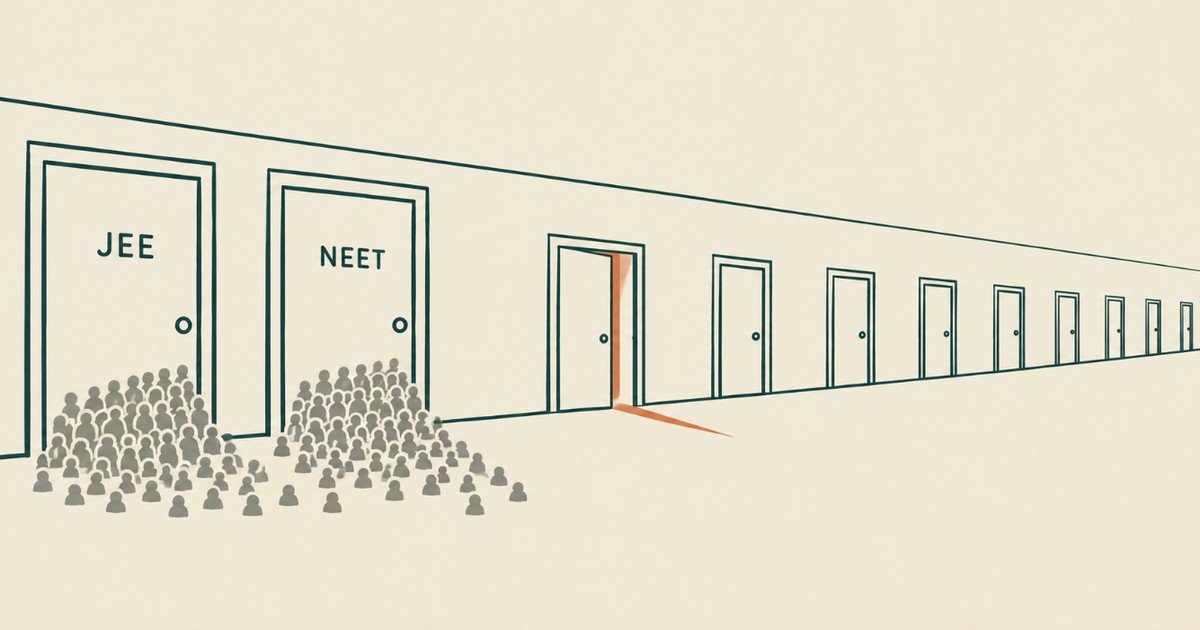
Start with the scale. Close to twenty lakh students sat NEET (UG) in 2026, according to the National Testing Agency’s own result notice. I have set out elsewhere how few coaching students ever reach the seat the hoardings promise. Crowds of that size create their own gravity. When a child’s whole class, building and family WhatsApp group are preparing for the same two papers, those papers stop feeling like choices. Instead, they feel like the weather.
The coaching calendar becomes the family calendar
Most of the machinery around a teenager’s last two school years is built for those same two exams. Coaching batches carry their names. Test series are timed to their dates, and hoardings along every main road celebrate their ranks. None of that is sinister, since institutes sell what most families ask to buy. Even so, one industry’s product line ends up writing a household’s calendar. It decides which evenings are spent where, and which Sundays belong to mock tests. An exam that nobody builds a batch around rarely makes it onto the fridge.
Prestige travels by word of mouth
Then there is the question every Indian parent has heard, sometimes aloud: what will people say? An IIT seat or a government medical seat needs no explanation to grandparents or colleagues. By contrast, a seat at a mathematics institute or a maritime university needs a sentence of explanation. That sentence can feel uncomfortably like an apology. As I wrote in my manifesto, a parent’s fear in a competitive system is not foolish, because it comes from love. Still, a door that needs explaining is not a lesser door. It is only a less familiar one.
A dozen authorities, a dozen websites
The last reason is the most practical. JEE and NEET arrive through one testing agency and a flood of news coverage. The other exams, however, belong to a dozen separate bodies. The list runs from the Union Public Service Commission and the Council of Architecture to IIT Bombay, a consortium of law universities and an agricultural research council. Each keeps its own website, calendar and eligibility rules. No single place hands a parent the whole picture. So most parents only ever see the part that is loudest.
What the narrow view quietly costs
The real cost is rarely a missed exam. More often, a child with a clear strength spends two years being measured against a paper that does not test it. Aditi is ranked on how fast she solves problems she did not choose. Meanwhile, the thing she does unusually well earns her nothing in a timed mock: staying with a hard idea long after others would give up. I have argued before that the intelligence behind a near-miss in an entrance exam opens many other strong doors. This article is the practical half of that argument. It shows the doors themselves.
Doors a JEE score opens beyond the IITs, and one it no longer opens
A JEE Main score that leads to a uniform
Some of the most overlooked doors sit inside the exam a family is already preparing for. Take the Indian Army’s 10+2 Technical Entry Scheme, listed on the Army’s officer-recruitment portal. It takes students with physics, chemistry and mathematics who have written JEE Main and shortlists them based on that performance. Shortlisted students then face the Services Selection Board. It is an officer’s route with an engineering education built in. So a JEE Main result that will never produce an IIT seat can still carry a teenager to an interview board few classmates think to try.
A space institute with its own form
The Indian Institute of Space Science and Technology in Thiruvananthapuram admits undergraduates on JEE Advanced marks. Crucially, it does so through its own admissions portal, not the joint IIT counselling most families watch. It also asks for a strong aggregate in the Class 12 board examination. A student who waits only for the IIT allotment can simply let this window close unnoticed.
The top rank that no longer opens IISER
The reverse surprise matters just as much. For years, a good JEE Advanced rank could also carry a student into an Indian Institute of Science Education and Research. From 2024, however, those institutes admit only through their own aptitude test. IISER Pune’s admissions page says so plainly. Some families assume JEE preparation covers science research as well. They tend to learn otherwise in June, after the separate registration has closed.
Twelve entrance exams other than JEE and NEET, read by strength
Start with the child, not the list
Read what follows the way a counsellor would, from the child outwards. A genuine strength shows itself in evidence. It is the subject a child returns to unasked, or the kind of problem that makes an afternoon disappear. A passing enthusiasm is not the same thing, and neither is a parent’s hope. So before scanning the list for prestige, ask which description sounds like the teenager at your table. I have grouped these entrance exams other than JEE and NEET into three rough families. The first is for the child who loves ideas. Next come exams for the child who reads, argues, draws or builds, and finally for the child who wants a working life beyond a desk.
For the child who loves the idea more than the answer
CMI, where mathematics is the destination
The Chennai Mathematical Institute admits undergraduates to honours programmes in mathematics, computer science and physics. According to CMI’s admissions page, one common entrance examination covers them all, and students choose their programme only after admission. Its paper rewards exactly the thinking Aditi does on her Sundays, where patience counts for more than speed. Better still, CMI publishes past papers with worked solutions. A family can therefore test a child’s fit in a single afternoon. For a Chennai family, the examination centre is also in the city.
ISI and the rare undergraduate stipend
The Indian Statistical Institute runs bachelor’s programmes in statistics and in mathematics. It also does something almost no undergraduate course in India does. As its 2026 admission notice records, it pays its B.Stat and B.Math students a monthly stipend. Eligibility requires mathematics and English in Class 12. Some children love numbers as a way of understanding the world, not as a hurdle before an engineering seat. For them, ISI is one of the most serious places in the country to study.
The IISER Aptitude Test, for science as enquiry
The IISER Aptitude Test is now the single route into the five-year BS-MS programmes at all seven Indian Institutes of Science Education and Research. Its 2026 information brochure sets out the process, and the course closes with a research thesis. It suits the child whose favourite question is why rather than how much. This is the reader who goes past the end of the chapter. Given the choice, she would rather design the experiment than memorise its result.
NEST, the research track from the atomic energy side
NEST is the entrance test for a five-year integrated MSc at two institutes: NISER in Bhubaneswar and the UM-DAE Centre for Excellence in Basic Sciences in Mumbai. The Department of Atomic Energy set up both. According to the NEST website, admitted students become eligible for an annual scholarship from that department. The paper spans biology, chemistry, mathematics and physics. It therefore suits the broadly curious science student who is not ready to choose one subject yet.
Thrive Tip
Put a past paper on the table.
Before any exam goes into the plan, download one past paper. Hand it to your child with nothing riding on it: don’t time it, and don’t mark it.
Watch instead for what happens in the first twenty minutes. A teenager happily stuck on a problem has told you more than any brochure can. So has one who quietly looks for the exit.
For the child who reads, argues, draws or builds
CLAT, law for the careful reader
The Common Law Admission Test, run by the Consortium of National Law Universities, is open to students from any stream. Its official syllabus says candidates need no prior knowledge of law. Instead, the paper is built from passages of about 450 words each. A Class 12 student should be able to read one in five to seven minutes, before answering questions on argument and reasoning. That makes CLAT an examination for the child who reads everything and argues with most of it. At home, that debating is sometimes mistaken for answering back.
I walk through each section of the paper, and the law universities it opens, in the guide to CLAT and the national law universities. AILET, SLAT and the Tamil Nadu route that needs no exam at all are set out in the guide to law routes that don’t go through CLAT.
IPMAT, management from the first year
IIM Indore launched its five-year Integrated Programme in Management in 2011. According to the institute’s programme page, it was the first of its kind in India. Students leave with both a bachelor’s degree and an MBA, and admission begins with the IPM Aptitude Test. The route suits the child who is quick with numbers and good with people. Often, this is the teenager already running the school fest while classmates are still forming a committee.
UCEED, design even without physics
IIT Bombay’s design entrance, UCEED, is open to students from science, commerce and the arts. The detail families miss sits in the fine print of IIT Bombay’s eligibility rules for 2026. Students with physics, chemistry and mathematics could apply to all seven participating institutes. Students from other streams could still reach the design programmes at IIT Bombay, IIT Delhi, IIT Hyderabad and IIT Indore. In other words, a commerce student who sketches in every margin can study design at an IIT. The national design and fashion institutes, NID and NIFT, hold separate entrances on their own calendars.
NATA, architecture tested for aptitude
The Council of Architecture runs the National Aptitude Test in Architecture. On its own website, NATA describes itself as a measure of visual perception, aesthetic sensitivity and reasoning, alongside academic learning. Unusually, it runs across many weekends in a season rather than on one day. Architecture does gate on Class 12 subjects, so a child considering it needs physics, chemistry and mathematics in Class 12. A second architecture route sits inside the JEE Main form itself, which I discuss in the JEE Main article. Either way, this is the builder’s exam. It suits the child who takes things apart and notices why one room feels better than another.
For the child who wants a working life beyond a desk
NDA, where the written paper is only half the story
The Union Public Service Commission conducts the National Defence Academy and Naval Academy examination for students straight out of Class 12. Its official notice sets a Class 12 pass as the requirement for the Army wing. The Air Force and Navy wings, however, ask for physics and mathematics. The written paper covers mathematics and general ability. Yet the notice is candid that success in it confers no right of admission. A separate Services Selection Board interview weighs the whole person. So the route suits the child who stays steady under pressure and is happiest in a team, whatever their stream. For parents who find this door frightening, I have written about “When Your Child’s Dream Scares You”.
IMU CET, the honest way onto a ship’s officer track
The Indian Maritime University is a central university based in Chennai. Its entrance test, IMU CET, leads to the officer-track degrees in marine engineering and nautical science. A 2020 training circular from the Directorate General of Shipping, later amended, ties admission to IMU CET. Maritime training institutes regulated by the Directorate must admit on that basis, private institutes included. That gives a parent a simple protection. Anyone offering an officer-track seat without an IMU CET rank is a warning sign. Seafaring also carries its own medical standards, so read them before a child falls in love with the sea.
NCHM JEE, the other JEE
There is a second national exam called JEE, and it has nothing to do with engineering. The Hotel Management Council’s NCHM JEE, conducted by the National Testing Agency, leads to a BSc in Hospitality and Hotel Administration. Its institutes span the country, and one of the central institutes is in Chennai. According to the council’s 2026 brochure, any Class 12 student with English may apply. The paper tests numerical ability, reasoning, general knowledge, English and aptitude for the service sector. The same brochure notes that Jawaharlal Nehru University awards the degree itself. It suits the child who is warm with strangers and calm in a crisis.
CUET for agriculture, and in Tamil Nadu, Class 12 marks
Agriculture’s own national entrance quietly disappeared a few years ago. The Indian Council of Agricultural Research now fills its all-India undergraduate seats through the agriculture papers of CUET, as its counselling portal shows. For a Tamil Nadu family, the more useful fact sits closer to home. Tamil Nadu Agricultural University runs its own undergraduate admissions through its admissions portal, with rank lists based on Class 12 marks rather than an entrance paper. It suits the child drawn to living things, food and land. Here, science ends in a field as often as in a laboratory.
Before an exam goes on the fridge
Check the subject gate while Class 11 is young
Several of these doors close at the subject stage rather than the exam stage. NATA needs physics, chemistry and mathematics. The NDA’s Air Force and Navy wings need physics and mathematics, and ISI asks for mathematics and English. UCEED, meanwhile, opens more institutes to a student who keeps physics, chemistry and mathematics. By contrast, CLAT and NCHM JEE ask for almost nothing in particular. So study this map before the Class 11 subject choice hardens, not after it. Read it alongside the clues your child gives at home, which I set out in the guide to choosing a stream after Class 10.
Count calendars, not only exams
Each authority keeps its own clock, and the clocks do not agree. Some registrations open in the autumn of Class 12, well before board examinations. Others fall in the spring. The current cycle’s dates sit together in the admissions calendar hub. The point here is simpler: every added exam brings an added deadline. A missed registration window cannot be made up with extra study.
One more exam is not one more chance
It is tempting to add every door to the list, on the logic that more tickets mean better odds. Entrance exams do not behave like lottery tickets, though. CLAT tests close reading, CMI tests proof, and NCHM JEE tests service aptitude. Preparing for five unrelated papers alongside board examinations tends to produce five tired attempts. Two or three entrance exams other than JEE and NEET that genuinely fit the child will usually serve far better. Let the child’s evidence, rather than the family’s anxiety, decide which ones make the cut.
The coaching question, asked honestly
Coaching exists for some of these exams and barely exists for others. For a few, such as CLAT or NATA, wide reading and regular sketching may do as much as any batch. The market’s silence about an exam, however, tells a parent nothing about its worth. It only shows where the market has chosen to sell. Whether coaching is necessary for JEE and NEET for a particular child is a separate decision, which I take up on its own. Once that is settled, a Chennai family still has to choose where, which I take up in the guide to the city’s coaching options.
Thrive Tip
Let your child cross things out.
Print the twelve names from this article. Ask your child to cross out every exam they would hate to prepare for, and to circle one they are curious about.
Then ask why, and listen for longer than feels comfortable. The crossings-out reveal as much as the circle does.
Back to the fridge
Aditi, with a wider map
Return to Aditi. Nothing about her needs fixing. Nor does anything here ask her parents to drop JEE preparation tomorrow. What changes is the map on the fridge. Once CMI and ISI appear on it, her Sunday with the primes stops looking like a distraction. It starts looking like evidence for a different plan. Her parents can hold JEE as one door among several, and watch which door their daughter keeps walking towards.
More doors, not lower ones
The two famous exams are real, and for some children they are exactly right. They were never the whole building, however. Beyond the crowd at those two entrances stand a dozen other doors. Each was built for a particular kind of mind: the proof-writer, the reader, the designer, the officer, the host, the sailor, the grower. A parent’s work in Class 11 is not to find the grandest door. Rather, it is to find the one their child was built for, and to make sure the child knows it exists.