
Most often, a parent with a child about to enter college has a version of the same question, usually right after their child has signed up for engineering or computer science. Will AI take my child’s job? Here is what the evidence actually says — the reassuring parts, the uncomfortable parts, and what to do about both.
The question that arrives with the admission form
A father, a form, and a question he hadn’t planned to ask
A father sat across from a counsellor, his son’s stream-selection form still unsigned on the table between them. The boy had chosen Computer Science with Data Structures as his optional — the modern safe choice, the one every relative nods at during a wedding. But the father kept circling back to something he clearly hadn’t planned to say aloud. Near the end of the session, he finally did. “If everyone says AI is going to write the code anyway,” he asked, “why am I paying two lakh rupees a year for him to learn to write it?” Stripped of the specifics, his question was the one at the heart of this piece: will AI take my child’s job?
Why this particular fear feels different
Parents have always worried about their children’s future careers, in familiar shapes: will the marks be enough, will the seat come through, will the coaching fees be worth it. This fear is not that fear. It does not ask whether the child will reach the destination. It asks whether the destination will still be standing when they arrive. A parent can prepare a child to clear a cut-off. No parent, and frankly no economist, can promise which jobs will exist in 2035. That is an uncomfortable thing for a counsellor to admit, and I would rather admit it than pretend otherwise.
What this article can honestly promise, and what it cannot
So let me be direct about what follows. I cannot tell you that your child’s future job is safe, because nobody building this technology can tell you that either — a point I will return to. What I can do is walk you through the actual evidence, drawn from the organisations that study this properly rather than the hoardings and headlines that sell fear or false comfort, and translate it into decisions you can make this year, regardless of how the larger story eventually settles.
What is actually happening to jobs — the honest global picture
The number that sounds more reassuring than the headlines suggest
Start with the study built specifically to answer this question at a global scale. The World Bank’s World Development Report 2026, released in August 2026, found that jobs in high-income countries are more than three times as likely to face automation risk from generative AI as jobs in low- and middle-income countries such as India — 14.2 per cent of jobs exposed in richer economies, against 4.5 per cent in economies like ours. If that were the whole story, an Indian parent would have less to fear than an American one, not more.
Where that comfort quietly runs out
The same report draws a more useful distinction than “safe” and “unsafe.” Some jobs are automation-amenable, meaning AI can perform the core task with little human input required. In contrast, others are complement-amenable, meaning AI enhances what a human does rather than replacing them. A further 16.2 per cent of jobs in developing economies fall into that second, safer category, the report finds. But averages hide concentration, and in India that concentration sits precisely in the sector every ambitious parent has pointed their child toward for two decades: information technology, finance and business services, where routine cognitive tasks — the kind an entry-level graduate has traditionally been hired to do — form the bulk of the job.
Two big numbers, and the gap between them
Zoom out further, and the picture is not one of simple loss. The World Economic Forum’s Future of Jobs Report 2025 estimates that automation, AI and other economic shifts will displace 92 million jobs worldwide by 2030, while creating 170 million new ones — a net gain of 78 million jobs, if the transition unfolds as forecast. That “if” is doing real work in that sentence. The jobs destroyed and the jobs created are rarely the same jobs, in the same place, done by the same people, which is precisely why a healthy global number can sit quite comfortably alongside a very unhealthy-looking one in a specific city, a specific industry, or a specific graduating class.
A warning nobody has actually measured yet
The most alarming number in this conversation did not come from an economist at all. In May 2025, Anthropic’s chief executive Dario Amodei told Axios that AI could eliminate up to half of all entry-level white-collar jobs within five years, potentially pushing US unemployment to between 10 and 20 per cent — as much as five times today’s rate.
It is worth noting, in the spirit of keeping my own denominator clean, that this is a prediction from someone building the technology in question, not a measured finding — CNN reported at the time that Amodei cited no research to support the specific figure. I include it because it is widely quoted and worth understanding correctly, not because it should be mistaken for data.
India’s own version of the story
The pipeline that built a country’s middle class
To understand why the fear lands harder here than the World Bank’s headline number might suggest, it helps to see what that 4.5 per cent is sitting on top of. For three decades, India’s information technology and business process industry ran on a particular promise: hire graduates in their tens of thousands each year, train them on the job, and let a mass intake of relatively low-cost coding, testing and support work absorb a huge share of the country’s engineering output. That pipeline is precisely what an entire ecosystem of coaching institutes, engineering colleges and anxious parents has been built around.
The headcount an entire tuition industry watches
That pipeline is now visibly narrowing. Business Standard’s reporting, carried by Careers360, showed Infosys’s headcount falling by 25,994 employees, or 7.6 per cent, in the 2024 financial year — its first year-on-year decline since 2001 — while TCS’s headcount fell by 13,249 in the same period, after nineteen years of continuous growth. Neither company was shrinking because business was bad. Both were, by their own account, restructuring around what AI-assisted delivery now allows a smaller team to do.
What the industry’s own body is finding
NASSCOM, the trade body that represents this industry, has little incentive to sound alarming. Yet, its own research community reports that the intent to hire freshers among Indian employers fell to an average of 14 per cent of all new hires in 2025, down from 18.8 per cent the year before, and that employment among 22-to-25-year-olds in AI-exposed roles fell by roughly 6 per cent between late 2022 and mid-2025, even as employment among their older, more experienced peers in the same roles rose by around 9 per cent.
Separately, industry reporting citing EY’s 2025 analysis put the decline in entry-level IT roles at 20 to 25 per cent already. Whatever the final number turns out to be, the direction is not in dispute: it is the first rung of the ladder, not the ladder itself, that has narrowed.
A country still short of hands, not short of work
Set that IT-specific squeeze beside a very different Indian labour shortage, and the picture stops looking like a single verdict on “jobs” and starts looking like a story about specific kinds of jobs.
India’s own nursing data, presented to the Rajya Sabha in mid-2026, put the country’s nurse-to-population ratio at 2.60 per 1,000 people, still below the World Health Organisation’s recommended benchmark, with Tamil Nadu among the four southern states carrying nearly half the country’s registered hospital nursing workforce.
Nobody is worried that AI will make India’s nursing shortage worse. The two stories sitting side by side — a narrowing entry point in one profession and a persistent shortfall in another — tell you something the aggregate 4.5 per cent figure cannot: the risk is not evenly spread across “having a job.” It is concentrated in a particular kind of work.
Which kinds of work are exposed, and which are not
The pattern every serious study agrees on
Strip away the specific numbers, and the World Bank’s framework, the WEF’s surveys and NASSCOM’s own findings all converge on the same underlying pattern. Work is more exposed when it is routine, codified and repeatable — the kind of task you could, in principle, write a detailed instruction manual for.
Work is less exposed when it depends on judgement calls that vary case by case, on a licence or qualification that carries legal accountability, on physical presence in an unpredictable environment, or on a relationship of trust that a person specifically wants to have with another person.
None of these categories maps neatly onto “technical” versus “non-technical,” or onto any single subject a child picks at sixteen. They map onto how the work is actually done.
What “routine cognitive work” looks like on an Indian résumé
In the Indian context, this means junior coding, manual software testing, basic data entry and reconciliation, first-draft legal research, entry-level back-office processing and much of voice- and chat-based customer support sit in the more exposed category — precisely the roles industry analysts have flagged as disrupted first, because generative AI tools now perform a meaningful share of exactly this work directly. This is not a prediction. It is already visible in the headcount numbers above.
Where judgement, licence and touch still hold
By the same logic, a nurse administering care at a bedside, an electrician diagnosing a fault in someone’s home, a lawyer arguing a case whose facts have never arisen in quite that combination before, and a career counsellor working through a specific child’s specific fears, all sit in the less exposed category. Not because these roles are untouched by AI; a nurse today already uses AI-assisted monitoring tools, and a counsellor can use AI to research a case faster than was once possible. They are less exposed because what a client, patient, or student is actually paying for is the judgement of the specific human in the room, not the retrievable information behind it.
The uncomfortable middle — engineering itself
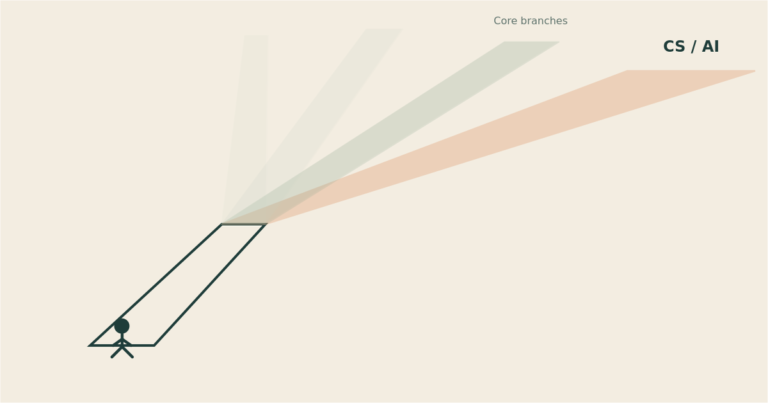
This is why “should my child do engineering” is the wrong-shaped question. Engineering is not one job; it is a large family of tasks sitting at very different points on this spectrum.
NASSCOM’s own industry analysis is candid about this split: routine coding, testing and maintenance are precisely the tasks moving to AI, while roles built on judgement, deep domain expertise and client relationships — system architects, senior engineers managing complex systems, consulting and advisory work — are expected to remain resilient, and in some cases to grow.
A degree does not sort a graduate into either category. What they were actually taught to do, day to day, does. I have written at more length about this in “Is Engineering Still a ‘Safe’ Bet? Rethinking the Safe Career”, but the short version belongs here too: the subject printed on the certificate matters less than most parents assume.
Thrive Tip
Ask any coaching institute or college one question before you enrol your child:
“Walk me through a typical week — how much of it is remembering a procedure, and how much is reasoning through something the student hasn’t seen before?” A place that struggles to answer is training your child for exactly the category of work now narrowing fastest.
What the skills lists keep repeating, and why it matters at fifteen
Analytical thinking tops the list, not syntax
Every year, the World Economic Forum surveys more than a thousand of the world’s largest employers on which skills they expect to matter most by 2030. Across three reports, analytical thinking has come out on top, named essential by seven in ten employers, followed closely by resilience, flexibility and creative thinking. Technical fluency in AI and data does appear on the list, and its demand is growing fast — but it sits alongside these human-centred skills, not above them, because the employers answering this survey are the same ones deciding which of their own graduates to keep.
The gap this site has been arguing about all along
If that list looks familiar, it should. It is, in different language, the same argument made in ‘Educate’ Means to Draw Out, Not Pour In: a child who has been trained to reproduce a syllabus, whether in history or in Python, has learned exactly the kind of routine, codified skill that a machine now performs faster and more cheaply than they ever will.
A child trained to reason through an unfamiliar problem has learned the one thing that keeps mattering, regardless of which specific tool eventually does the typing.
The AI conversation has not introduced a new argument for real learning over rote learning. It has simply raised the price of ignoring the old one, and rather sooner than any of us expected.
So what would I actually tell a parent in this position
Don’t choose the stream by subtracting your fear
The first thing I would say is also the hardest for an anxious parent to hear: don’t pick a stream by asking which one AI is least likely to touch, because the honest answer, per the pattern above, is that most streams contain both exposed and resilient work. A commerce graduate who only ever learns to fill a ledger and a computer science graduate who only ever learns to copy a textbook’s syntax are equally exposed, whatever their certificates say. Choose based on where your child’s evidenced strength and interest genuinely sit, then build resilience deliberately within that choice, rather than trying to escape the problem through the subject line on a form.
Build the human layer on purpose
Because employers now name judgement, communication and adaptability as consistently as they name technical skill, these can no longer be treated as things a child will simply pick up along the way. Look for opportunities that put your child in front of real, unscripted situations: a debate club, a part-time role that involves actual customers, a group project where they lead rather than execute someone else’s plan. These build exactly the kind of non-routine capability that stays valuable when the routine parts of a job move elsewhere.
Treat AI fluency as literacy, not betrayal
Some parents, once they understand the threat, react by wanting to keep their child away from AI tools altogether, as though distance itself offered protection. India’s own employers are already moving the opposite way — four in five plan structured reskilling around AI, and Indian companies lead the world in sponsoring generative AI training for their own staff. A child who learns to direct these tools well, and to judge their output critically rather than accept it blindly, is building exactly the complement-amenable skill this whole article has been describing. Fluency with the tool and the reasoning ability it cannot replace grow together, not against each other.
Judge a college or coaching programme by how it teaches
When you are evaluating any college, coaching institute or course from here on, ask less about its placement record and more about what a typical week of learning actually looks like. A programme that trains chiefly for recall is training your child for precisely the category of work now narrowing fastest, however prestigious its name.
Keep more than one future genuinely alive
Finally, resist the pressure, from the market as much as from relatives, to specialise so narrowly and so early that your child has no adjacent ground to stand on if their particular corner of the job market shifts. A curious, competent generalist with one area of real depth adapts far more easily than a narrow specialist with none. Encourage the depth your child is genuinely drawn to, absolutely, but pair it with just enough breadth that a single shift in the market cannot strand them completely.
The honest answer
Will AI take my child’s job? The honest short answer
So, will AI take my child’s job? Some version of it, quite possibly, yes — the specific tasks, the specific title, the specific way that job is done today may well not exist in its current form by the time your child is thirty. But the underlying capacity a well-educated child builds — the ability to reason through something nobody has handed them a template for, to work with a tool rather than be replaced by it, to bring judgement a client actually wants from a human being — was always the real asset underneath any job title. AI has not invented this truth. It has simply made it impossible to ignore any longer.
Back to the father and the unsigned form
That is close to what a counsellor would tell that father. Whether he signs the form for Computer Science should depend on his son’s evidenced interest and aptitude, and on a plan for what his son builds around that choice — not on whether the subject line itself feels like a safe bet against an uncertain decade. No counsellor can honestly guarantee what 2035 will look like. What honest guidance can offer instead is a clear-eyed plan for raising a young person equipped to meet whatever it turns out to be.