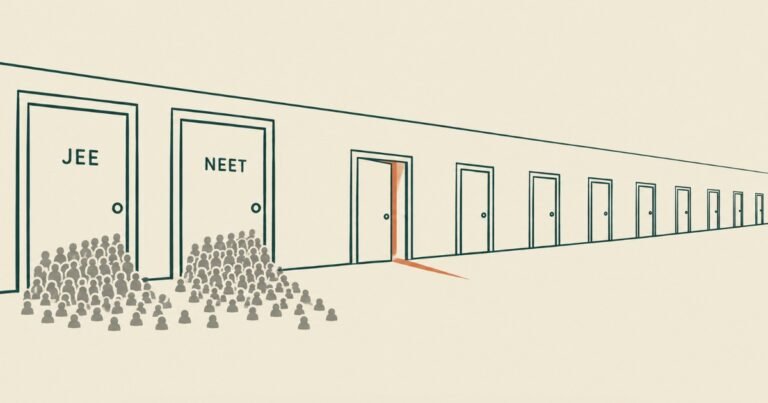
Every Indian parent has heard the reassurance: whatever else your child chooses, let them at least do engineering — it is the safe one. Is engineering still a safe career in India? The numbers on jobs, wages, and automation suggest the answer is more complicated than the reassurance implies, and it is worth reading before the next family conversation about streams.
The reflex we never examine
A conversation that emerges every counselling season
Every year, in the weeks around board results, a version of the same conversation reaches most counsellors. A parent describes a child who is genuinely torn — perhaps drawn to design, or economics, or something outdoors — and then adds, almost apologetically, that they have told the child to “at least take engineering, and decide after.”
I hear this from families where nobody has ever worked as an engineer, and from families where three generations have. Call the child in this composite Arjun, built from many such conversations rather than one, because the pattern matters here, not the person. Arjun’s parents are not wrong to want a safety net for him. They are working from a piece of received wisdom so old that nobody thinks to check it any more: whatever else changes, engineering is safe.
Where the reassurance came from
The belief has a real history behind it, not just a stereotype’s staying power. India’s software services boom through the 1990s and 2000s turned a BTech degree into the most reliable ticket out of financial uncertainty that a middle-class family had ever held. A generation of parents watched cousins and neighbours join campus placements straight out of college and send money home within months. That memory is not irrational; it happened, and for a long stretch of years it kept happening reliably enough to harden into a rule of thumb. The question this article asks is simple: does the rule still hold, or are we still following directions to a house renovated beyond recognition?
What this article does not argue
To be clear from the outset, none of what follows says engineering is a poor choice, or that the families who choose it are being foolish. Millions of Indian engineers build genuinely good careers, and some of the strongest employment numbers in the country today sit inside specific corners of this very degree.
The real question — is engineering still a safe career in India, in the specific sense parents mean when they use the word “safe” — is narrower than it first appears, and, I think, more useful for it: “engineering” is not one safe choice but a bundle of very different ones, and a parent who checks the bundle before committing four years and several lakh rupees to it makes a sounder decision than one who trusts the label alone.
The employability numbers no one agrees on
Three reports, three very different numbers
Start with the confusion at the heart of this debate, because it is instructive in itself. The India Skills Report 2026, released jointly by ETS, CII, AICTE and the Association of Indian Universities, put overall BE/BTech employability at 70.15 per cent, a figure the report itself frames as broadly stable.
Mercer-Mettl’s India Graduate Skill Index, drawing on data across 2,700 campuses, arrived at a far lower 42.6 per cent for graduate employability generally.
TeamLease, an HR and staffing firm, went further, projecting that only around 10 per cent of India’s 1.5 million engineering graduates would secure a job in a given year. Three credible organisations, three numbers that barely resemble one another — and a parent Googling “engineering job prospects India” will meet all three within the first page of results.
What “employable” quietly assumes
The gap between these figures is not fraud; it is definition. The India Skills Report measures employability through the Wheebox Global Employability Test — a standardised assessment of domain knowledge, communication and reasoning that estimates whether a graduate has the attributes employers generally want. It is not a placement count.
TeamLease’s much starker number is closer to an actual outcome: graduates who convert into an offer within the hiring year. Mercer-Mettl sits somewhere between the two, weighting technical and non-technical skill gaps together. None of the three is wrong, exactly. Each answers a slightly different question and calls its answer by the same word, which is precisely the kind of vague terminology this site has argued elsewhere is worth pressing on rather than accepting at face value.
The one number every report agrees on
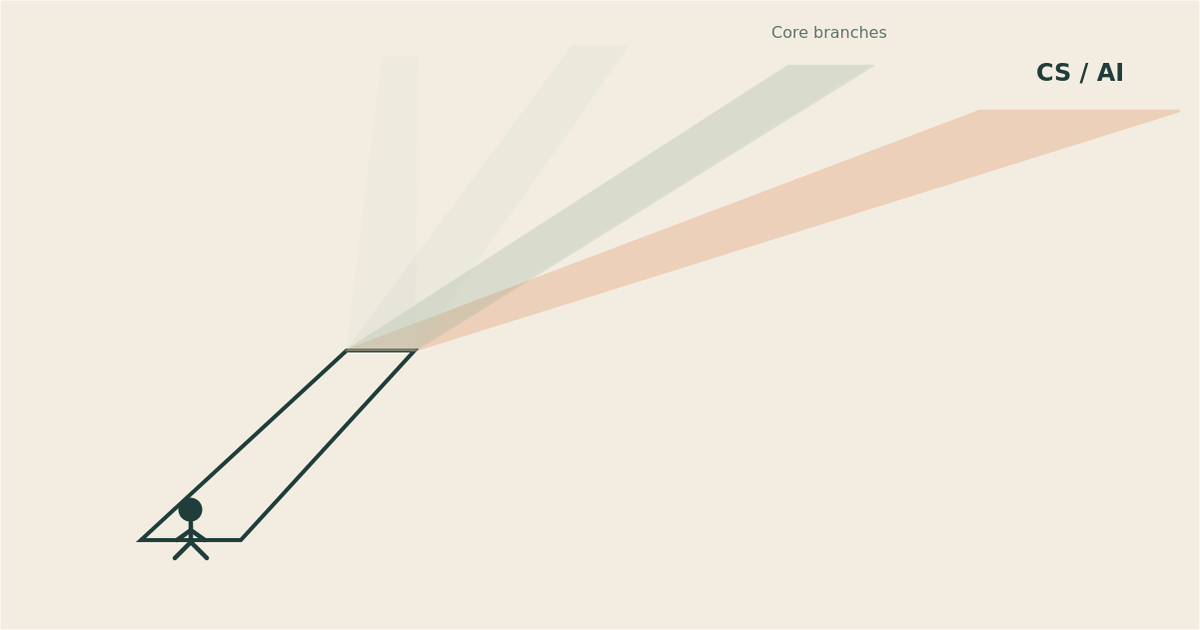
Strip away the headline disagreement, and a consistent pattern survives across all three sources: the branch matters enormously more than the degree. The India Skills Report 2026 recorded computer science and IT engineering graduates at 80 and 78 per cent employability respectively, driven explicitly by AI, data analytics and automation-related hiring, while polytechnic and ITI graduates languished at 32.92 and 45.95 per cent. TeamLease’s own analysis attributes its bleaker figure largely to outdated curricula in traditional branches that have not kept pace with what employers now want. Whichever survey a parent trusts, the branch-level split tells the same story: “engineering” as a category is not the unit that determines a graduate’s odds. The specific branch is.
Which engineering is actually oversupplied
Seats rose, and vacancies fell — but not evenly
For years, the oversupply story was straightforward: too many engineering seats, not enough demand, and AICTE data confirmed it. That picture has genuinely shifted. AICTE-approved intake climbed to nearly 15 lakh seats for the 2024–25 session, and enrolment reached an eight-year high, driven overwhelmingly by a surge in computer science and allied fields. The national vacancy rate, which had sat above 30 per cent for years, fell to 16.36 per cent — the lowest in recent memory. Read quickly, that headline suggests the oversupply problem has resolved itself. Read closely, it reveals something more specific: demand has concentrated, not disappeared.
The core branches quietly emptying out
The concentration has a cost, and it lands on the branches parents of an earlier generation considered unimpeachable. As computer science and AI seats expanded through 2024–25, mechanical, civil and other core branches were left with tens of thousands of empty chairs even after multiple rounds of counselling.
Tamil Nadu recorded 54,587 vacant engineering seats after its third counselling round that year; Andhra Pradesh reported close to 1.2 lakh vacant seats overall. Institutions in several states responded by cutting core-branch intake by as much as half, according to education-sector experts quoted in national reporting. In Tamil Nadu, those empty seats surface round by round, and I have walked through the TNEA counselling process step by step, including where the competition genuinely concentrates, in a separate piece. The oversupply has not vanished. It has simply moved into the very branches that built engineering’s reputation for safety in the first place.
What this means for the branch, not just the degree
Put the two halves of this section together, and the practical implication for a family sharpens considerably. “Is engineering oversupplied?” is the wrong question to be asking at the dinner table. “Is the specific branch and college my child is considering oversupplied?” is the right one, and it has a very different answer depending on whether the branch in question is computer science at a well-regarded institution or mechanical engineering at a college struggling to fill its own seats. Which of those two rooms a child can reach is settled earlier than most families notice, and for the national institutes it begins with what JEE Main actually gates. A parent who treats the word “engineering” as a single, uniform commodity is, in effect, buying a mystery box — the label tells you far less than the contents do.
The paycheck that never grew
A decade, almost unchanged
Even where a job is secured, the safety a parent is really buying is financial — and here the numbers are unusually stark. Entry-level compensation at TCS and Infosys, India’s two largest IT employers, has stayed within a narrow band of roughly 3 to 3.5 lakh rupees a year for well over a decade, according to reporting on fresher pay at India’s largest IT firms, which traced the figure back to the mid-2000s.
A separate ground report found individual freshers taking home barely enough to cover a shared room in a satellite city, let alone the independence a graduate salary is supposed to represent. This is not one company having a difficult year. It is the standard entry rate at the two firms that, between them, hire more fresh engineers annually than almost anyone else in the country.
What inflation did to that number
A flat rupee figure across fifteen years is not, in real terms, a flat salary — it is a falling one. Consumer prices in India have very nearly doubled over the period these salary bands have held steady, which means a fresher earning what their equivalent earned in 2010 is taking home meaningfully less purchasing power today, not more.
The industry’s own defenders rarely dispute the arithmetic; they point instead to the small minority of hires — graduates of premier institutes, or those in specialised digital roles — who now command packages up to three times the standard band. That defence is true and also slightly beside the point, because it confirms rather than contradicts the central claim: the safety net was never uniform. It was always concentrated in a narrow slice of the graduating class.
Why the model keeps wages flat
The mechanism behind the stagnation is not mysterious, and it connects directly back to the oversupply picture. India produces roughly 1.5 million engineering graduates a year, and even the more optimistic employability estimates concede that a large share of them are broadly interchangeable for entry-level, process-driven IT services work.
When far more workers are available than roles require, and the skills gap between an “employable” graduate and an “industry-ready” one remains wide, employers face little competitive pressure to raise starting pay. TeamLease’s own analysts have pointed to exactly this demand-supply mismatch as the reason wages have held flat even as the cost of living has not. A safety net stretched across that many people, in other words, was never going to be a generous one for most of them.
Thrive Tip
Before your child commits to a branch, ask any college for last year’s placement figures broken down branch by branch, not the campus-wide average. A glossy 92 per cent placement rate can quietly average a 98 per cent computer science batch against a 60 per cent mechanical one. The branch-level number is the one that will actually apply to your child.
The machine now arriving at the entry rung
What the World Economic Forum found
Set the domestic picture beside the global one, and a further complication emerges. The World Economic Forum’s Future of Jobs Report 2025, drawing on over a thousand employers across 55 economies, projects that 39 per cent of workers’ core skills will change by 2030, and that AI and automation will displace roughly 92 million jobs globally even as they create 170 million new ones.
A separate Forum analysis found that entry-level, white-collar job postings had fallen sharply worldwide since early 2024, with youth unemployment in India running at around 17 per cent — more than double the overall national rate. The disruption the report describes is not evenly spread across a career. It concentrates precisely at the rung a fresh graduate is trying to climb onto.
A layoff that made the point at home, with a caveat worth keeping
India’s own IT sector supplied a vivid, if more complicated, illustration of this shift in 2025, when Tata Consultancy Services announced it would reduce roughly 12,000 roles — about 2 per cent of its global workforce — as part of what it called a “future-ready transformation”.
The honest caveat matters here: TCS’s own chief executive, K Krithivasan, explicitly stated in interviews that the cuts were not primarily an AI-replaces-humans story, and that they affected middle and senior grades far more than fresh graduates, reflecting a skills mismatch and deployment difficulties rather than a blanket automation of junior work.
Industry body Nasscom, meanwhile, has separately estimated that India will need roughly a million AI-skilled professionals by 2026, with fewer than a fifth of current IT staff AI-skilled today. Read together, the honest picture is not “AI is firing engineers” but something narrower and, for a parent planning years ahead, more actionable: the industry is visibly reallocating its workforce towards AI-adjacent skills, and the reallocation is already underway.
The hiring rebound, and what it is actually rebuilding
None of this means the door has shut. Fresher hiring at India’s largest IT firms is, by most 2026 industry reporting, recovering: TCS alone plans to bring in around 42,000 graduates in FY26, with Infosys and Wipro adding tens of thousands more between them.
Industry hiring analysis describes this as a “twin hiring pattern” — targeted recruitment into AI, cloud and cybersecurity roles running alongside rationalisation of older, more routine positions.
Naukri’s own monthly hiring index recorded AI/ML roles rising 34 per cent year-on-year even as overall fresher hiring grew a more modest 8 per cent in early 2026. The door has not closed. It has narrowed and moved, admitting graduates with a particular skill profile more readily than it admits graduates with a generic one.
What still makes the degree worth having
The analytical foundation still transfers
None of the numbers above is an argument for abandoning engineering as a category, and it would be dishonest of this piece to imply otherwise. Four years of rigorous quantitative training — problem decomposition, mathematical reasoning, systematic debugging of one’s own thinking — remains a genuinely useful foundation, whether a graduate ends up in a core engineering role, a completely unrelated field, or something that does not yet have a settled name. The habits of mind an engineering course builds outlast any single job title, which is a different and more durable claim than “engineering guarantees a job.”
Where the strong numbers actually sit
It is also worth stating plainly where this degree is, right now, unambiguously strong. Computer science and IT engineering graduates post employability figures well above every other stream the India Skills Report measured, and the same report recorded AI and machine learning roles growing by roughly 600 per cent year on year. A child with genuine aptitude and interest in this specific direction is not chasing a fading opportunity; they are stepping into one of the few segments of the Indian graduate job market that is, by every measure available, expanding rather than contracting.
A foundation, not a guarantee
The honest summary, then, is neither the alarmist version nor the reassuring one many parents were raised on. A degree opens the door to the room. What a student does with the years spent inside it — which branch, which skills layered on top, which specific college’s placement record — decides whether the room still has any use for them by the time they walk out. That is a much smaller and more manageable claim than “safe,” but it is the one the evidence actually supports.
So, is engineering still a safe career in India?
Safety was never the degree — it was the specifics
If the last several sections have done their work, the word “safe” should feel considerably less stable than it did at the start of this article. What Arjun’s parents mean by it — a reliable, well-paying job at the end of four years, regardless of what happens elsewhere in the economy — was never really a property of the word “engineering.” It was a property of a particular branch, at a particular tier of college, in a particular decade of hiring conditions. Change any one of those three variables, and the safety changes with it. The degree was always a proxy for something narrower, and the proxy has started to fail visibly enough that it is worth naming directly.
The skill that outlasts the branch
If the branch itself is not a stable enough foundation, something underneath it has to be, and the research on this point is unusually consistent. The World Economic Forum’s own skills-disruption projection — that 39 per cent of core skills will change by 2030 — implies that no single technical branch, however well chosen today, is likely to remain the safest option for an entire career.
What tends to hold up across that kind of churn is not a fixed skill set but the capacity to keep acquiring one: applied problem-solving, comfort with new tools, and the willingness to treat a first job as a beginning rather than a destination. This is not a comforting platitude so much as the most literal reading of what the disruption data actually says.
The question I ask instead
As a counsellor, the question I try to get a family asking is not “will engineering keep my child safe?” — no single degree can promise that any longer, in any field. The better question is whether this particular child shows genuine, evidenced pull towards the kind of thinking engineering demands, or whether the family is choosing it purely because it is the option nobody has to explain to the relatives. I have written elsewhere about what genuinely predicts a child’s intelligence beyond exam scores, and the same principle applies here: evidence of aptitude and sustained interest is a far more reliable compass than the reassurance of a familiar label.
What this means for your family, starting now
Ask for the branch-specific numbers, not the brochure average
Before signing on to any college or branch, request the actual placement breakdown for the last three years, by branch, not the marketing figure that blends a thriving computer science batch with a struggling mechanical one. A transparent institution will hand this over without hesitation. One that redirects you back to a single glowing headline number is, in effect, answering the question by declining to answer it — and that non-answer is itself useful information, in much the same way I have argued elsewhere that an institute’s evasiveness about its real numbers tells a parent something important on its own.
Build the skill layer regardless of the branch chosen
Whatever branch a child ultimately studies, the gap this article has documented between “technically employable” and “industry-ready” is closable, and it is closable well before graduation. Internships, personal projects, and genuine fluency with the tools a target industry actually uses — rather than only the syllabus a college happens to teach — are precisely what separates the fortunate minority commanding stronger packages from the majority stuck at the entry-level average. This is not an argument for turning a teenager’s every evening into extra coursework; it is an argument for treating one real project, pursued with curiosity rather than dragged through for a certificate, as worth more than another tuition class.
Keep the non-engineering door genuinely open
Finally, and perhaps hardest for many families to hear: if a child’s evidenced strengths point elsewhere — towards design, the humanities, commerce, or a field not yet fashionable enough to have its own hoarding — engineering-by-default is rarely the safer bet the family assumes it to be. If your child is still in Class 10, start with how to choose a stream after 10th, before the stream is fixed.
A mismatched engineer, sitting through four years of material that never engaged them, is not accumulating safety; they are accumulating debt, disengagement, and a degree that data alone will not translate into a strong career. Many of those other doors sit behind the entrance exams other than JEE and NEET, which many families hear about only after the application windows have closed. Law is one such door that stays open even after an engineering degree, through the three-year LLB after a first degree.
If aptitude and interest are still unclear, a deliberate gap year built around genuine exploration is very often the more honest safety measure than a rushed default into a branch nobody in the family can really justify beyond habit.
Thrive Tip
This week, ask your teenager one direct question: “If marks weren’t a factor at all, what would you actually want to study?” Do not correct the answer, and do not explain why it is impractical. Simply write it down. Whatever they say is data about where their real curiosity lives — and that data is worth having on hand well before the stream-choice conversation becomes urgent.
Back to that dinner-table conversation
What I would tell Arjun’s parents
Return, finally, to Arjun’s parents, telling him to “at least do engineering” while he quietly wants something else. I would not tell them they are wrong to want security for their son — that instinct is not the problem here.
Asked directly, is engineering still a safe career in India for a child pushed into it purely for the label? On everything this article has laid out, no — not reliably, and not in the specific branch most families default to without checking. I would tell them that the security they are picturing no longer lives in the word “engineering” by itself; it lives in a specific branch, a specific college’s honest placement record, and a specific set of skills their son builds on top of whatever he chooses.
The choice that was always the real one
The billboard version of safety asks a child to fit themselves to a label that has quietly stopped guaranteeing what it once did. The steadier version asks a family to look past the label, at the specific branch, the specific institution, and the specific child in front of them — and to choose with that evidence in hand, rather than with the comfort of a rule of thumb inherited from a decade that no longer exists. That is a harder conversation to have at the dinner table than “just do engineering, kanna.” It is also, on everything the evidence says, the only version of “safe” actually left standing.