Should a CBSE child switch to the State Board for Class 11? The CBSE vs State Board for TNEA cutoff question turns on one formula, three years of rank lists, and a paper your child may never write.
The decision that arrives at the end of Class 10
A form on the dining table
Anitha has read the Class 11 admission form three times. It is still lying open on her dining table in Velachery. Her daughter Nila is finishing Class 10 in a CBSE school and wants to study engineering. Over Sunday lunch, an uncle was certain Nila should move to the State Board for Classes 11 and 12. He said TNEA favours State Board marks. A cousin disagreed just as firmly, insisting that normalisation evens everything out. So Anitha now holds the CBSE vs State Board for TNEA cutoff question with two confident answers and no way to check either.
A family drawn to carry the arithmetic
Anitha and Nila are not real people. I have drawn them to give this decision a face, and the flat, the lunch and the relatives are all my invention. What is real is the arithmetic they are about to meet. The formula is published, and the rank lists are public. Both relatives, it turns out, are partly right for reasons neither of them gave. That gap between a confident answer and the actual mechanism is what this article sets out to close.
What this article will and won’t settle
This piece will not tell you which board is better. Instead, it explains how Tamil Nadu Engineering Admissions, or TNEA, turns Class 12 marks into a rank. It then shows what the much-quoted normalisation rule actually does, and what three years of rank lists reveal. Finally, it maps when the board decision matters for engineering admission and when it barely matters at all. By the end, you should be able to weigh the choice for your own child.
How TNEA turns three marks into a rank
Two hundred marks, one formula
TNEA has no entrance examination. Instead, the TNEA 2026 information brochure reduces three Class 12 subjects to a score out of 200. Mathematics counts in full out of 100, while Physics and Chemistry count for 50 each. So a student with 95 in Mathematics, 92 in Physics and 94 in Chemistry scores 95 plus 46 plus 47, which is 188. In other words, that one subject carries as much weight as both sciences together. That single fact shapes a TNEA rank more than any board ever will.
One sitting, and only one
Two further rules in the brochure catch many families by surprise. First, improvement marks are not considered, so a better score from a later attempt cannot replace the original. Second, TNEA checks the minimum eligibility bar against raw marks rather than adjusted ones. That bar is 45 per cent across the three subjects for the general category and 40 per cent for the reserved categories. In practice, therefore, TNEA treats the Class 12 board examination as a single sitting, whichever board your child writes it under.
When two students tie
With lakhs of applicants on a 200-mark scale, ties happen constantly, and the brochure lists how they are broken. The higher Mathematics percentage wins first, followed by Physics and then the fourth optional subject. After those comes the overall Class 12 percentage, then date of birth, with the older candidate preferred. Last of all, a random number assigned to every applicant settles what remains. Notice that the very first tie-breaker rewards the subject the formula already favours. For a TNEA-first plan, then, Mathematics does most of the heavy lifting.
What normalisation does — and what it leaves alone
The brochure’s own example
Because applicants come from many boards, the brochure equates their marks with State Board marks through a process it calls normalisation. The rule rests on a 2007 Tamil Nadu Act and a government order from the same year. Its worked example is simple. Suppose the State Board’s highest Physics mark is 100 while another board’s highest is 90. Both top marks are then treated as 100, so a student from the other board who scored 60 is counted as 66.66. For CBSE and ISC students, moreover, the brochure uses the highest mark in the whole country. Tamil Nadu applicants alone do not set that figure.
A hundred divided by a hundred
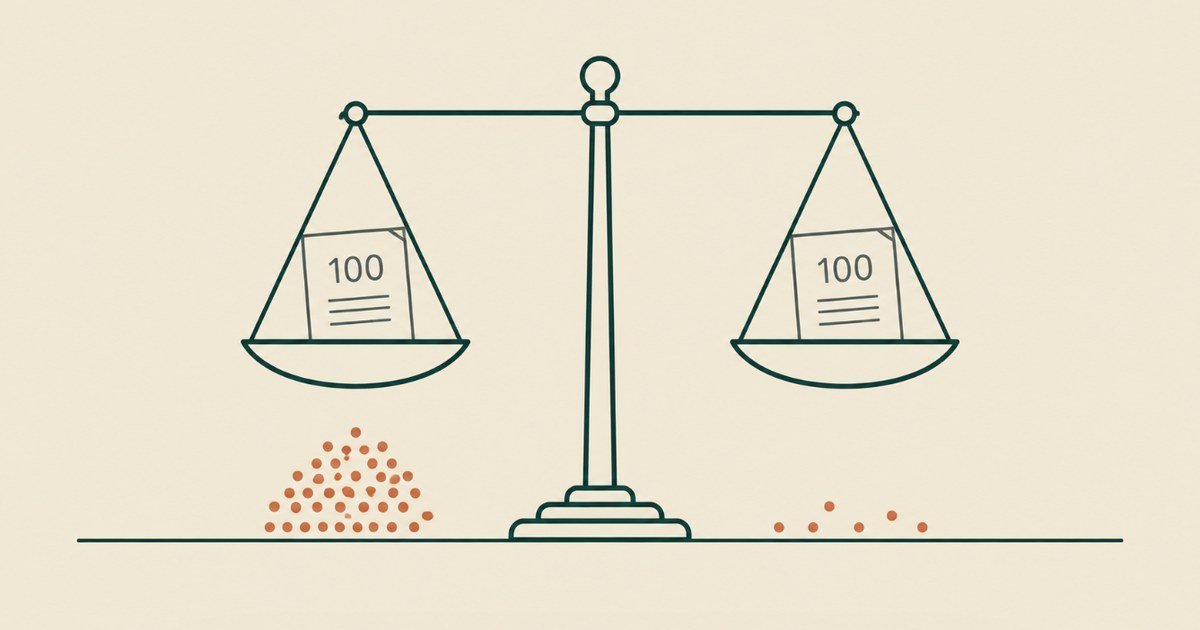
Now apply that rule to CBSE as it actually performs. In 2025, CBSE awarded full marks to 1,128 students in Mathematics, 274 in Physics and 2,384 in Chemistry. The national highest in all three subjects was therefore 100. Divide by 100, multiply by 100, and a CBSE student’s 92 simply remains 92. Nila’s 188 would stay exactly 188. In an ordinary year, then, normalisation changes nothing for a CBSE applicant. The board’s toppers already sit at the ceiling the rule adjusts to.
The toppers line up; the crowd doesn’t
Here the cousin’s reassurance starts to break down. Normalisation looks at only one number from each board, namely its single highest mark. It says nothing about how many students crowd in just beneath that mark, and that crowd is where the boards differ. In the same 2025 results, the State Board recorded 3,022 full marks in Mathematics, 1,125 in Physics and 3,181 in Chemistry. Two boards can share a topper at 100 while producing very different numbers of 98s and 99s. Since TNEA places everyone on one list, those clusters decide where a 188 finally lands.
The protection the rule genuinely offers
Fairness to the rule means naming what it does protect. Where a board sets a paper so demanding that its best student scores 85, normalisation lifts every student from that board in proportion. A small state board with an unusually harsh Physics paper, for example, would see its applicants scaled up rather than stranded. That is a genuine safeguard for such boards. However, it does not reach the situation most Chennai families are asking about. There, both boards have toppers at 100, and the real difference lies in the depth of the field below.
What three rank lists reveal about CBSE vs State Board for TNEA cutoff
Sixty-five, about 145, then fifty-three
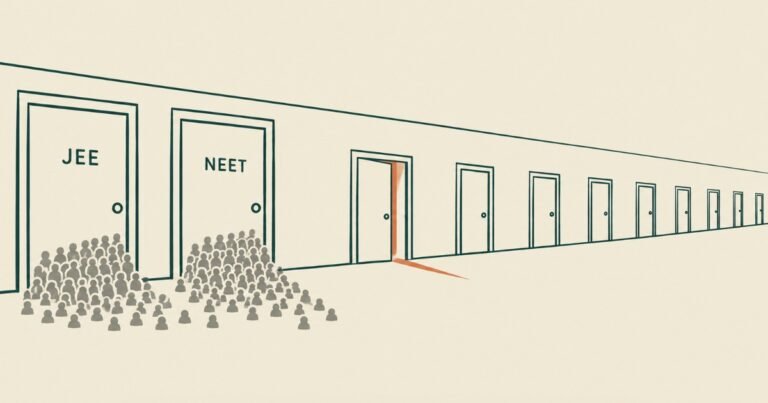
The rank lists show how this plays out at the very top. In 2024, 65 applicants scored a perfect 200. The following year’s figures imply that roughly 58 of them came from the State Board. That leaves about seven from every other board combined. The next year, about 145 students reached 200, with 139 from the State Board and just five from everywhere else. Then, in 2026, only 53 students reached 200: 39 from the State Board and 14 from other boards. Within a single year, the share of perfect scores going to other boards rose from under four per cent to more than a quarter.
What the figures cannot show
Before drawing any conclusion, one caution matters. These numbers describe only the few dozen students at the very top. Moreover, TNEA does not publish how many applicants come from each board. Consequently, they cannot tell us whether CBSE students as a whole fare better or worse. That comparison needs a denominator nobody has released. I have argued before that the missing denominator is where misleading numbers hide, and this article must pass the same test. What the figures show honestly is narrower: how sharply the top of the list can shift within one year.
The paper your child never sat
So why did the top swing so far? One likely explanation arrived before any results were out. In March 2026, teachers told DT Next that the State Board’s Mathematics and Physics papers had been tougher that year. They expected fewer full marks as a result. One student even described the Physics questions as unusually indirect. Fewer State Board students at the very top left more room there for everyone else. The practical consequence is striking. A CBSE student’s TNEA rank depends partly on the difficulty of a State Board paper that student never writes. The reverse holds too, since State Board students’ ranks shift with a CBSE paper they never see.
Same marks, different years
Picture Nila’s 188 in two different years. Suppose one year’s State Board papers are generous, and many of its students cluster above 195. Her 188 then slides further down the list. In a year like 2026, fewer do, and the same 188 climbs. The normalisation rule would treat her marks identically in both years, yet her rank would not stay the same. Neither Anitha nor anyone else can know in Class 10 how hard a particular paper will be two years later. Any board choice made purely for the cutoff is therefore a bet on papers that have not yet been set.
Two boards, two kinds of paper
What each board’s paper is built to test
The boards also design their papers differently. Since the 2025 examinations, half of each CBSE Class 12 paper has been competency-based. These case-based and application questions test whether a student can use a concept in an unfamiliar setting. The State Board paper, by contrast, is organised into sections of one-mark multiple-choice questions and two-, three- and five-mark answers. Neither design is secret, and each suits some students more than others. Paper design is one plausible reason the full-mark counts differ so much. Still, nothing in the published data lets anyone separate it cleanly from the other reasons.
How much of the mark the school awards
The split between the board’s examination and the school’s own assessment differs too. On the State Board, Mathematics is a 90-mark theory paper with 10 internal marks. Physics and Chemistry each add 20 for practicals and 10 for school assessment to a 70-mark written test. In CBSE, by contrast, Mathematics gives 80 to the written paper and 20 to internal assessment, and Physics and Chemistry divide into 70 and 30. Because Mathematics counts double in TNEA, the difference matters most there. Schools themselves award twenty CBSE Mathematics marks, against ten on the State Board.
Why neither is the easy board
It is tempting to read the full-mark counts as settling the CBSE vs State Board for TNEA cutoff debate for good. The 2026 results argue against that reading. In a single year, the State Board’s count of perfect TNEA scores fell from 139 to 39. A board is a curriculum, a way of teaching and an annual paper. Only the last of these shows up in a cutoff. The first two, meanwhile, shape two whole years of your child’s learning.
When CBSE vs State Board for TNEA cutoff matters — and when it doesn’t
A TNEA-first plan
Suppose the realistic target is a government college or an Anna University department through TNEA. In that case, the board decides the scale on which your child is ranked, and nothing else intervenes. The State Board student writes the same paper as those who have dominated the top of recent lists. That candidate rises or falls with it. The CBSE student, meanwhile, faces a crowd produced by a different paper. For such a family, the CBSE vs State Board for TNEA cutoff question is real, even though it has no permanent answer. The full allotment process is set out in TNEA Counselling, Explained Step by Step.
What a CBSE family can still control
A CBSE family committed to TNEA still holds three real levers. First, Mathematics deserves the lion’s share of attention, since it is half the score and the first tie-breaker. Second, treat Class 12 as the only attempt, because a later improvement score will not count. Third, keep at least one entrance-exam route open alongside, so that a single rank list is never the only door. None of these depends on which way the State Board paper swings, which is exactly why they are worth your energy.
JEE, BITSAT and the entrance-exam routes
For other routes, the picture changes almost completely. Admission to the IITs, NITs and IIITs through JoSAA uses board marks only as a threshold. A student needs 75 per cent in Class 12 (65 per cent for SC, ST and PwD candidates) or a place in the top 20 percentile of their own board. Similarly, BITS Pilani asks for 75 per cent across Physics, Chemistry and Mathematics, with at least 60 in each. The rank then comes from BITSAT itself.
On both routes, the entrance examination decides the rank, and the board mark only has to clear a bar. I have explained what JEE Main gates in JEE Main: What It Actually Gates. The deadlines, meanwhile, sit together in Thirteen Admission Deadlines That Pass Before the Board Exams Begin.
Where the 7.5 per cent quota fits
One Tamil Nadu provision turns on schooling rather than marks. The brochure reserves 7.5 per cent of seats, on a preferential basis, for students who studied from Class 6 to Class 12 in state government schools. For those students, the government also pays tuition, hostel and development fees. Because eligibility runs all the way back to Class 6, a move from a private CBSE school in Class 11 cannot create it. For families already in government schools, though, it can matter more than any cutoff.
What a switch at sixteen really costs
A board change is almost always a school change as well, and that cost never appears in the cutoff arithmetic. New textbooks, new teachers, new friends and a different style of paper all arrive in the same year. Moreover, since 2025–26, Class 11 in Tamil Nadu no longer ends in a public examination. As a result, the first State Board paper a newly switched student meets is the one that decides the TNEA rank. Some children take such a move in their stride, while others lose a term finding their feet. You know better than anyone which kind of child is sitting at your table.
Thrive Tip
Before any form is signed, sit down with your child and list five colleges they would genuinely be glad to join. Beside each one, write how it admits students: TNEA rank, JEE, BITSAT or its own entrance test. If most of the list runs through entrance examinations, the board mark only has to clear a bar. The switching question may then quietly settle itself.
Three questions before you choose
Which door is the real target?
Begin with destinations. A family whose honest first choice is a government engineering college in Tamil Nadu is asking a TNEA question. A family aiming at the IITs or BITS is asking an entrance-exam question instead, where the board mark is a threshold. Many families, understandably, want both at once. Knowing which one weighs more tells you how much space the CBSE vs State Board for TNEA cutoff comparison deserves.
Where does this child learn best?
Next, think about the child in front of you. Some students do their best work through thorough, steady mastery of a set syllabus. Others come alive when a paper throws something unfamiliar at them, and many are a mix of both. You already hold fifteen years of evidence about how your child learns: how they revise, what excites them and what makes them freeze. That evidence is more reliable than any relative’s certainty about which board wins. It will also matter long after the rank list is published.
What will Class 11 actually look like?
Finally, look concretely at the next two years. Ask any school you are considering how it now runs Class 11 without a public examination. Ask how much time it gives to board preparation in the final year, and how it supports students who are also preparing for entrance tests. It is worth asking, too, how many students join at Class 11 and how they settle in. A school that answers those questions clearly is telling you something the formula never can.
The mark, and the child behind it
Back to the dining table
Return, for a moment, to Anitha and the form on her table. Her uncle was right that State Board students have dominated the top of recent TNEA lists. Her cousin was right that normalisation evens out the toppers. Yet neither of them had the mechanism. The rule aligns the toppers and leaves the crowd to move with each year’s paper. What Anitha can actually decide is narrower and far more useful. She can decide which routes Nila is truly aiming for, and where Nila learns best.
A choice made with open eyes
No board can guarantee a cutoff, because no family can know two years ahead how hard a particular paper will be. What a family can know is whether TNEA is the main door or one of several. It can also know whether a move at sixteen would help this particular child or unsettle her. Decide on those grounds, and the CBSE vs State Board for TNEA cutoff question takes its proper, smaller place. Whichever form Anitha finally signs, she will have signed it for her daughter rather than for a rank list. That is the part of the decision that lasts.