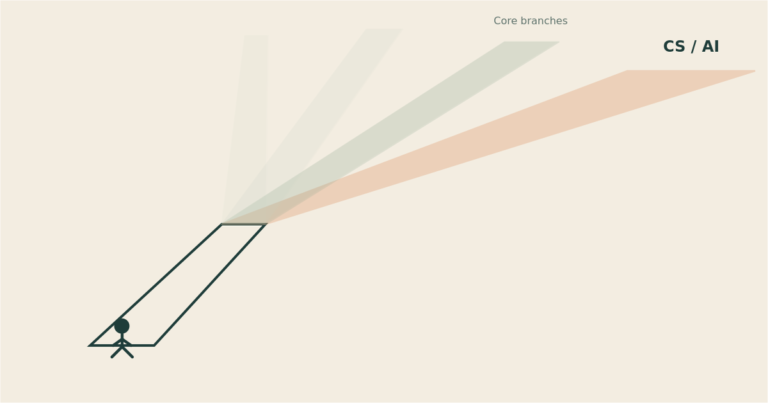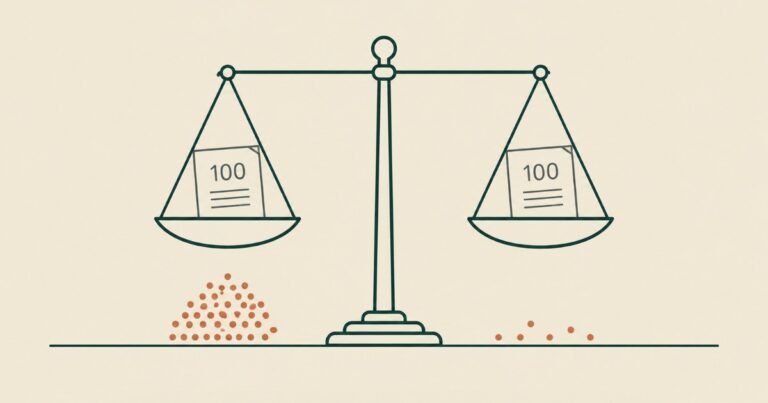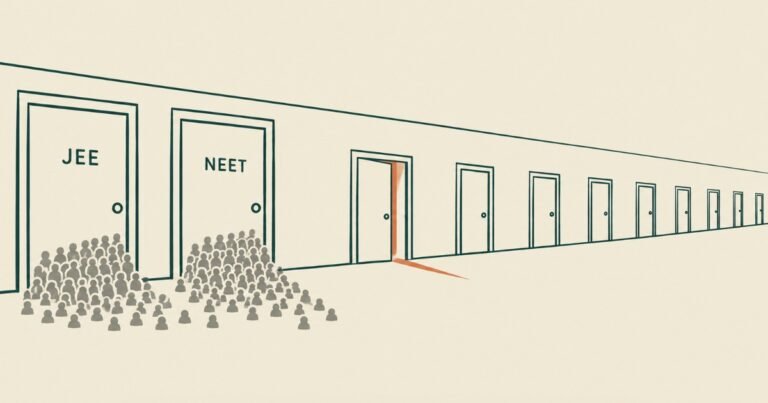

JEE and NEET coaching in Chennai comes in four shapes, from a national chain near the bus depot to a residential school in Namakkal. Each carries a different share of the Kota model home.
Four leaflets on a Chennai table
The week after the last board paper
It is the last week of March. Arun has just written his final Class 10 State Board paper at a school in Chennai’s southern suburbs. Outside the exam centre, young men in matching T-shirts were handing out leaflets, and by evening four of them lie on the dining table.
One comes from a national coaching chain that has opened a branch near the bus depot. The second is a glossy prospectus from a CBSE school offering Class 11 seats with entrance preparation built into the timetable. Next comes a photocopied sheet from a neighbourhood teacher who takes physics classes in English and Tamil above a pharmacy. The fourth is not paper at all. It is an uncle’s phone call about a residential school in Namakkal where, he says, the results come every year.
Arun’s parents have been thinking about JEE and NEET coaching in Chennai for months. Yet nobody at the table quite knows how to compare four such different offers.
A boy invented to hold a pile of paper
I should say plainly that Arun is invented. What is not invented is the pile in front of him. Any Chennai family whose child is finishing Class 10 will recognise those four offers, because this city really does sell coaching in these four shapes. I have given the pile a boy, and the boy a family, only so that the comparison below has a kitchen table to happen at.
The question every leaflet shares
Arun’s family has already decided that he will have some help. Whether a child needs coaching at all, and how much, is a separate decision, which I take up in the five-dose guide to coaching. The question here is narrower and more local. Of the kinds of coaching this city offers, which one fits this particular child? Every leaflet on that table borrows, openly or quietly, from one famous town. So before comparing them, it helps to know what the Kota model is, and which pieces of it each leaflet carries home.
The model every leaflet borrows from
A town built around one exam
Kota, an industrial town on the Chambal River in Rajasthan, became India’s shorthand for entrance coaching. At its height, the town drew over two lakh students a year to its institutes. Picture what that means for a single child. A fifteen- or sixteen-year-old leaves home, often for the first time. She lives in a hostel or a paying-guest room near the institute. Her day belongs to classes, doubt sessions and tests, and the tests sort her batch by rank every few weeks. In short, the Kota model has four parts. They are distance from home, a day the institute owns, constant ranking, and a school that shrinks to the margins.
Why the town is emptying
That model is now shrinking in its own home. Estimates for the 2024–25 session range from 85,000 students, by industry insiders’ count, to 1.24 lakh, by the district administration’s. Nearly 60 per cent of hostels stood empty. The general manager of one old Kota institute put the shift neatly. Its admissions across India had grown, while enrolment in its Kota centres had halved. The same report gives several reasons. Coaching chains had opened branches in students’ home states, and parents wanted to save money. Online platforms had become cheap and popular, and families had grown frightened by the suicides.
By late 2025, Kota’s hostel owners were protesting against institutes opening branches outside Rajasthan. The institutes replied that they would go wherever students were willing to enrol. That exchange tells a Chennai parent something important. The children stopped going to Kota, so Kota’s institutes started coming to them.
Kota came to Chennai in pieces
The brand travels, the town stays behind
You can see the arrival on Chennai’s main roads. Allen, the institute that grew up in Kota, runs NEET classroom programmes in Chennai, and Aakash runs several centres across the city. PhysicsWallah, which began online, opened its first Tamil Nadu centre in Chennai for the 2025–26 year. By December 2025, it was running more than 20 centres across Chennai, Hyderabad and Bengaluru. So the Kota name now has a Chennai address, often within a bus ride of home.
Yet a brand is only one piece of a model. The town itself does not travel: the hostel, the distance from family and the round-the-clock world of other aspirants all stay behind. Chennai families therefore face a different question from the one Kota families faced. They are not choosing between Kota and home. Instead, they are choosing which pieces of Kota to let into home.
Four forms of JEE and NEET coaching in Chennai
Seen this way, the four offers on Arun’s table sort themselves neatly. A national chain’s city branch brings Kota’s syllabus pace and its tests, but sends the child home each night. Next, an integrated school brings Kota’s clock into the school day itself, often years before Class 11. A neighbourhood institute brings the least of Kota and the most of the familiar. Finally, a residential school in Namakkal brings almost the whole model, only a few hours from home. Each form of JEE and NEET coaching in Chennai suits some children well. None suits every child, and the rest of this article takes them one at a time.
The first form: a national chain, a bus ride away
What arrives from Kota
A chain branch brings the Kota method in a nearly complete package. That means the same printed modules, the same pace through the syllabus and the same all-India test series as the parent institute. Aakash, for instance, describes its Chennai classroom course for Class 11 as a two-year programme covering both NEET and the board syllabus. For a motivated child, that national yardstick is useful, because it shows where she stands against lakhs of others rather than against one classroom.
The batch system arrives too. Large institutes rank students and move them between batches, and life in a lower batch can feel very different from life at the top. I have set out the questions to ask about that in the checklist for the admissions counter, so I will not repeat them here. Ask them in Chennai exactly as you would in Kota.
What stays in Rajasthan
What does not arrive is the distance. The child sleeps in her own bed, eats food cooked at home and keeps her school friends. Someone who knows her face notices if she goes quiet at dinner. In my view, that is the single largest difference between the Kota model and its Chennai branch, and it is worth a great deal.
The cost that remains is the evening. A city branch usually runs after school or at weekends, so the child’s day stretches across two institutions and a road between them. The Ministry of Education’s guidelines for coaching centres ask centres not to clash with school hours and not to run past five hours a day. Even so, the guidelines count only the hours inside the classroom. They do not count the forty minutes on an MTC bus.
The second form: coaching folded into the school day
The “techno” school
The second leaflet on Arun’s table comes from a different kind of institution. Several chains that began in Andhra Pradesh now run CBSE schools across Chennai with entrance preparation built in. Narayana’s Chennai schools describe preparing children for IIT-JEE, NEET and Olympiads within one seamless curriculum. Its Mogappair branch, which runs from nursery to Class 10, describes a curriculum that blends CBSE, state-board and competitive-exam syllabi. Sri Chaitanya runs similar “Techno” schools in the city as well.
This is not the dummy-school arrangement that worries the CBSE, where a child stays enrolled but rarely attends. Here the school is real, and the child attends every day. What arrives from Kota, therefore, is not the hostel but the clock. The entrance timetable moves inside the school. It can start long before a child is old enough to have shown whether she wants it.
Why the sixteen-year line does not reach inside
The government’s coaching guidelines bar centres from enrolling children under sixteen. That rule, however, is written for coaching centres. A recognised school is governed as a school, so the line does not obviously follow coaching once it moves inside the school building.
Other states have noticed this seam. In August 2026, Maharashtra published a draft law that would forbid coaching centres from any form of integration with recognised schools. Its coaching association objected, partly on the ground that the draft does not stop schools and junior colleges from running coaching classes themselves. Whatever one thinks of that argument, it shows how hard the line is to draw.
The question to ask at the school gate
Some children genuinely thrive in a tightly structured school, and a family that chooses one is not making a mistake. Still, ask a plain question at the admissions office. In Class 8, how many periods a week go to entrance material? And what gave way to make room for them: the games period, art, library time, or the slow reading that has nothing to do with any exam? A school that answers frankly is telling you something good about itself. The early years have their own work to do, as I explain in the guide to choosing a stream after Class 10. That work rarely fits inside a micro-schedule.
The third form: the neighbourhood institute
Small rooms, familiar faces
The photocopied sheet is the humblest offer on the table, and often the first one State Board families try. It usually means a small centre above a shop or in a converted house. A teacher or two run it, and the neighbourhood knows them by name. Batches are small. Classes often cover the board syllabus and the entrance syllabus together, and many teachers explain hard ideas in Tamil as well as English. For a child moving from the State Board towards a paper that follows the CBSE syllabus, that mix can matter a great deal. I explain the distance between the two in the article on CBSE, the State Board and the TNEA cutoff.
Where it serves well, and where it strains
The neighbourhood institute’s strength is knowledge of the child. A teacher with twenty students notices when one of them stops understanding, and usually knows the parents too. It is also close to home and usually costs far less than a brand.
Its limits are those of size. A small centre may not have teachers for every subject at the depth JEE Advanced demands. Its own tests, too, compare a child only with the few others in the room. So ask two things. Who teaches each subject, and how far did they take last year’s students? Then ask where the mock papers come from. For many families, a good neighbourhood teacher and an all-India test series give most of what a brand offers. They do so at a fraction of the cost and with almost none of the strain.
The fourth form: Tamil Nadu’s own Kota
Namakkal before NEET
The uncle on the phone is pointing at something most Chennai families never think of as Kota, though it shares a good deal of Kota’s design. For years before NEET, a handful of western Tamil Nadu districts dominated medical admissions. They did it through residential higher secondary schools built around the Class 12 board exam.
In 2016, admissions still went by board marks. That year, half of all students admitted to the state’s medical colleges came from just four districts: Namakkal, Dharmapuri, Erode and Krishnagiri. Close to a thousand came from Namakkal alone, and 220 from a single school. Students boarded there from out of town. Most of these schools taught the Class 12 syllabus for two years and left the Class 11 portion largely aside.
That same 2017 analysis compared Namakkal directly with Kota, in its price and its results. Then NEET arrived, and in its first year the district’s count of students qualifying for medical college fell from 957 to 109.
How the model turned towards the entrance exam
The schools adapted quickly. As early as 2017, the secretary of one Namakkal school group predicted that every school would switch to NEET-focused coaching. By 2024, the shift was plain in the results. That July, under the Supreme Court’s order, the National Testing Agency released NEET results centre by centre. They showed that 12.7 per cent of the 6,180 candidates who wrote the exam in Namakkal scored above 600 out of 720. Nationally, the figure was about 3.5 per cent. Nearly a quarter of Tamil Nadu’s 700-plus scorers that year wrote the exam there.
Read those figures with the same care as any topper wall. The schools select their students, and many arrive already strong, a pattern I unpack in the piece on the coaching institute success rate. One year’s data also says little on its own. Still, the shape is clear. Tamil Nadu built its own coaching town long before Chennai met the national chains, and it has outlasted the exam it was designed for.
A fifteen-year-old, a long way from home
Of all four forms, this one carries the most of Kota. It brings the distance, the hostel, the day owned by the institution and the ranking, all within the state. A Class 10 child who chooses it at fifteen will live away from her family through two of the most changeable years of adolescence.
So the questions here go beyond results. How often does she come home? Who in the hostel would notice if she stopped eating properly, or stopped sleeping? Is there a counsellor she could reach without asking permission from the same people who rank her? What happens to a child who wants to leave in the middle of Class 11? For government-school students, the state itself has run residential coaching camps for NEET, which I describe in the five-dose guide. Those are crash courses for a different group of children, however, and nothing like a two-year residence. And for a government-school child, the state’s 7.5 per cent reservation in professional courses may count for as much as any residential programme.
Who regulates JEE and NEET coaching in Chennai?
Rajasthan wrote a law, and softened it
Kota’s own state now has a statute. On 3 September 2025, the Rajasthan Assembly passed its coaching centres bill by voice vote, with a psychological counsellor mandatory in every institute. Under it, a centre cannot register without a counselling system, and it must let families pay fees in at least four instalments. Critics noted that the final version raised the size at which centres come under the law, so centres with 51 to 100 students escape it. Even in Kota, then, the rulebook covers some of the model, not all of it.
Tamil Nadu’s own words for its coaching market
Tamil Nadu’s Assembly has described its coaching market in its own words. In August 2026, it passed a resolution urging the Centre to abolish NEET. That resolution pointed to the growth of unregulated coaching centres charging steep fees for NEET. The resolution belongs to the state’s long campaign against the exam, so it argues one side of a live political question. On this narrower point, though, it is the state’s own account of the coaching centres its children attend.
For a Chennai family, then, the Ministry of Education’s 2024 guidelines remain the clearest yardstick for JEE and NEET coaching in Chennai. They are guidelines rather than a statute, and states must enforce them. Their force therefore depends on how firmly a state chooses to act. Meanwhile, the picture around Tamil Nadu is moving. Maharashtra has published a draft law, and Andhra Pradesh issued draft rules in February 2026, with a five-hour cap and a ban on dummy schools.
What that leaves in a parent’s hands
In practice, the protection a Chennai family has is the questions it asks before paying. Ask about refunds in writing, and pay by instalment where you can. Ask what counselling actually exists, and who the counsellor is. The full list sits in the admissions-counter checklist I linked above. Where no state rulebook stands behind a parent, that list becomes the main safeguard a family has.
Matching the form to the child
Read the child before the leaflet
No form on Arun’s table is right or wrong in itself. Each one fits a particular kind of child. A self-directed child who wants to keep her school life may need only a light dose. That could be a chain branch twice a week, or a neighbourhood teacher and a test series. Another child works best inside tight structure, and her interest in science is evidenced rather than hoped for. She may do well in an integrated school, provided you know what it has crowded out. Then there is the child who needs to be known by name before she can learn. For her, the small institute is often the right first step.
The residential school asks the most of a child, so it asks the most evidence of her. Over time and without prompting, she should have shown that she wants this, and that she can manage away from home. If the wish to send her came first from the adults, say so out loud at the table. The article on when to push and when to let go may help with the conversation that follows.
The road is Chennai’s hostel
In Kota, the hidden cost was loneliness. In Chennai, it is time on the road. An evening class on the far side of the city can quietly add an hour or more to a day that already began before seven. That hour almost always comes out of sleep. Teenagers already need more sleep than they get, for reasons I set out in the article on why a sleepy teenager is not a lazy one. Daily movement suffers next, so protect even twenty minutes of it, as the piece on movement as medicine explains. A nearer centre with a slightly weaker brand often leaves a child better rested, and a rested child learns more.
Thrive Tip
Before you sign for any centre, make the journey once with your child. Go at the real class time, on a school day, by the transport she would actually use. Then add that time, both ways, to her week. The road is part of the course, even though no brochure lists it.
Back at Arun’s table
Four leaflets, one conversation
That evening, Arun’s parents stop comparing the leaflets with each other and start comparing them with him. They ask him what he wants to keep. He says his evening cricket on the street, his friends from school, and his own bed.
Seen that way, the Namakkal school falls away first, and his father calls the uncle back to thank him kindly. Next, the integrated school goes, because Arun likes his State Board school and its teachers. The family settles on the neighbourhood teacher for physics and chemistry, with an all-India test series added in the new year. They also agree to look again after the Class 11 half-yearly exams. If the mock results show gaps that the small centre cannot fill, the chain branch near the bus depot is still there.
The pieces you choose to keep
Choosing JEE and NEET coaching in Chennai comes down to which pieces of Kota a family lets into its house, and how many. The distance, the hours, the ranking and a school pushed to the margins can each be taken in a smaller dose, or left out altogether. The child sitting at your table is the best guide to which pieces belong there. However strong a leaflet looks, that child’s settled interests and tired evenings tell you more than its ranks do.
Thrive Tip
Write the four pieces of the Kota model down the side of a page: distance from home, hours in the day, constant ranking, and a school pushed aside. Then tick which ones each option on your table brings. The option with the fewest ticks that still gives your child what she lacks is usually the one to try first.